


SARS-CoV-2 seroprevalence trends in healthy blood donors during the COVID-19 outbreak in Milan
- PMID: 33539289
- PMCID: PMC8092034
- DOI: 10.2450/2021.0324-20
SARS-CoV-2 seroprevalence trends in healthy blood donors during the COVID-19 outbreak in Milan
Abstract
Background: The Milan metropolitan area in Northern Italy was among the most severely hit by the SARS-CoV-2 outbreak. The aim of this study was to examine the seroprevalence trends of SARS-CoV-2 in healthy asymptomatic adults, and the risk factors and laboratory correlates of positive tests.
Materials and methods: We conducted a cross-sectional study in a random sample of blood donors, who were asymptomatic at the time of evaluation, at the beginning of the first phase (February 24th to April 8th 2020; n=789). Presence of IgM/IgG antibodies against the SARS-CoV-2-Nucleocapsid protein was assessed by a lateral flow immunoassay.
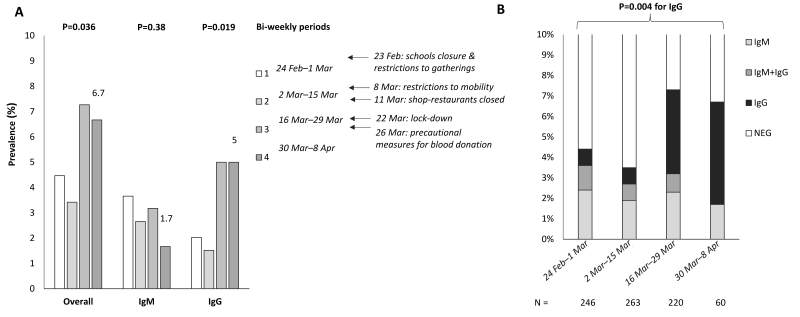
Results: The test had a 100/98.3 sensitivity/specificity (n=32/120 positive/negative controls, respectively), and the IgG test was validated in a subset by an independent ELISA against the Spike protein (n=34, p<0.001). At the start of the outbreak, the overall adjusted seroprevalence of SARS-CoV-2 was 2.7% (95% CI: 0.3-6%; p<0.0001 vs 120 historical controls). During the study period, characterised by a gradual implementation of social distancing measures, there was a progressive increase in the adjusted seroprevalence to 5.2% (95% CI: 2.4-9.0; 4.5%, 95% CI: 0.9-9.2% according to a Bayesian estimate) due to a rise in IgG reactivity to 5% (95% CI: 2.8-8.2; p=0.004 for trend), but there was no increase in IgM+ (p=not significant). At multivariate logistic regression analysis, IgG reactivity was more frequent in younger individuals (p=0.043), while IgM reactivity was more frequent in individuals aged >45 years (p=0.002).
Discussion: SARS-CoV-2 infection was already circulating in Milan at the start of the outbreak. The pattern of IgM/IgG reactivity was influenced by age: IgM was more frequently detected in participants aged >45 years. By the end of April, 2.4-9.0% of healthy adults had evidence of seroconversion.
Conflict of interest statement
The Authors declare no conflict of interests.
Figures
References
-
- Lavezzo E, Franchin E, Ciavarella C, et al. Suppression of COVID-19 outbreak in the municipality of Vo, Italy. medRxiv. 2020 2020.04.17.20053157.
-
- Flaxman S, Mishra S, Gandy A, et al. Estimating the number of infections and the impact of non-pharmaceutical interventions on COVID-19 in 11 European countries. 2020. [Accessed on 05/04/2020.]. https://www.imperial.ac.uk/mrc-global-infectious-disease-analysis/covid-...
MeSH terms
Substances
LinkOut - more resources
Full Text Sources
Medical
Miscellaneous
