Review
. 2021 Feb 2;10(2):300.
doi: 10.3390/cells10020300.

Mechanisms of Coronavirus Nsp1-Mediated Control of Host and Viral Gene Expression

Affiliations
Review

Mechanisms of Coronavirus Nsp1-Mediated Control of Host and Viral Gene Expression

Keisuke Nakagawa et al. Cells. .

Abstract

Many viruses disrupt host gene expression by degrading host mRNAs and/or manipulating translation activities to create a cellular environment favorable for viral replication. Often, virus-induced suppression of host gene expression, including those involved in antiviral responses, contributes to viral pathogenicity. Accordingly, clarifying the mechanisms of virus-induced disruption of host gene expression is important for understanding virus-host cell interactions and virus pathogenesis. Three highly pathogenic human coronaviruses (CoVs), including severe acute respiratory syndrome (SARS)-CoV, Middle East respiratory syndrome (MERS)-CoV, and SARS-CoV-2, have emerged in the past two decades. All of them encode nonstructural protein 1 (nsp1) in their genomes. Nsp1 of SARS-CoV and MERS-CoV exhibit common biological functions for inducing endonucleolytic cleavage of host mRNAs and inhibition of host translation, while viral mRNAs evade the nsp1-induced mRNA cleavage. SARS-CoV nsp1 is a major pathogenic determinant for this virus, supporting the notion that a viral protein that suppresses host gene expression can be a virulence factor, and further suggesting the possibility that SARS-CoV-2 nsp1, which has high amino acid identity with SARS-CoV nsp1, may serve as a major virulence factor. This review summarizes the gene expression suppression functions of nsp1 of CoVs, with a primary focus on SARS-CoV nsp1 and MERS-CoV nsp1.

Keywords: coronaviruses; host gene expression suppression; mRNA degradation; nsp1; translational suppression; virulence factor.


Conflict of interest statement

The authors declare no conflict of interest.

Figures
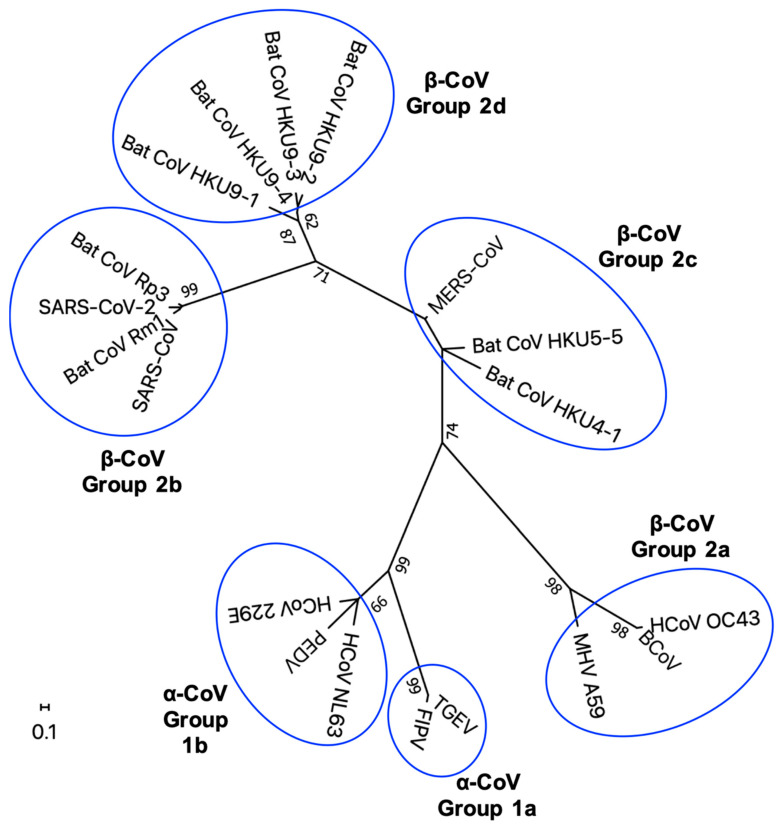
Figure 1
Figure 1
Phylogenetic tree of CoV nsp1. Unrooted maximum likelihood phylogeny of 17 publicly available amino acid sequences of CoV nsp1 is shown. a-CoVs and b-CoVs are divided into groups 1a and 1b and groups 2a, 2b, 2c, and 2d respectively, and the tree, based on 100 amino acid residues, was designed using MEGA X [82]. All positions containing gaps and missing data were eliminated. Bootstrap values (1000 replicates) above 60 are shown. The scale bar indicates the estimated number of substitutions per 10 amino acids. The virus strains used in the phylogenetic analysis are as follows: SARS-CoV-2 (accession no.: MN908947.3); SARS-CoV (Urbani strain, accession no.: AY278741.1); Bat CoV Rm1, bat isolates from Rhinolophus macrotis (horseshoe bat) (accession no.: DQ412043.1); Bat CoV Rp3, bat isolate from R. pearsoni (accession no.: DQ071615.1); Bat CoV HKU4-1, bat isolates from Tylonycteris pachypus (lesser bamboo bat) (accession no.: NC_009019.1); Bat CoV HKU5-5, bat isolate from Pipistrellus abramus (Japanese pipistrelle) (accession no.: EF065512.1); Bat CoV HKU9-1, Bat CoV HKU9-2, Bat CoV HKU9-3, and Bat CoV HKU9-4, bat isolates from Rousettus leschenaulti (Leschenault’s rousette) (accession no.: EF065513.1, EF065514.1, EF065515.1, EF065516.1 and, respectively); MHV strain A59 (accession no.: AF029248.1); human coronavirus OC43 (HCoV OC43) (accession no.: MN306036); bovine coronavirus (BCoV) (accession no.: NC_003045.1); feline infectious peritonitis virus (FIPV) (accession no.: MG893511.1); transmissible gastroenteritis virus (TGEV) (accession no.: KX900408.1); porcine epidemic diarrhea virus (PEDV) (accession no.: MT843278.1); human coronavirus NL63 (HCoV NL63) (accession no.: MN306018.1); human coronavirus 229E (HCoV 229E) (accession no.: KY369908.1).
Figure 2
Figure 2
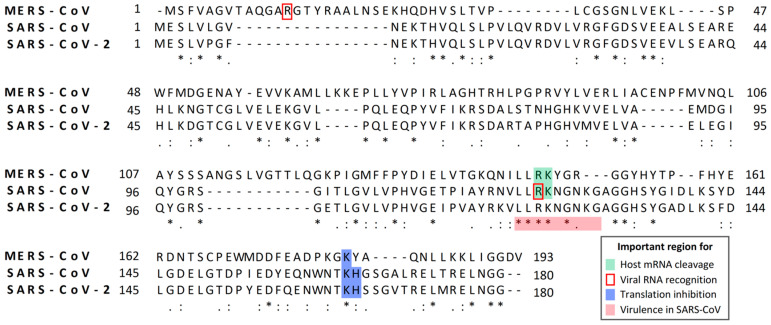
Alignment of the amino acid sequences of nsp1s of MERS-CoV, SARS-CoV, and SARS-CoV-2. Nsp1 sequences of the MERS-CoV strain EMC2012 (accession no.: YP_009047229), SARS-CoV strain Urbani (accession no.: AAP13442), and SARS-CoV-2 isolate Wuhan-Hu-1 (accession no.: MN908947.3) are aligned using Multiple Sequence Comparison by Log-Expectation (MUSCLE) alignment algorithm. Perfect matches, high-amino acid similarities, and low-amino acid similarities are represented by asterisks, double dots, and single dots, respectively. A dash “-” indicates a gap in the sequence. The numbers beside the aligned sequences show the positions of amino acid residues. Residues shown in green represent the functional amino acids for host mRNA cleavage. Residues shown by a red box outline represent the functional amino acids for viral mRNA recognition. Residues shown in blue represent the amino acids that are important for translation inhibition. Residues shown in red represent the amino acids that are important for virulence in mice.
Figure 3
Figure 3
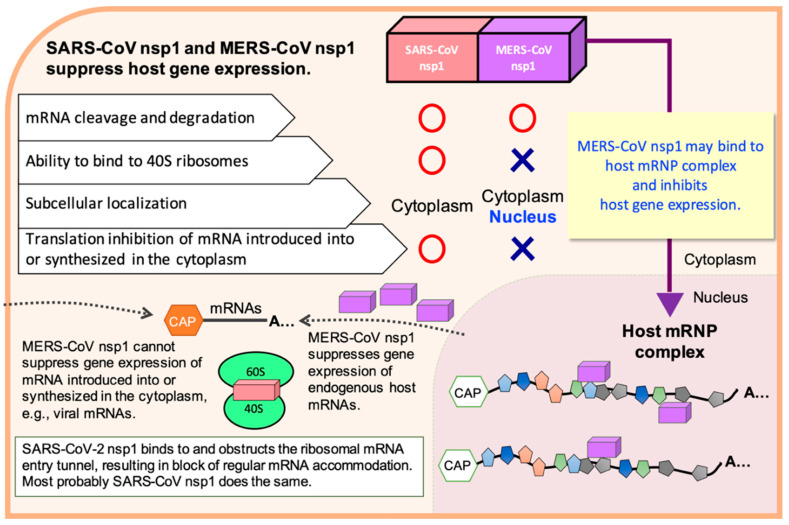
Biological properties of SARS-CoV nsp1, MERS-CoV nsp1, and SARS-CoV-2 nsp1 for inhibiting host gene expression and a possible mechanism of the MERS-CoV nsp1-mediated inhibition of host gene expression. It has been suspected that SARS-CoV nsp1 and MERS-CoV nsp1 recruit a cellular endonuclease to induce endonucleolytic RNA cleavage in host mRNAs, leading to accelerated mRNA degradation.

References

    1. Rota P.A., Oberste M.S., Monroe S.S., Nix W.A., Campagnoli R., Icenogle J.P., Penaranda S., Bankamp B., Maher K., Chen M.H., et al. Characterization of a novel coronavirus associated with severe acute respiratory syndrome. Science. 2003;300:1394–1399. doi: 10.1126/science.1085952. - DOI - PubMed
    1. Drosten C., Gunther S., Preiser W., van der Werf S., Brodt H.R., Becker S., Rabenau H., Panning M., Kolesnikova L., Fouchier R.A., et al. Identification of a novel coronavirus in patients with severe acute respiratory syndrome. N. Engl. J. Med. 2003;348:1967–1976. doi: 10.1056/NEJMoa030747. - DOI - PubMed
    1. Peiris J.S., Guan Y., Yuen K.Y. Severe acute respiratory syndrome. Nat. Med. 2004;10:88–97. doi: 10.1038/nm1143. - DOI - PMC - PubMed
    1. Zaki A.M., van Boheemen S., Bestebroer T.M., Osterhaus A.D., Fouchier R.A. Isolation of a novel coronavirus from a man with pneumonia in Saudi Arabia. N. Engl. J. Med. 2012;367:1814–1820. doi: 10.1056/NEJMoa1211721. - DOI - PubMed
    1. Alshukairi A.N., Zheng J., Zhao J., Nehdi A., Baharoon S.A., Layqah L., Bokhari A., Al Johani S.M., Samman N., Boudjelal M., et al. High Prevalence of MERS-CoV Infection in Camel Workers in Saudi Arabia. mBio. 2018;9 doi: 10.1128/mBio.01985-18. - DOI - PMC - PubMed

Publication types

Substances