Review
. 2021 Feb 2;11(2):371.
doi: 10.3390/nano11020371.

Charge Transfer and Biocompatibility Aspects in Conducting Polymer-Based Enzymatic Biosensors and Biofuel Cells

Affiliations
Review

Charge Transfer and Biocompatibility Aspects in Conducting Polymer-Based Enzymatic Biosensors and Biofuel Cells

Simonas Ramanavicius et al. Nanomaterials (Basel). .

Abstract

Charge transfer (CT) is a very important issue in the design of biosensors and biofuel cells. Some nanomaterials can be applied to facilitate the CT in these bioelectronics-based devices. In this review, we overview some CT mechanisms and/or pathways that are the most frequently established between redox enzymes and electrodes. Facilitation of indirect CT by the application of some nanomaterials is frequently applied in electrochemical enzymatic biosensors and biofuel cells. More sophisticated and still rather rarely observed is direct charge transfer (DCT), which is often addressed as direct electron transfer (DET), therefore, DCT/DET is also targeted and discussed in this review. The application of conducting polymers (CPs) for the immobilization of enzymes and facilitation of charge transfer during the design of biosensors and biofuel cells are overviewed. Significant attention is paid to various ways of synthesis and application of conducting polymers such as polyaniline, polypyrrole, polythiophene poly(3,4-ethylenedioxythiophene). Some DCT/DET mechanisms in CP-based sensors and biosensors are discussed, taking into account that not only charge transfer via electrons, but also charge transfer via holes can play a crucial role in the design of bioelectronics-based devices. Biocompatibility aspects of CPs, which provides important advantages essential for implantable bioelectronics, are discussed.

Keywords: bioelectrochemistry; biosensors; conducting polymers (CPs); direct charge transfer; direct electron transfer; electrochemical deposition; electrochemical sensors; glucose biosensors; microbial and enzymatic biofuel cells; polymer-modified electrodes.


Conflict of interest statement

The authors declare no conflict of interest.

Figures
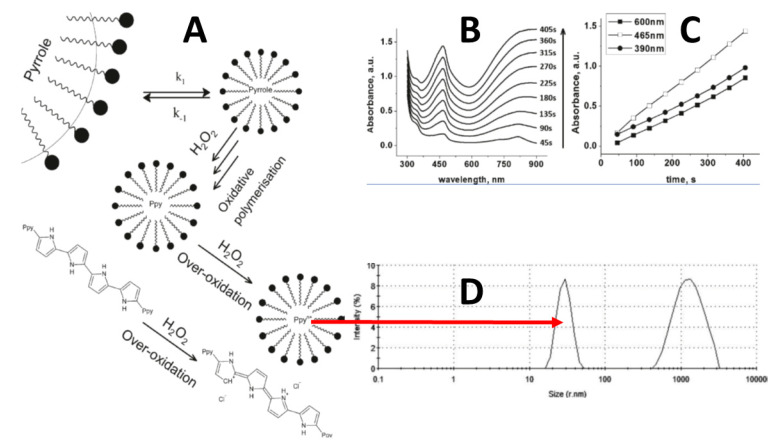
Figure 1
Figure 1
(A) Polypyrrole particle formation initiated by H2O2. (B) During the course of the polymerization reaction increasing optical absorbance spectra. (C) Increase of optical absorbance at 390, 465, and 600 nm during the formation of Ppy. (D) Spectra of formed Ppy diameter determined by dynamic light scattering.
Figure 2
Figure 2
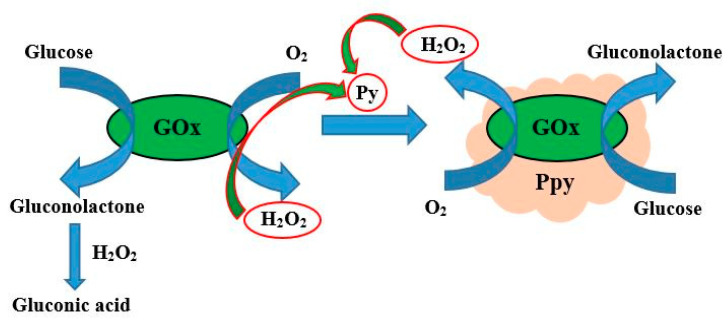
Formation of polypyrrole by glucose oxidase assisted polymerization, according to our researches [24,44,61,64,68,69].
Figure 3
Figure 3
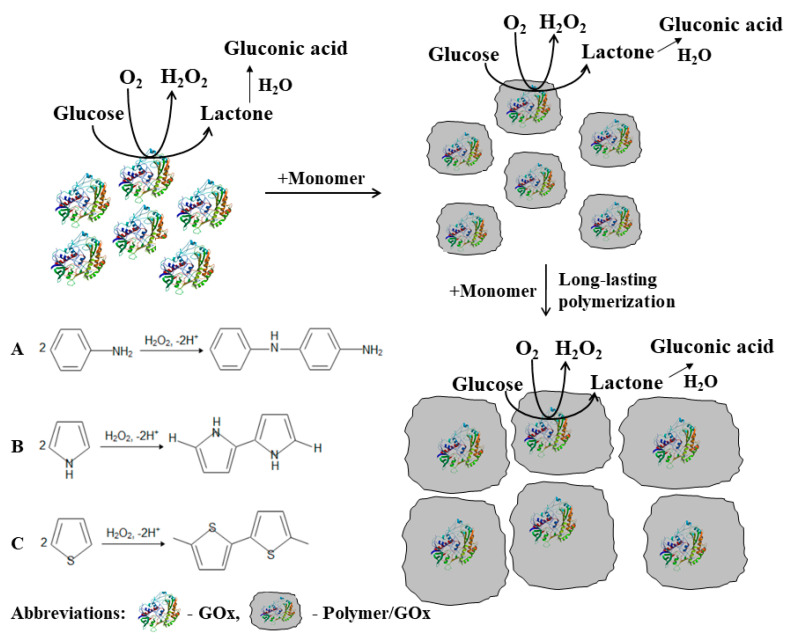
Formation of conducting polymer (A—polyaniline, B—polypyrrole, C—polythiophene) layers around the redox enzyme—glucose oxidase, which during catalytic action is producing H2O2, which in the presented polymerization reactions acts as an initiator. Adapted from [61].
Figure 4
Figure 4
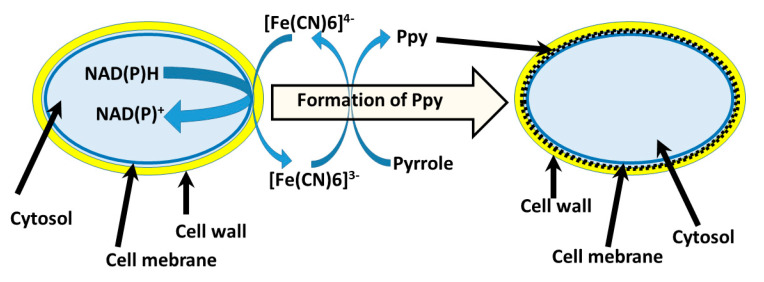
The scheme of Ppy formation in yeast cell wall [59]; Enzymes—oxido-reductases, which are present in plasma membrane, oxidize [Fe(CN)6]4− into [Fe(CN)6]3−, which induces the polymerization of pyrrole [58].
Figure 5
Figure 5
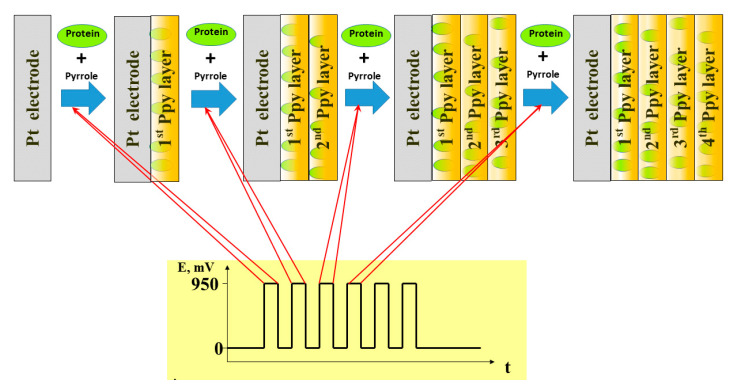
The scheme of Ppy electrochemical deposition by potential pulses and entrapment of proteins within the formed Ppy layer.
Figure 6
Figure 6
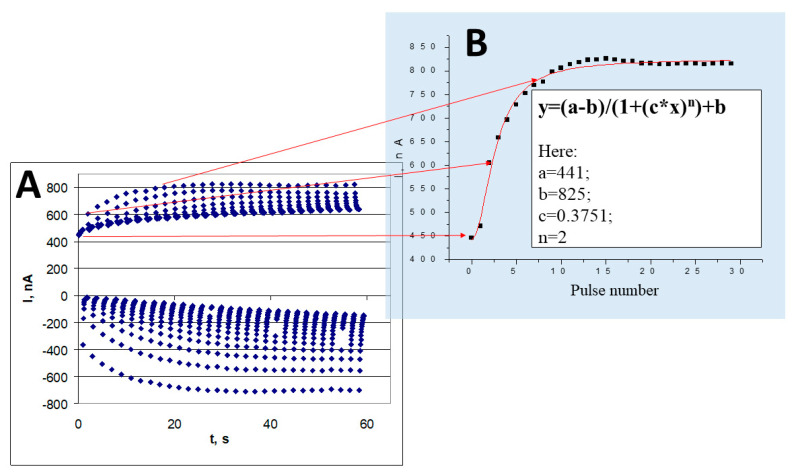
(A) Chrono-amperogram, registered during electrochemical deposition of polypyrrole by potential-pulse mode. (B) Dependence of anodic peaks on the pulse number during electrochemical deposition. Figure drawn according data presented in [30].
Figure 7
Figure 7
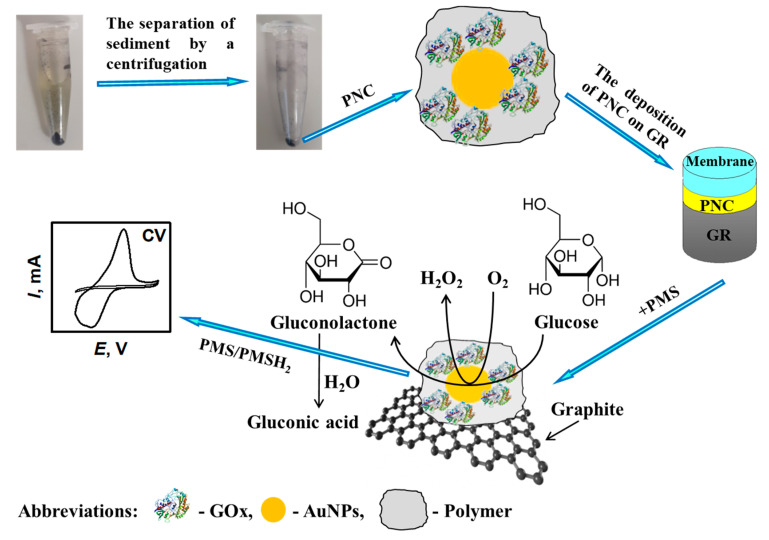
Principle scheme of the formation of a composite structure consisting of polyaniline (PANI), gold nanoparticles (AuNPs), and glucose oxidase (GOx) PANI/AuNPs-GOx, which is followed by a cyclic voltammetry-based investigation. Adapted from [168].
Figure 8
Figure 8
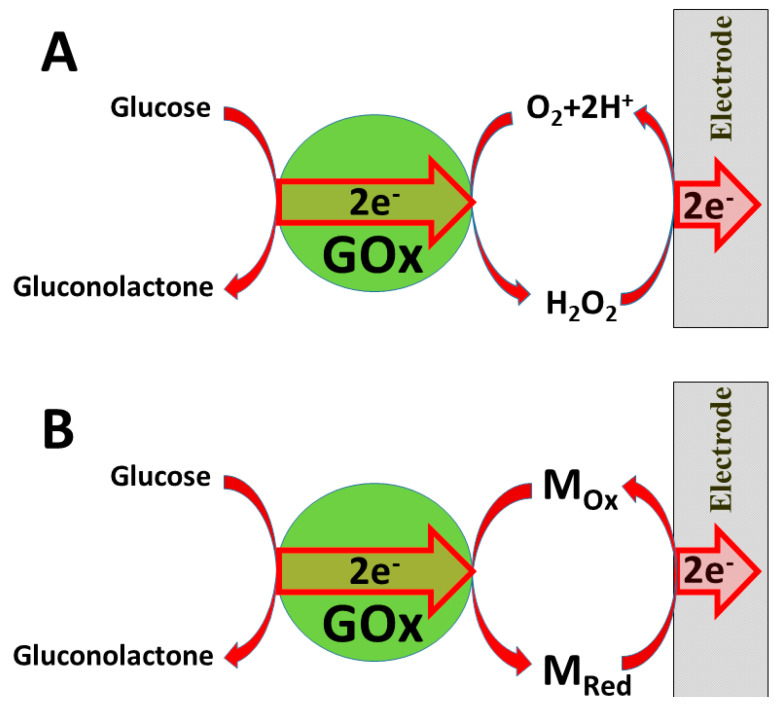
Charge transfer from glucose oxidase (GOx): (A) via formed hydrogen peroxide; (B) via redox mediator Mox/MRed.
Figure 9
Figure 9
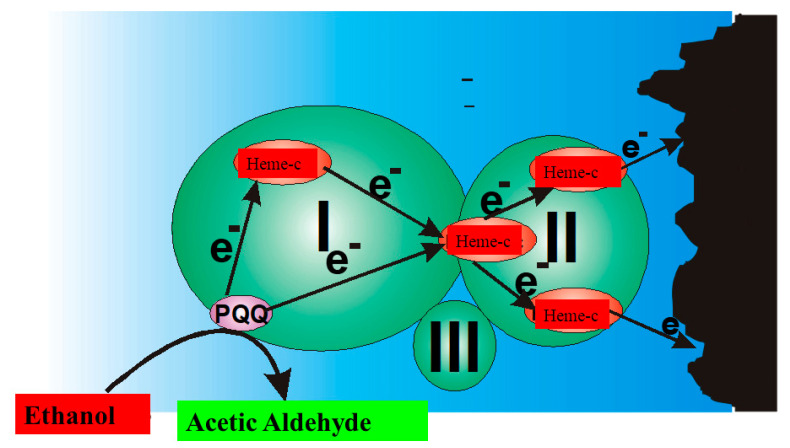
Charge transfer within PQQ-Heme dependent alcohol dehydrogenase, and direct electron transfer from PQQ-Heme dependent alcohol dehydrogenase, which can be applied in the design of biofuel cells [161] and amperommetric biosensors of the third generation.
Figure 10
Figure 10
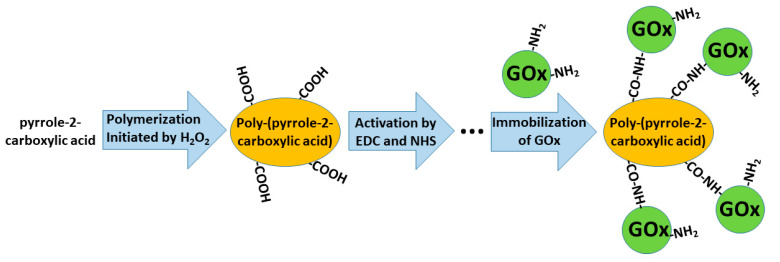
Formation of poly-(pyrrole-2-carboxylic acid), followed by the activation of carboxylic groups and covalent immobilization of glucose oxidase (GOx).

References

    1. Ramanavicius S., Ramanavicius A. Progress and Insights in the Application of MXenes as New 2D Nano-Materials Suitable for Biosensors and Biofuel Cell Design. Int. J. Mol. Sci. 2020;21:9224. doi: 10.3390/ijms21239224. - DOI - PMC - PubMed
    1. Bakirhan N.K., Ozcelikay G., Ozkan S.A. Recent progress on the sensitive detection of cardiovascular disease markers by electrochemical-based biosensors. J. Pharm. Biomed. Anal. 2018;159:406–424. doi: 10.1016/j.jpba.2018.07.021. - DOI - PubMed
    1. Ramanavicius S., Ramanavicius A. Conducting Polymers in the Design of Biosensors and Biofuel Cells. Polymers. 2021;13:49. doi: 10.3390/polym13010049. - DOI - PMC - PubMed
    1. Falk M., Psotta C., Cirovic S., Shleev S. Non-Invasive Electrochemical Biosensors Operating in Human Physiological Fluids. Sensors. 2020;20:6352. doi: 10.3390/s20216352. - DOI - PMC - PubMed
    1. Emir G., Dilgin Y., Ramanaviciene A., Ramanavicius A. Amperometric nonenzymatic glucose biosensor based on graphite rod electrode modified by Ni-nanoparticle/polypyrrole composite. Microchem. J. 2021;161:105751. doi: 10.1016/j.microc.2020.105751. - DOI