Review
. 2021 Feb 2;11(2):88.
doi: 10.3390/metabo11020088.

Metabolic Versatility of Mycobacterium tuberculosis during Infection and Dormancy

Affiliations
Review

Metabolic Versatility of Mycobacterium tuberculosis during Infection and Dormancy

Dorothy Pei Shan Chang et al. Metabolites. .

Abstract

Mycobacterium tuberculosis (Mtb), the causative agent of tuberculosis (TB), is a highly successful intracellular pathogen with the ability to withstand harsh conditions and reside long-term within its host. In the dormant and persistent states, the bacterium tunes its metabolism and is able to resist the actions of antibiotics. One of the main strategies Mtb adopts is through its metabolic versatility-it is able to cometabolize a variety of essential nutrients and direct these nutrients simultaneously to multiple metabolic pathways to facilitate the infection of the host. Mtb further undergo extensive remodeling of its metabolic pathways in response to stress and dormancy. In recent years, advancement in systems biology and its applications have contributed substantially to a more coherent view on the intricate metabolic networks of Mtb. With a more refined appreciation of the roles of metabolism in mycobacterial infection and drug resistance, and the success of drugs targeting metabolism, there is growing interest in further development of anti-TB therapies that target metabolism, including lipid metabolism and oxidative phosphorylation. Here, we will review current knowledge revolving around the versatility of Mtb in remodeling its metabolism during infection and dormancy, with a focus on central carbon metabolism and lipid metabolism.

Keywords: Mycobacterium tuberculosis; dormancy; infection; metabolism; systems biology; tuberculosis.


Conflict of interest statement

The authors declare no conflict of interest.

Figures
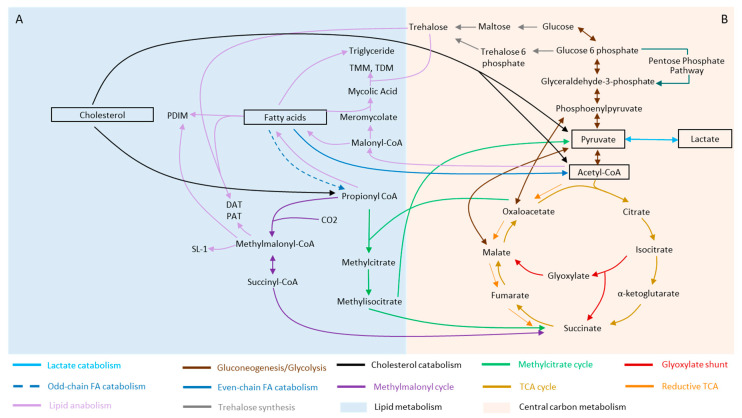
Figure 1
Figure 1
Schematic diagram linking central carbon metabolism (CCM) and lipid metabolism in Mycobacterium tuberculosis (Mtb). (A) Catabolism of cholesterol and fatty acids (dark blue and black arrows) produces a variety of substrates, including succinyl-coenzyme A (CoA), propionyl-CoA and acetyl-CoA, which are channeled into CCM. While acetyl-CoA enters the tricarboxylic acid cycle (TCA) cycle (gold arrows), succinyl-CoA and propionyl-CoA enter the methylmalonyl cycle (dark purple arrows) and methylcitrate cycle (green arrows), respectively. Dashed (- -) dark blue arrow indicates catabolism of odd-chain fatty acids while solid dark blue arrow indicates catabolism of even-chain fatty acids. Fatty acids further serve as building blocks for other lipids, including triglycerides, which are involved in dormancy, while methylmalonyl-CoA serves as precursors of more complex Mtb lipids, including sulfolipids, acylated trehalose (light purple arrows). (B) Mtb is able to adapt to varying conditions through the diversity of its central carbon metabolism pathways, including the pentose phosphate pathway (dark green arrow), and variations in the TCA cycle. When under favorable conditions, carbon will flow through the classic TCA cycle (gold arrows), favoring the biosynthesis of precursors and generation of adenosine triphosphate (ATP). During infection when the bacterium is exposed to various stress conditions, carbon intermediates can also go through the reductive branch of the TCA cycle (orange arrows) or glyoxylate shunt (red arrows) in Mtb. These pathways are important for the regeneration of metabolites such as succinate, which is essential for instance in adaptation to hypoxia. During growth, intermediates of the TCA cycle must be withdrawn for the biosynthesis of fatty acids, nucleotide bases and amino acids through gluconeogenesis. These intermediates are replenished to achieve steady levels for normal TCA function by anaplerosis. The anaplerotic node is the metabolic link between glycolysis, gluconeogenesis (dark red arrows) and the TCA cycle (gold arrows) and acts as a switch that directs the flow of carbon distribution within the CCM. An example of anaplerosis is during growth on fatty acids, when the glyoxylate shunt (red arrows) serves to replenish malate via isocitrate lyase and malate synthase. Glucose further serves as a precursor for trehalose (grey arrow), which is a building block of glycolipids. Abbreviations: SL-1 = sulfolipid-1; FA = fatty acid; TCA = tricarboxylic acid cycle, CoA = coenzyme A; CO2 = carbon dioxide; DAT = diacyl trehalose; PAT = poly-acyl trehalose; PDIM = phthiocerol dimycocerosate; TMM = trehalose monomycolate; TDM = trehalose dimycolate. Note: the schematic is a simplified form and do not represent all steps of the biosynthesis and catabolic pathways of the various metabolites.
Figure 2
Figure 2
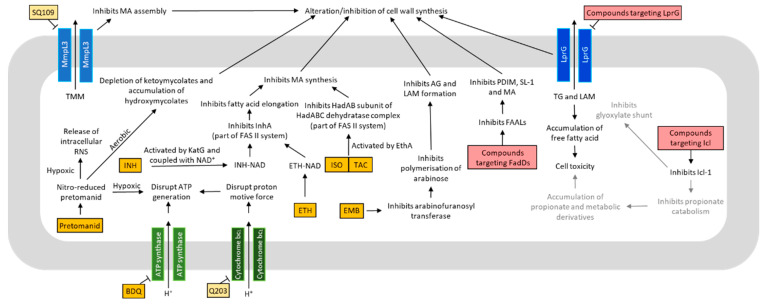
Mechanisms of action of various antituberculosis (anti-TB) drugs and compounds targeting the metabolism of Mycobacterium tuberculosis (Mtb). Many anti-TB drugs and compounds target different aspects of metabolism, and consequently lead to bacteriostasis or bactericidal effects. Some anti-TB drugs and compounds may share the same cellular targets. Others may act on different targets, which can affect common metabolic pathway(s). Drugs approved for treatment are colored in orange. Compounds undergoing clinical trials are colored in yellow. Compounds still in vitro developmental phase are colored in red. Text colored in grey are the proposed mechanisms. Abbreviations: INH = isoniazid; ETH = ethionamide; ISO = isoxyl; TAC = thioacetazone; BDQ = bedaquiline; FadDs = fatty acid adenylating enzymes; ICL = isocitrate lyase; EMB = ethambutol; ATP = adenosine triphosphate; NAD = nicotinamide adenine dinucleotide; LprG = Lipoarabinomannan carrier protein LprG; EthA = flavin adenine dinucleotide (FAD)-containing monooxygenase; HadAB = β-hydroxyacyl-ACP dehydratase HadAB complex; KatG = catalase-peroxidase; FAS II = type II fatty acid synthase; InhA = enoyl-ACP reductase; RNS = reactive nitrogen species; AG = arabinogalactan; TG = triacylglycerol; LAM = lipoarabinomannan; FAAL = fatty acyl AMP ligase; PDIM = phthiocerol dimycocerosates; SL-1 = sulfolipid-1; MA = mycolic acid.

References

    1. World Health Organization . Global Tuberculosis Report 2019. World Health Organization; Geneva, Switzerland: 2019.
    1. Cambier C.J., Falkow S., Ramakrishnan L. Host evasion and exploitation schemes of Mycobacterium tuberculosis. Cell. 2014;159:1497–1509. doi: 10.1016/j.cell.2014.11.024. - DOI - PubMed
    1. Cohen A., Mathiasen V.D., Schön T., Wejse C. The global prevalence of latent tuberculosis: A systematic review and meta-analysis. Eur. Respir. J. 2019;54:1900655. doi: 10.1183/13993003.00655-2019. - DOI - PubMed
    1. Pandey A.K., Sassetti C.M. Mycobacterial persistence requires the utilization of host cholesterol. Proc. Natl. Acad. Sci. USA. 2008;105:4376–4380. doi: 10.1073/pnas.0711159105. - DOI - PMC - PubMed
    1. De Carvalho L.P.S., Fischer S.M., Marrero J., Nathan C., Ehrt S., Rhee K.Y. Metabolomics of Mycobacterium tuberculosis reveals compartmentalized co-catabolism of carbon substrates. Chem. Biol. 2010;17:1122–1131. doi: 10.1016/j.chembiol.2010.08.009. - DOI - PubMed

LinkOut - more resources