. 2021 Feb 2;11(2):373.
doi: 10.3390/ani11020373.

Supplementation with Proline Improves Haemato-Biochemical and Reproductive Indicators in Male Rabbits Affected by Environmental Heat-Stress

Affiliations

Supplementation with Proline Improves Haemato-Biochemical and Reproductive Indicators in Male Rabbits Affected by Environmental Heat-Stress

Sameh A Abdelnour et al. Animals (Basel). .

Abstract

Twenty-four adult rabbit bucks (n = 6 per treatment) were fed a basal diet supplemented with 0 (control), 50, 100, and 150 mg proline/kg dry matter (DM) diet for 12 weeks to determine possible usefulness for alleviating the negative impact of environmental heat stress on redox status, haemato-biochaemical attributes and semen quality. There were significant dose-response effects, with increments in levels of dietary proline (LDP) quadratically improving red blood cell counts (p = 0.017), rectal temperature (p = 0.009), and respiratory rate (p < 0.001). Increasing LDP cubically affected superoxide dismutase activity in blood plasma (p = 0.012) and total antioxidant capacity in both blood and seminal plasma (p < 0.001 and p = 0.006, respectively). The optimal response was observed at 30 and 80 mg proline/kg DM for blood and seminal plasma, respectively. With regards to homeostasis indexes, increments in LDP cubically modified blood plasma concentrations of total protein (p = 0.002) and albumin (p < 0.001), with an optimal response found at 70 mg proline/kg DM. A linear relationship (p = 0.005) was also observed between LDP and blood plasma glucose concentrations, with the optimal response being found at 100 mg proline/kg DM. Increasing LDP also showed positive effects on reproductive traits, with quadratic increases in blood plasma testosterone and cortisol concentrations (p < 0.001; optimal responses at 50 and 60 mg proline/kg DM, respectively), a positive linear relationship with in libido, ejaculate volume, sperm concentration and total sperm count (p < 0.001 for all; optimal responses observed at 100 mg proline/kg DM) and a quadratic increase in total functional sperm fraction (p < 0.001; optimal response at 70 mg proline mg/kg DM). Hence, the optimal positive effects of dietary proline supplementation on redox status, blood metabolites, and reproductive traits of rabbit bucks may be achieved at 50-100 mg/kg DM.

Keywords: antioxidants; heat stress; metabolites; proline; rabbits; semen.


Conflict of interest statement

The authors declare no conflict of interest.

Figures

Figure 1
Figure 1
Diagram for the experimental design. RT= rectal temperature; RR= respiration rate; * Haematological variables were carried out at week 12 only.
Figure 2
Figure 2
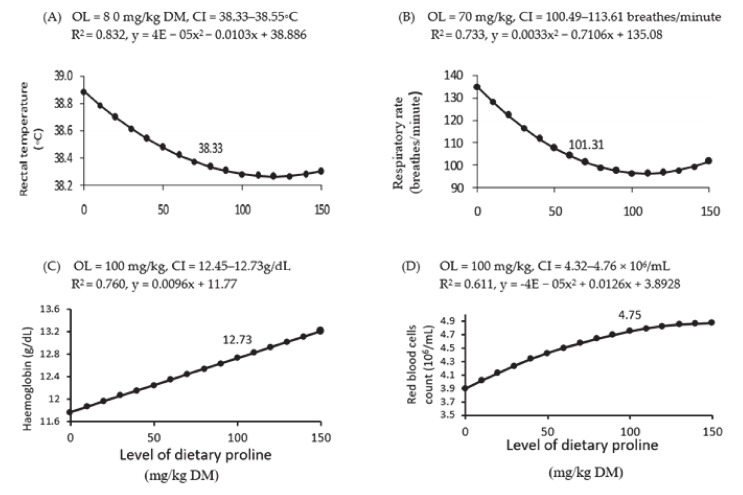
Dose–response curve of rectal temperature (A), respiratory rate (B), haemoglobin concentration (C), and red blood cell counts (D) for different levels of dietary supplemental proline. DM = dry matter, OL = optimum level of dietary supplemental proline and CI = confidence interval. R2 = regression value, and x and y are the dependent variable (proline level) and the independent variable of the regression equation, respectively. The figure only shows significant (p < 0.05) relationships.
Figure 3
Figure 3
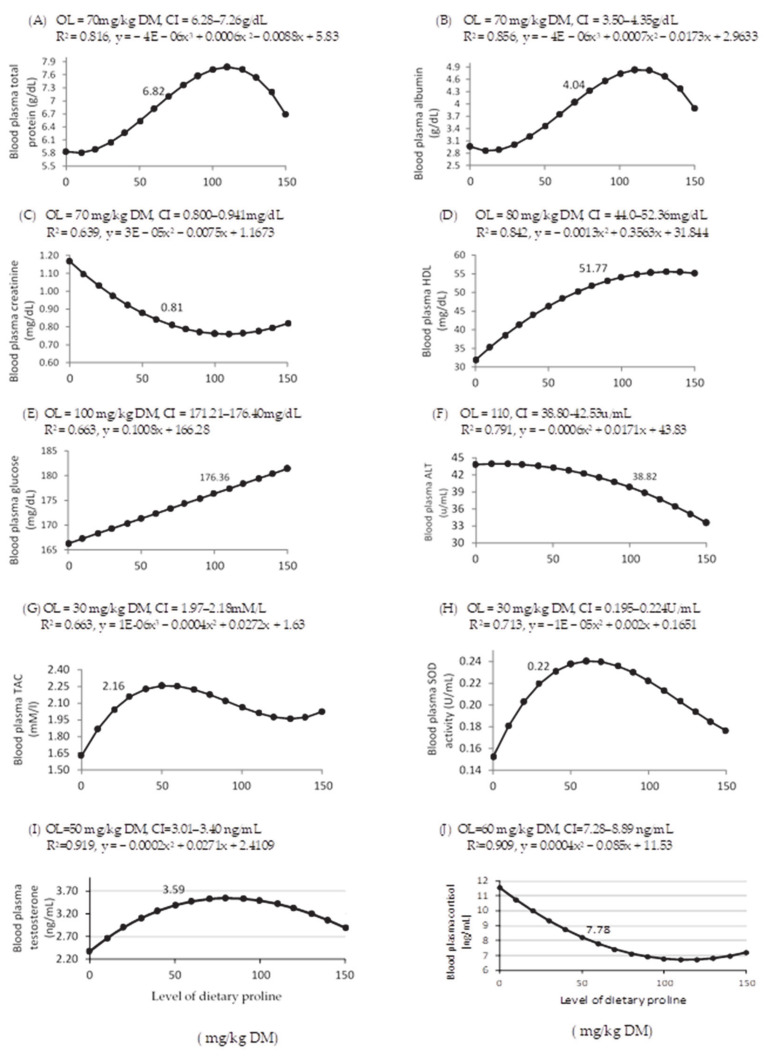
Dose–response curve of blood plasma total protein (A), albumin (B), creatinine (C), high density lipoprotein (HDL, (D)), glucose (E), alanine aminotransferase (ALT, (F)), total antioxidant capacity (TAC, (G)), superoxide dismutase activity (SOD, (H)), testosterone (I), and cortisol (J) for different levels of dietary supplemental proline. DM = dry matter, OL = optimum level of dietary supplemental proline and CI = confidence interval, R2 = regression value, and x and y are the dependent variable (proline level) and the independent variable of the regression equation, respectively. The figure only shows significant relationships (p < 0.05).
Figure 4
Figure 4
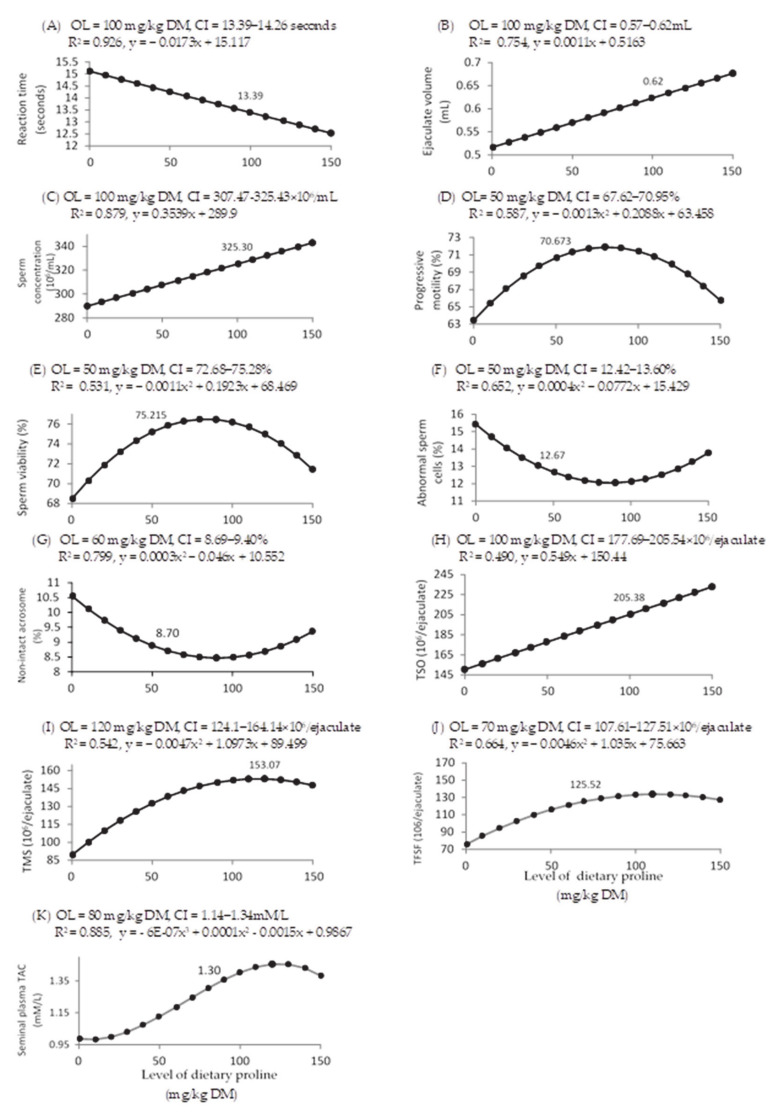
Dose–response curve of reaction time (A), ejaculate volumen (B), sperm concentration (C) and percentages of motile sperm cells (D), viable sperm cells (E), normal sperm cells (F), non-intact acrosome sperm cells (G), total sperm output (TSO, (H)), total motile sperm count (TMSO, (I)), total functional sperm fraction (TFSF, (J)), and seminal plasma antioxidant capacity (TAC, (K)) for different levels of dietary supplemental proline. DM = dry matter, OL = optimum level of dietary supplemental proline, CI = confidence interval, R2 = regression value, and x and y are the dependent variable (proline level) and the independent variable of the regression equation, respectively. The figure only shows significant (p < 0.05) relationships.

References

    1. El-Desoky N., Hashem N., Elkomy A., Abo-Elezz Z. Physiological response and semen quality of rabbit bucks supplemented with Moringa leaves ethanolic extract during summer season. Animal. 2017;11:1549–1557. doi: 10.1017/S1751731117000088. - DOI - PubMed
    1. Marai I., Habeeb A., Gad A. Rabbits’ productive, reproductive and physiological performance traits as affected by heat stress: A review. Livest. Prod. Sci. 2002;78:71–90. doi: 10.1016/S0301-6226(02)00091-X. - DOI
    1. Sabés-Alsina M., Tallo-Parra O., Mogas M.T., Morrell J.M., Béjar M.L. Heat stress has an effect on motility and metabolic activity of rabbit spermatozoa. Anim. Reprod. Sci. 2016;173:18–23. doi: 10.1016/j.anireprosci.2016.08.004. - DOI - PubMed
    1. Liang X., Zhang L., Natarajan S.K., Becker D.F. Proline Mechanisms of Stress Survival. Antioxid. Redox Signal. 2013;19:998–1011. doi: 10.1089/ars.2012.5074. - DOI - PMC - PubMed
    1. Phang J.M. Proline Metabolism in Cell Regulation and Cancer Biology: Recent Advances and Hypotheses. Antioxid. Redox Signal. 2019;30:635–649. doi: 10.1089/ars.2017.7350. - DOI - PMC - PubMed

LinkOut - more resources