


The Relationship of Race, Psychosocial Stress and Resiliency Indicators to Neurocognitive Impairment among Older Americans Enrolled in the Health and Retirement Survey: A Cross-Sectional Study
- PMID: 33540911
- PMCID: PMC7908633
- DOI: 10.3390/ijerph18031358
The Relationship of Race, Psychosocial Stress and Resiliency Indicators to Neurocognitive Impairment among Older Americans Enrolled in the Health and Retirement Survey: A Cross-Sectional Study
Abstract
Background: Race/ethnicity, toxic stress (TS), resilience-promoting factors (RPFs), and their interactions were investigated in relationship to neurocognitive impairment (NI) in a nationally representative sample of adult Americans ≥50 years enrolled in the Health and Retirement Study (HRS) between 2012 and 2014.
Methods: NI was defined as physician diagnosis of Alzheimer's disease/dementia or HRS total cognition score ≤ 10. Race/ethnicity (i.e., African American, White, or Other), TS (i.e., everyday discrimination and chronic stressors), and mastery (as indicator of RPF) were self-reported. Multivariable logistic regression models estimated race-, TS-, RPF-associated odds ratios (ORs), and 95% confidence intervals (CI) for NI adjusting for socio-demographic confounders.
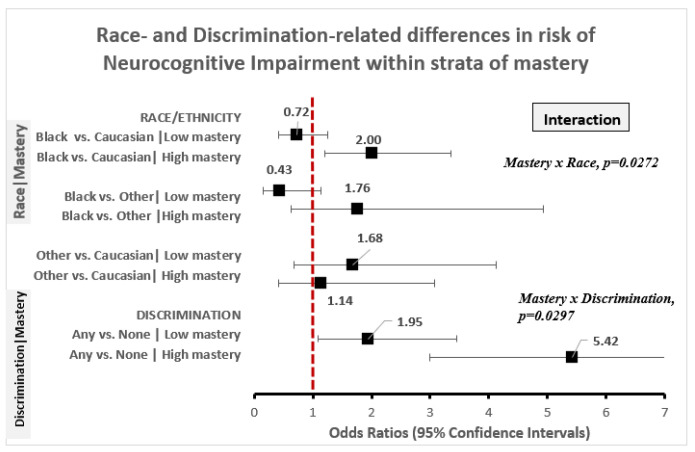
Results: 6317 respondents interviewed between the years 2012 and 2014, age range 55-104 years old, 83% White, 13% Black and 4% Other race were included in the study. Chronic stress (OR = 1.88, 95% CI: 1.42-2.48), discrimination (OR = 3.31, 95% CI: 2.12-5.19) and low mastery (OR = 1.85, 95% CI: 1.38-2.48) were each associated with higher NI risk while low mastery was associated with higher NI risk in discrimination and race/ethnicity dependent manner. Specifically, low mastery-associated risk for NI was evident among adults that denied experiencing discrimination (OR = 2.01, 95% CI: 1.51-2.68), but absent among those that experienced discrimination (OR = 0.72, 95% CI: 0.32-1.62). Further, AA race was associated with NI risk but only among adults with high mastery (OR = 2.00, 95% CI: 1.20-3.35).
Conclusions: Discrimination, chronic stress, and low mastery were associated with worse cognition. Persisting cognitive disadvantage for AA vs. White/Other race only among high mastery adults suggests that adverse social experiences may counteract mastery-associated cognitive benefits among AA population. TS reduction through policies that promote equal treatment by race/ethnicity in social life, health, justice, and economic systems may promote successful cognitive aging.
Keywords: everyday discrimination; minority race; neurocognitive impairment; older Americans; resilience promoting factors; toxic stress.
Conflict of interest statement
The authors declare no conflict of interest.
Figures


References
-
- U.S. Census Bureau PD . Annual Estimates of the Resident Population by Sex, Race and Hispanic Origin for the United States, States and Counties: 1 April 2010 to 1 July 2014. U.S. Census Bureau, Population Division; Washington, DC, USA: 2015.
-
- The Henry J. Kaiser Family Foundation Key Facts Race, Ethnicity & Medical Care, 2007. [(accessed on 19 May 2020)]; Available online: www.kff.org.
MeSH terms
Grants and funding
LinkOut - more resources
Full Text Sources
Other Literature Sources
