. 2021 Feb 4;11(1):3154.
doi: 10.1038/s41598-021-82337-7.

Phylogenetic and genetic characterization of Treponema pallidum strains from syphilis patients in Japan by whole-genome sequence analysis from global perspectives

Affiliations

Phylogenetic and genetic characterization of Treponema pallidum strains from syphilis patients in Japan by whole-genome sequence analysis from global perspectives

Shingo Nishiki et al. Sci Rep. .

Abstract

Japan has had a substantial increase in syphilis cases since 2013. However, research on the genomic features of the Treponema pallidum subspecies pallidum (TPA) strains from these cases has been limited. Here, we elucidated the genetic variations and relationships between TPA strains in Japan (detected between 2014 and 2018) and other countries by whole-genome sequencing and phylogenetic analyses, including syphilis epidemiological surveillance data and information on patient sexual orientation. Seventeen of the 20 strains in Japan were SS14- and the remaining 3 were Nichols-lineage. Sixteen of the 17 SS14-lineage strains were classified into previously reported Sub-lineage 1B. Sub-lineage 1B strains in Japan have formed distinct sub-clusters of strains from heterosexuals and strains from men who have sex with men. These strains were closely related to reported TPA strains in China, forming an East-Asian cluster. However, those strains in these countries evolved independently after diverging from their most recent common ancestor and expanded their genetic diversity during the time of syphilis outbreak in each country. The genetic difference between the TPA strains in these countries was characterized by single-nucleotide-polymorphism analyses of their penicillin binding protein genes. Taken together, our results elucidated the detailed phylogenetic features and transmission networks of syphilis.


Conflict of interest statement

The authors declare no competing interests.

Figures
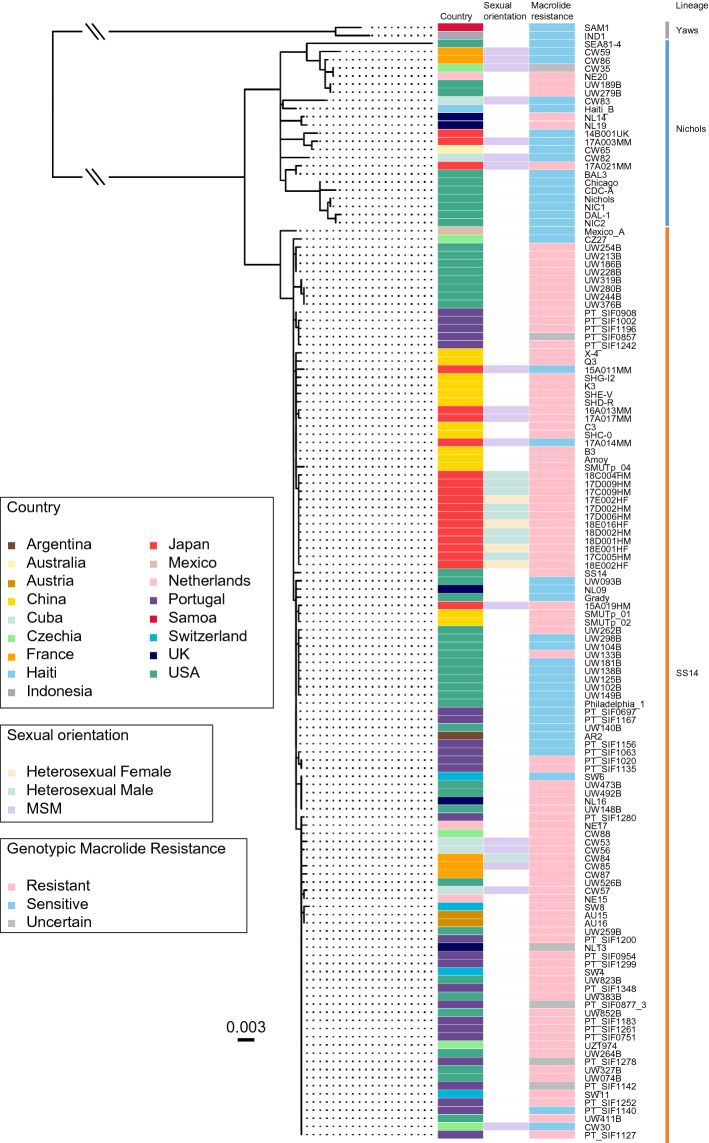
Figure 1
Figure 1
Maximum likelihood phylogenetic analysis of 135 Treponema pallidum subspecies pallidum and 2 Treponema pallidum subspecies pertenue genomes. The boxes in the columns show (from the left) for each strain: its lineage, its country of origin, sexual orientation of the patient, and its macrolide resistance genetic profile. For macrolide resistance, if either the A2058G or A2059G mutation in the 23S rRNA genes was present, the strain was classified as resistant. If mixed alleles were detected in these sites, the strain was classified as ‘‘uncertain’’. The scale represents the number of substitutions per site.
Figure 2
Figure 2
Bayesian maximum credibility phylogenetic analysis of 102 clinical Treponema pallidum subspecies pallidum genomes. (a) Time scaled phylogenetic tree of the TPA genomes in this study. (b) Expanded view of East Asian cluster-related node. The colored nodes represent the country of origin of the TPA genomes. The branch point nodes are shaded to indicate the posterior support (black ≥ 96%, dark grey ≥ 91%). The boxes on the right indicate the sexual orientation of the patient, the resistant mutations in the 23S rRNA genes, and the non-synonymous mutations in the penicillin-binding protein genes as shown in the legends. For the 23S rRNA genes, orange and green colors indicate the resistant-type and wild-type sites, respectively. For the penicillin-binding protein genes, pink and blue colors indicate the mutant and wild-type sites, respectively. The boxes with light-colored squares are single nucleotide polymorphism (SNP) sites that were not detected in the draft genome, and were determined by PCR-based Sanger sequencing with the primers shown in Table S2. The divergence estimates (95% HPD) of the time of each node are shown as follows: I, 1998 (1995–2002); II, 2002 (2000–2007); III, 2006 (2003–2009); IV, 2006 (2004–2010); V, 2007 (2006–2012); VI, 2008 (2006–2012); VII, 2009 (2008–2015); VIII, 2013 (2010–2016).
Figure 2
Figure 2
Bayesian maximum credibility phylogenetic analysis of 102 clinical Treponema pallidum subspecies pallidum genomes. (a) Time scaled phylogenetic tree of the TPA genomes in this study. (b) Expanded view of East Asian cluster-related node. The colored nodes represent the country of origin of the TPA genomes. The branch point nodes are shaded to indicate the posterior support (black ≥ 96%, dark grey ≥ 91%). The boxes on the right indicate the sexual orientation of the patient, the resistant mutations in the 23S rRNA genes, and the non-synonymous mutations in the penicillin-binding protein genes as shown in the legends. For the 23S rRNA genes, orange and green colors indicate the resistant-type and wild-type sites, respectively. For the penicillin-binding protein genes, pink and blue colors indicate the mutant and wild-type sites, respectively. The boxes with light-colored squares are single nucleotide polymorphism (SNP) sites that were not detected in the draft genome, and were determined by PCR-based Sanger sequencing with the primers shown in Table S2. The divergence estimates (95% HPD) of the time of each node are shown as follows: I, 1998 (1995–2002); II, 2002 (2000–2007); III, 2006 (2003–2009); IV, 2006 (2004–2010); V, 2007 (2006–2012); VI, 2008 (2006–2012); VII, 2009 (2008–2015); VIII, 2013 (2010–2016).
Figure 3
Figure 3
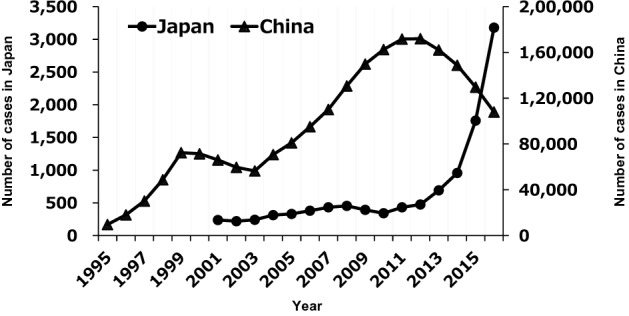
Number of primary and secondary syphilis cases reported in Japan and China, 1995–2016. The number of primary and secondary syphilis cases reported in Japan (plotted with circles, left scale) and in China (plotted with triangles, right scale). The original data were derived from The Japan National Tourism Organization (https://www.jnto.go.jp/jpn/statistics/visitor_trends/index.html).

References

    1. Newman L, et al. Global estimates of the prevalence and incidence of four curable sexually transmitted infections in 2012 based on systematic review and global reporting. PLoS ONE. 2015;10:e0143304. doi: 10.1371/journal.pone.0143304. - DOI - PMC - PubMed
    1. Fenton KA, et al. Infectious syphilis in high-income settings in the 21st century. Lancet Infect. Dis. 2008;8:244–253. doi: 10.1016/S1473-3099(08)70065-3. - DOI - PubMed
    1. Takahashi T, et al. Rapid increase in reports of syphilis associated with men who have sex with women and women who have sex with men, Japan, 2012 to 2016. Sex. Transm. Dis. 2018;45:139–143. doi: 10.1097/OLQ.0000000000000768. - DOI - PMC - PubMed
    1. Marra C, et al. Enhanced molecular typing of Treponema pallidum: Geographical distribution of strain types and association with neurosyphilis. J. Infect. Dis. 2010;202:1380–1388. doi: 10.1086/656533. - DOI - PMC - PubMed
    1. Grillová L, et al. Molecular characterization of Treponema pallidum subsp. pallidum in Switzerland and France with a new multilocus sequence typing scheme. PLoS ONE. 2018;13:e0200773. doi: 10.1371/journal.pone.0200773. - DOI - PMC - PubMed

Publication types

MeSH terms

Substances