Mucociliary Clearance of Different Respiratory Conditions: A Clinical Study
- PMID: 33542749
- PMCID: PMC7850890
- DOI: 10.1055/s-0039-3402495
Mucociliary Clearance of Different Respiratory Conditions: A Clinical Study
Abstract
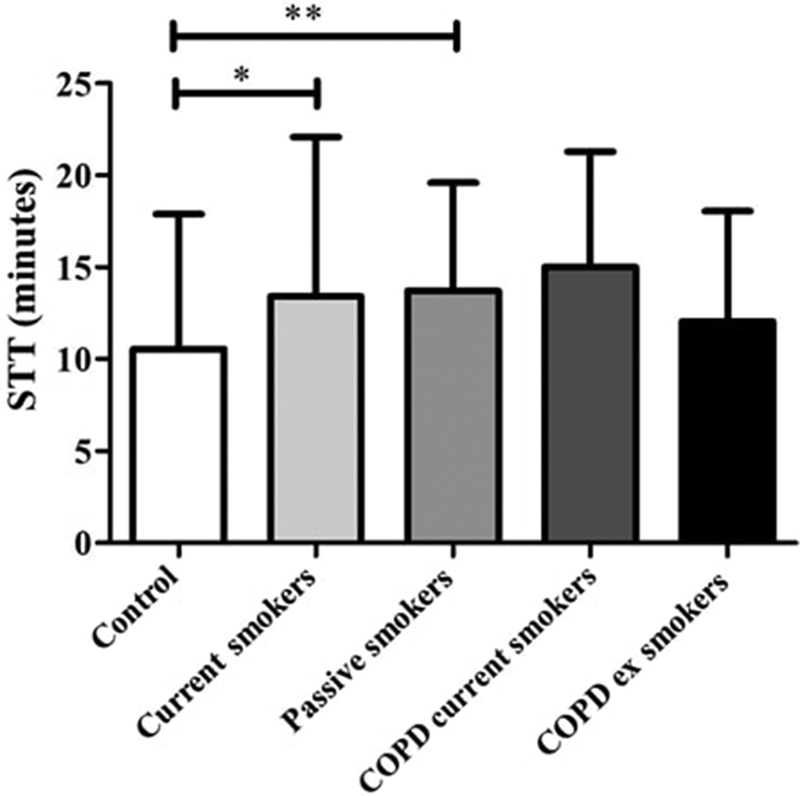
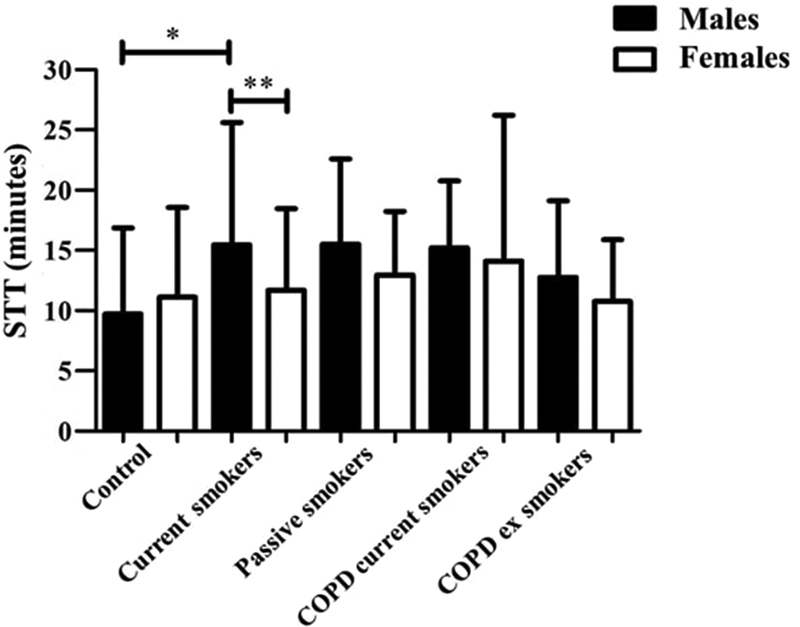
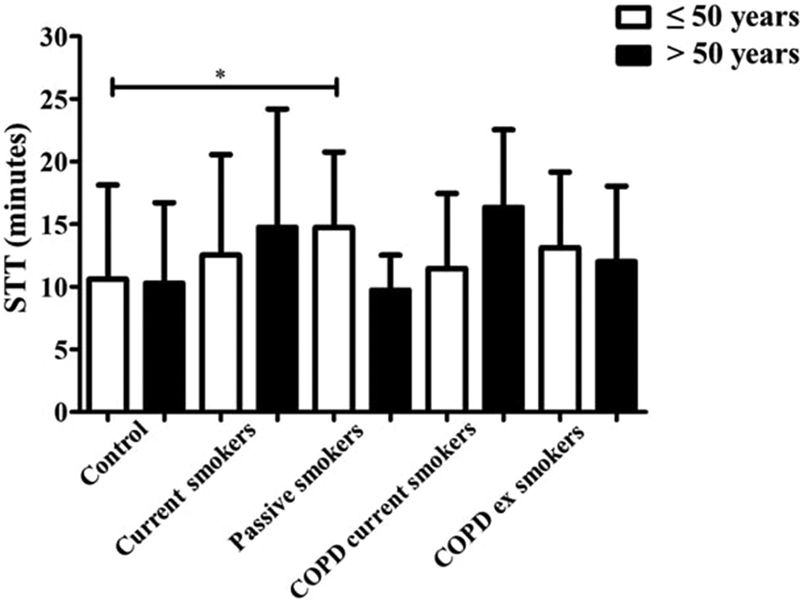
Introduction Mucociliary clearance (MCC) is the first line of defense of the pulmonary system. Mucociliary clearance impairment may lead to increased risk of respiratory infections, lung injury, pulmonary repair problems, chronic dysfunctions and progression of respiratory diseases. Objective To characterize the MCC of active and passive smokers and individuals with chronic obstructive pulmonary disease (COPD) and compare the MCC behaviors between men and women of different age groups. Methods Patients with COPD (current smokers and ex-smokers) and apparently healthy individuals (current smokers, passive smokers and nonsmokers) were evaluated. All of the subjects underwent lung function and MCC evaluation (saccharin transport test [STT]). Smokers (with or without COPD) were questioned about the smoking history. Results A total of 418 individuals aged 16 to 82 years old, of both genders, were evaluated. The STT values of active and passive smokers were statistically higher than those of the control group ( p < 0.01). Men of the control group had lower values of STT than active smokers (9.7 ± 7.1 and 15.4 ± 10.1 minute, respectively, p < 0.01). In addition, higher MCC velocity was observed in women that are current smokers (11.7 ± 6.8 minute) compared with men (15.4 ± 10.1 minute) in this group ( p = 0.01). Among the younger age groups (< 50 years old), only passive smokers presented higher STT in relation to the control group. Conclusion Passive and active smoking are factors that influence negatively the MCC, and passive smokers may present losses of this mechanism at a younger age. Additionally, male smokers present worse MCC than male nonsmokers.
Keywords: chronic obstructive pulmonary disease; mucociliary clearance; passive smoking; saccharin; smoking.
Fundação Otorrinolaringologia. This is an open access article published by Thieme under the terms of the Creative Commons Attribution License, permitting unrestricted use, distribution, and reproduction so long as the original work is properly cited. ( https://creativecommons.org/licenses/by/4.0/ ).
Conflict of interest statement
Conflicts of Interests The authors have no conflicts of interests to declare.
Figures
References
-
- Trindade S HK, de Mello Júnior J F, Mion O G. Métodos de estudo do transporte mucociliar. Rev Bras Otorrinolaringol. 2007;73:704–712.
-
- Proença de Oliveira-Maul J, Barbosa de Carvalho H, Goto D M. Aging, diabetes, and hypertension are associated with decreased nasal mucociliary clearance. Chest. 2013;143(04):1091–1097. - PubMed
-
- Plaza Valía P, Carrión Valero F, Marín Pardo J, Bautista Rentero D, González Monte C. [Saccharin test for the study of mucociliary clearance: reference values for a Spanish population] Arch Bronconeumol. 2008;44(10):540–545. - PubMed
-
- Paul P, Johnson P, Ramaswamy P, Ramadoss S, Geetha B, Subhashini A S. The effect of ageing on nasal mucociliary clearance in women: a pilot study. ISRN Pulmonol. 2013;2013:1–5.
LinkOut - more resources
Full Text Sources