Review
. 2021 Apr;43(2):193-206.
doi: 10.1007/s00281-021-00836-1. Epub 2021 Feb 5.

Cytokine "fine tuning" of enthesis tissue homeostasis as a pointer to spondyloarthritis pathogenesis with a focus on relevant TNF and IL-17 targeted therapies

Affiliations
Review

Cytokine "fine tuning" of enthesis tissue homeostasis as a pointer to spondyloarthritis pathogenesis with a focus on relevant TNF and IL-17 targeted therapies

Tobias Russell et al. Semin Immunopathol. 2021 Apr.

Abstract

A curious feature of axial disease in ankylosing spondylitis (AS) and related non-radiographic axial spondyloarthropathy (nrAxSpA) is that spinal inflammation may ultimately be associated with excessive entheseal tissue repair with new bone formation. Other SpA associated target tissues including the gut and the skin have well established paradigms on how local tissue immune responses and proven disease relevant cytokines including TNF and the IL-23/17 axis contribute to tissue repair. Normal skeletal homeostasis including the highly mechanically stressed entheseal sites is subject to tissue microdamage, micro-inflammation and ultimately repair. Like the skin and gut, healthy enthesis has resident immune cells including ILCs, γδ T cells, conventional CD4+ and CD8+ T cells and myeloid lineage cells capable of cytokine induction involving prostaglandins, growth factors and cytokines including TNF and IL-17 that regulate these responses. We discuss how human genetic studies, animal models and translational human immunology around TNF and IL-17 suggest a largely redundant role for these pathways in physiological tissue repair and homeostasis. However, disease associated immune system overactivity of these cytokines with loss of tissue repair "fine tuning" is eventually associated with exuberant tissue repair responses in AS. Conversely, excessive biomechanical stress at spinal enthesis or peripheral enthesis with mechanically related or degenerative conditions is associated with a normal immune system attempts at cytokine fine tuning, but in this setting, it is commensurate to sustained abnormal biomechanical stressing. Unlike SpA, where restoration of aberrant and excessive cytokine "fine tuning" is efficacious, antagonism of these pathways in biomechanically related disease may be of limited or even no value.

Keywords: Enthesis; IL-17; Spondyloarthritis; TNF.


Conflict of interest statement

The authors declare that they have no competing interests..

Figures
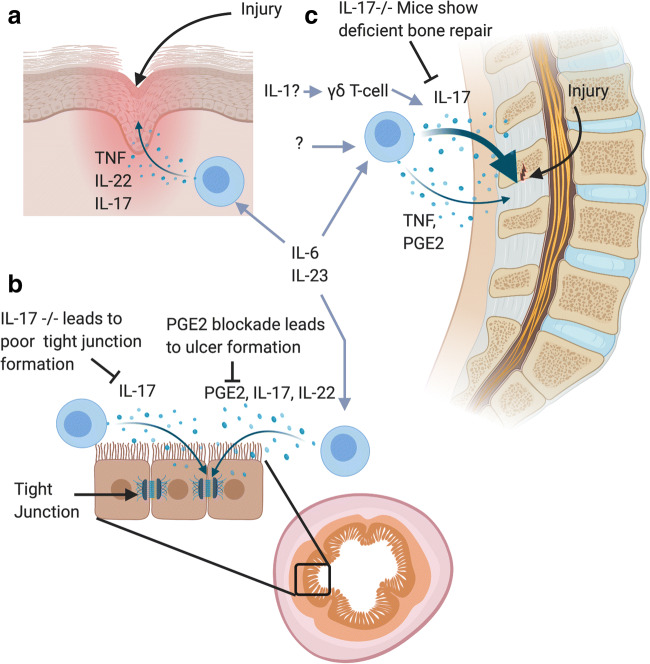
Fig. 1
Fig. 1
The spondyloarthropathy target tissues beyond the spine including the gut and the skin have a well-established understanding whereby the immune system plays a key role in physiological tissue repair. a Damage to the skin leads to rapid influx of immune cells producing cytokines including TNF, IL-17 and IL-22 which are involved in keratinocyte proliferation and extra cellular matrix deposition. b The evidence for microdamage to the spinal enthesis and how this regulates of IL-17A, TNF and PGE2 at entheses and tendons is discussed in the text. Mouse knockouts for IL-17A show impaired fracture healing responses which is rescued by IL-17A supplementation. c The hostile enzymatic and microbial normal gut environment is associated with tissue microdamage. IL-23, IL-22, IL-17A, IL-22 or PGE2 play key roles in gut homeostasis in experimental models. In particular, IL-17A plays a pivotal role in the tight junction formation between cells are damaged resulting in leaky gut
Fig. 2
Fig. 2
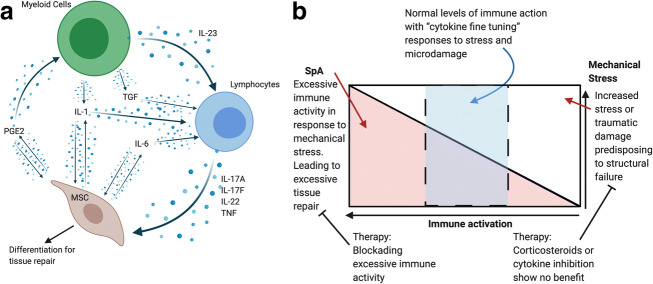
a Beyond TNF and IL-17A other cytokines are indirectly involved in the axis. For example, IL-1, IL-6 and TGF-beta can prime IL-17A, IL-17F and IL-22 production and genetic polymorphisms in IL-1 an IL-6 are linked to AS. Independently of the impact on IL-17 pathway biology these cytokines can also directly impact on stromal and MSC biology. b The balance between immune activation in response to mechanical stress. Overactivation of the immune system in response to mechanical damage can lead to excessive repair as seen in SpA (red). Conversely blocking the immune system when excessive mechanical stress induced injury can be detrimental to the repair process or may render repair ineffective
Fig. 3
Fig. 3
Overactivation of the immune system in tissue damage and excessive bone repair responses in ankylosing spondylitis. SNPs in PGE2 and IL-23/17 axis cytokines and others are clearly linked to spinal inflammation and post-inflammation repair. It is proposed that the initial microdamage to the spinal enthesis as shown in Fig. 1 leads to inflammation an immune driven tissue repair response. The same cytokine TNF and IL-23/17 pathways are responsible for both inflammation and also contributing to excessive repair responses. The dysregulation of homeostatic fine tuning of tissue repair, thus results in the characteristic post inflammation disease phenotype
Fig. 4
Fig. 4
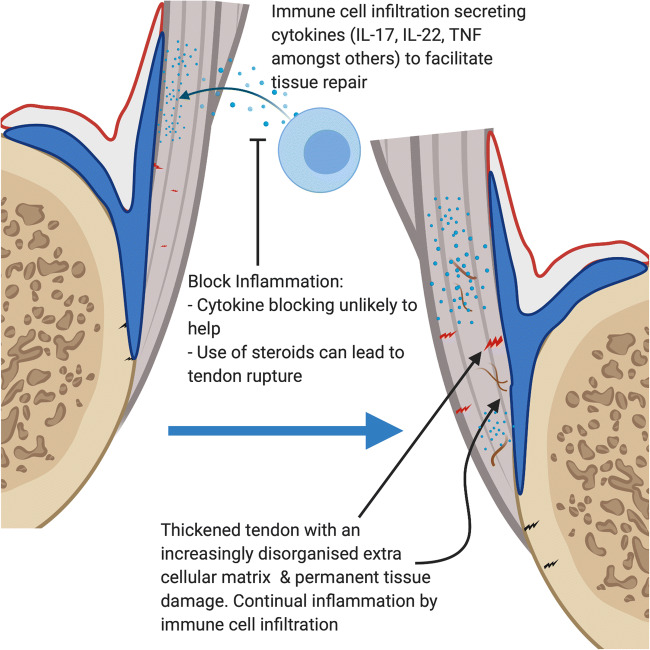
Inflammation in tendinopathy. The synovio-entheseal complex with tendons wrapping around bony tuberosities shows how the enthesis is more than merely a focal attachment site leading to stress dissipation over a wide area. Micro-damage at the Achilles tendon enthesis organ in chronic tendinopathy at this and other tendon locations near attachment points leads to immune cell infiltration to aid in tissue repair. However, unlike SpA, the excessive microdamage and injury may lead to persistent and elevated local immune responses or increased immune system fine tuning in an attempt to restore homeostasis. Prolonged inflammation may in theory contribute to tendinopathies, with thickening of the tendon and gradual loss of extra cellular matrix organization weakening the tendon. Unlike SpA where cytokine blockade efficiently controls disease by modulating the excessive immune fine tuning of cytokine homeostasis in a normal biomechanical environment, the situation here is different. The primary issue may be an abnormal biomechanical environment where the cell infiltration and associated physiological increase in fine tuning represents a repair attempt. The use of corticosteroids can lead to tendon ruptures highlighting an important role in a controlled amount of inflammation in tissue repair

References

    1. Watad A, Bridgewood C, Russell T, Marzo-Ortega H, Cuthbert R, McGonagle D. The early phases of ankylosing spondylitis: emerging insights from clinical and basic science. Front Immunol. 2018;9(2668):2668. - PMC - PubMed
    1. Ostrowska M, Maslinski W, Prochorec-Sobieszek M, Nieciecki M, Sudol-Szopinska I. Cartilage and bone damage in rheumatoid arthritis. Reumatologia. 2018;56(2):111–120. - PMC - PubMed
    1. McGonagle D, Stockwin L, Isaacs J, Emery P. An enthesitis based model for the pathogenesis of spondyloarthropathy. Additive effects of microbial adjuvant and biomechanical factors at disease sites. J Rheumatol. 2001;28(10):2155–2159. - PubMed
    1. Martin JC, Beriou G, Heslan M, Bossard C, Jarry A, Abidi A, et al. IL-22BP is produced by eosinophils in human gut and blocks IL-22 protective actions during colitis. Mucosal Immunol. 2016;9(2):539–549. - PubMed
    1. Kanno E, Kawakami K, Ritsu M, Ishii K, Tanno H, Toriyabe S, et al. Wound healing in skin promoted by inoculation with Pseudomonas aeruginosa PAO1: the critical role of tumor necrosis factor-alpha secreted from infiltrating neutrophils. Wound repair and regeneration : official publication of the Wound Healing Society [and] the European Tissue Repair Society. 2011;19(5):608–21 - PubMed

Publication types

LinkOut - more resources