. 2021 Feb 3;14(4):706.
doi: 10.3390/ma14040706.

Whither Magnetic Hyperthermia? A Tentative Roadmap

Affiliations

Whither Magnetic Hyperthermia? A Tentative Roadmap

Irene Rubia-Rodríguez et al. Materials (Basel). .

Abstract

The scientific community has made great efforts in advancing magnetic hyperthermia for the last two decades after going through a sizeable research lapse from its establishment. All the progress made in various topics ranging from nanoparticle synthesis to biocompatibilization and in vivo testing have been seeking to push the forefront towards some new clinical trials. As many, they did not go at the expected pace. Today, fruitful international cooperation and the wisdom gain after a careful analysis of the lessons learned from seminal clinical trials allow us to have a future with better guarantees for a more definitive takeoff of this genuine nanotherapy against cancer. Deliberately giving prominence to a number of critical aspects, this opinion review offers a blend of state-of-the-art hints and glimpses into the future of the therapy, considering the expected evolution of science and technology behind magnetic hyperthermia.

Keywords: cancer; hysteresis losses; magnetic hyperthermia; magnetic nanoparticles; magnetic particle imaging; nanoparticles synthesis; nanotoxicity; standardization; theranostics; thermometry.


Conflict of interest statement

The authors of Section 5 are full-time employees of Endomagnetics Limited, which is the commercial manufacturer of the Magtrace® magnetic marker. The authors of Section 9 are full-time employees of Magnetic Insight, which is a commercial supplier of magnetic particle imaging and localized hyperthermia systems. The other authors declare no conflicts of interest.

Figures

Figure 1
Figure 1
Schematic representation of a continuous flow setup for large-scale production of magnetic nanoparticles.
Figure 2
Figure 2
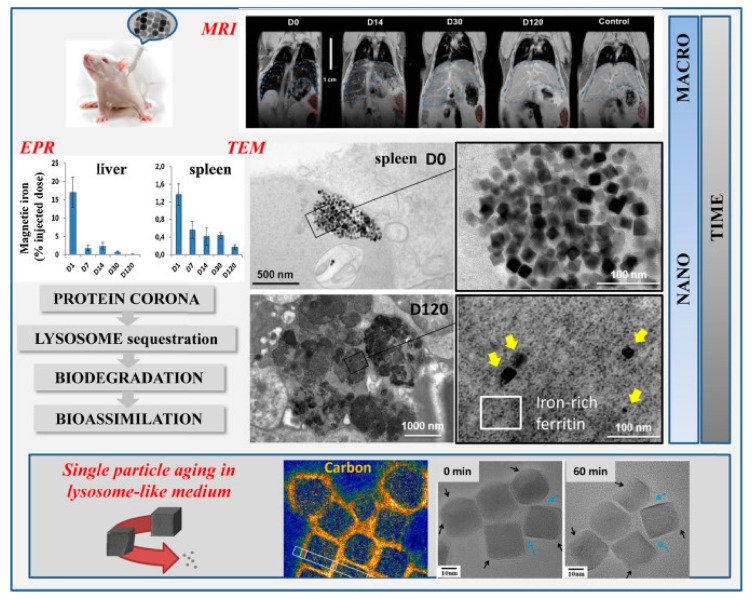
Multiscale follow-up of iron oxide nanocubes over time using in vivo magnetic resonance imaging (MRI) in mice, ex vivo electron paramagnetic resonance (EPR) quantification in organs, TEM observations of intracellular distribution and morphological biotransformations (reproduced with permission from [104].
Figure 3
Figure 3
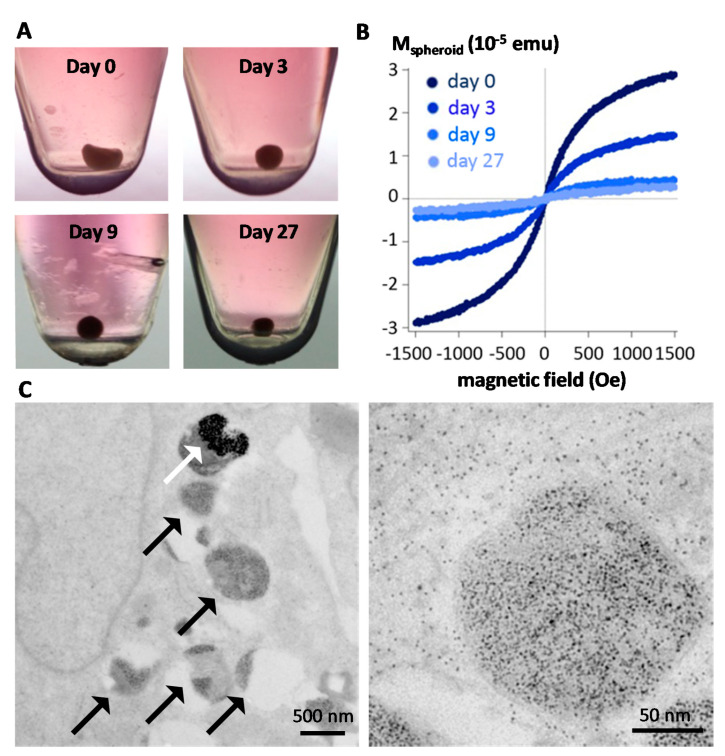
Intracellular biodegradation of MNPs monitored within cell spheroids as tissue model. (A) The spheroids are formed from 200,000 stem cells, which spontaneously regroup into a cohesive spherical aggregate that can be kept in culture over a month without experiencing any cell mortality or tissue necrosis. (B) Magnetometry can be performed at the single spheroid level, evidencing a massive degradation of the nanoparticles in a few days after internalization. (C) TEM images one month after nanoparticle internalization, demonstrating that only a few intact nanoparticles remain within the endosomes (white arrow) while both endosomes and cytoplasm are filled with the ferritin protein (black arrows) containing the iron released from degradation, with a diameter 5–7 nm as seen in the close-up image on the right. Reproduced with permission from [111].
Figure 4
Figure 4
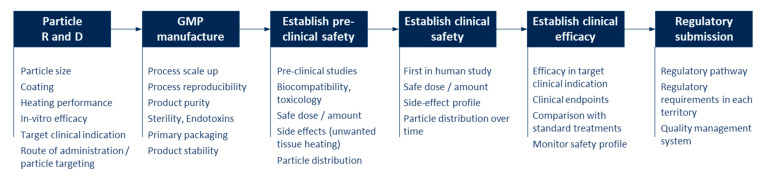
Steps to regulatory approval of MNPs for magnetic hyperthermia.
Figure 5
Figure 5
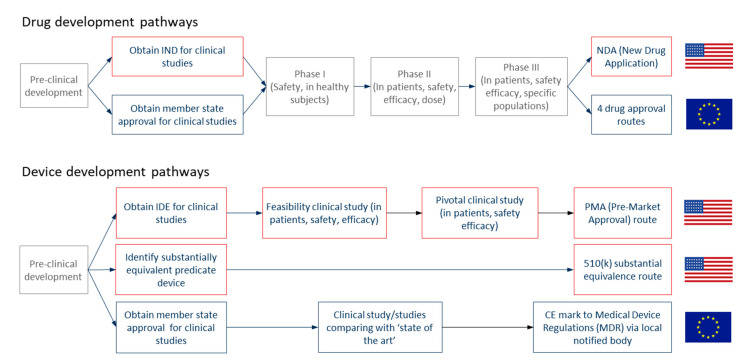
Development and regulatory pathways for drugs and devices in the US and Europe. IDE stands for Investigational Device Exemption, while IND stands for Investigational New Drug Application.
Figure 6
Figure 6
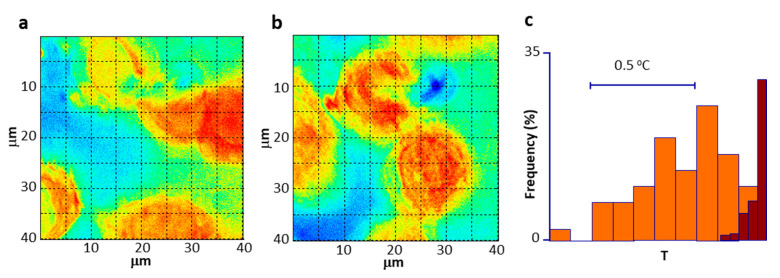
Thermal images of MNPs internalized in cells, (a), before, and (b), during irradiation with an AC magnetic field; (c), average temperature shift upon the application of an AC magnetic field.
Figure 7
Figure 7
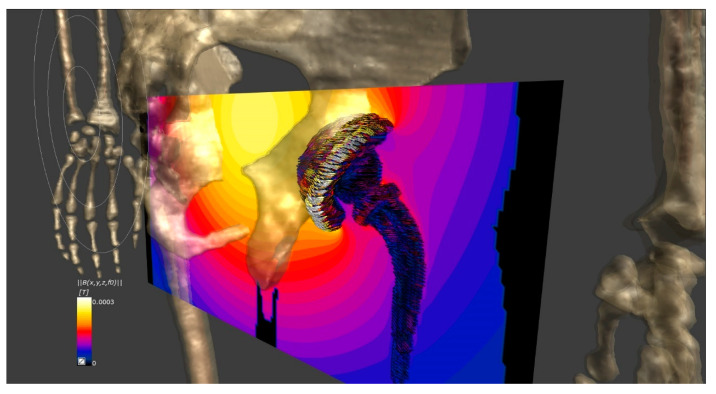
Calculated field and temperature patterns in and around the hip implant of a prospective patient of magnetic hyperthermia to treat a prostate tumor.
Figure 8
Figure 8
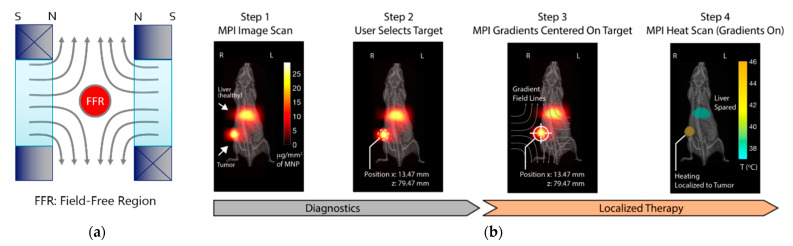
(a) MPI uses a selection field to localize the nanoparticle signal. The diverging magnetic field lines produce a unique FFR in the center. By varying the applied magnetic field, the FFR can be translated across the sample; (b) workflow of an MPI-directed localized magnetic hyperthermia therapy for solid tumors. Following tracer administration, MPI was performed to identify tumor location and size and to identify tracer uptake in healthy tissue such as the liver. The measured target dose and off-target areas of risk are then used to optimize magnetic hyperthermia treatment planning. Follow-up scans can be performed to assess response to therapy over time. Reprinted (adapted) with permission from [212].

References

    1. MagForce USA, Inc. Has Received FDA Approval to Proceed with Its Streamlined Trial Protocol for the Next Stage of Pivotal U.S. [(accessed on 29 November 2020)];Single-Arm Study for the Focal Ablation of Intermediate Risk Prostate Cancer with the NanoTherm Therapy System. Available online: https://www.magforce.com/en/news/?article=325.
    1. “Nanomedicine Upscaling for Early Clinical Phases of Multimodal Cancer Therapy”. This NoCanTher Project Has Received Funding from the European Union’s Horizon 2020 Research and Innovation Programme under Grant Agreement No 685795. [(accessed on 29 November 2020)]; Available online: https://cordis.europa.eu/project/id/685795.
    1. Multifunctional Nanoparticles for Magnetic Hyperthermia and Indirect Radiation Therapy (RADIOMAG) [(accessed on 29 November 2020)]; Available online: www.cost-radiomag.eu/
    1. Richardson J.J., Caruso F. Nanomedicine toward 2040. Nano Lett. 2020;20:1481–1482. doi: 10.1021/acs.nanolett.0c00620. - DOI - PubMed
    1. European Nanomedicine Characterization Lab. [(accessed on 30 November 2020)]; Available online: http://www.euncl.eu/