Review
. 2021 Feb 3;22(4):1509.
doi: 10.3390/ijms22041509.

The Role of Oxidative Stress in Pancreatic β Cell Dysfunction in Diabetes

Affiliations
Review

The Role of Oxidative Stress in Pancreatic β Cell Dysfunction in Diabetes

Natsuki Eguchi et al. Int J Mol Sci. .

Abstract

Diabetes is a chronic metabolic disorder characterized by inappropriately elevated glucose levels as a result of impaired pancreatic β cell function and insulin resistance. Extensive studies have been conducted to elucidate the mechanism involved in the development of β cell failure and death under diabetic conditions such as hyperglycemia, hyperlipidemia, and inflammation. Of the plethora of proposed mechanisms, endoplasmic reticulum (ER) stress, mitochondrial dysfunction, and oxidative stress have been shown to play a central role in promoting β cell dysfunction. It has become more evident in recent years that these 3 factors are closely interrelated and importantly aggravate each other. Oxidative stress in particular is of great interest to β cell health and survival as it has been shown that β cells exhibit lower antioxidative capacity. Therefore, this review will focus on discussing factors that contribute to the development of oxidative stress in pancreatic β cells and explore the downstream effects of oxidative stress on β cell function and health. Furthermore, antioxidative capacity of β cells to counteract these effects will be discussed along with new approaches focused on preserving β cells under oxidative conditions.

Keywords: anti-oxidants; diabetes; oxidative stress; pancreatic β cells.


Conflict of interest statement

The authors declare no conflict of interest.

Figures
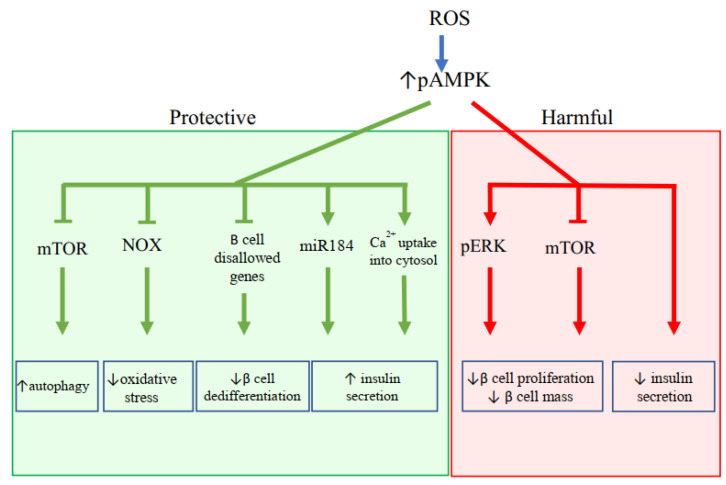
Figure 1
Figure 1
Downstream effects of upregulation of AMP-activated protein kinase (AMPK) activation via oxidative stress. The upregulation of AMPK has both protective and harmful effects. AMPK exerts its protective effect through inhibiting mTOR, NOX2, and β cell disallowed genes, and increasing expression of miR184 and uptake of Ca2+. Taken together, they increase autophagy and insulin secretion, and decrease oxidative stress and β cell dedifferentiation. AMPK also has harmful effects mediated by the activation of ERK and inhibition of mTOR, both of which results in decreased β cell proliferation.
Figure 2
Figure 2
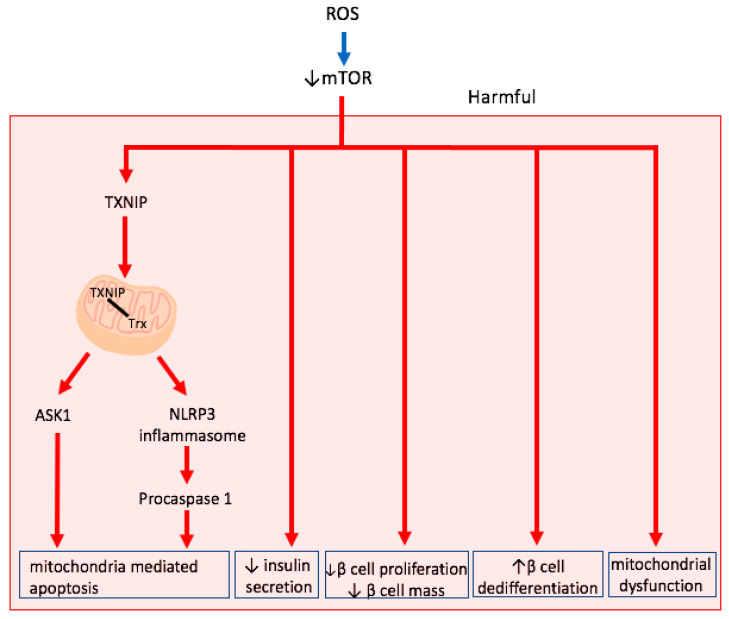
Downstream effects of downregulation of mTOR via oxidative stress. The downregulation of mTOR primarily harms β cells through initiating mitochondrial mediated apoptosis through the upregulation of Thioredoxin-interacting protein (TXNIP), inducing mitochondrial dysfunction, increasing β cell dedifferentiation, and decreasing insulin secretion and β cell proliferation.
Figure 3
Figure 3
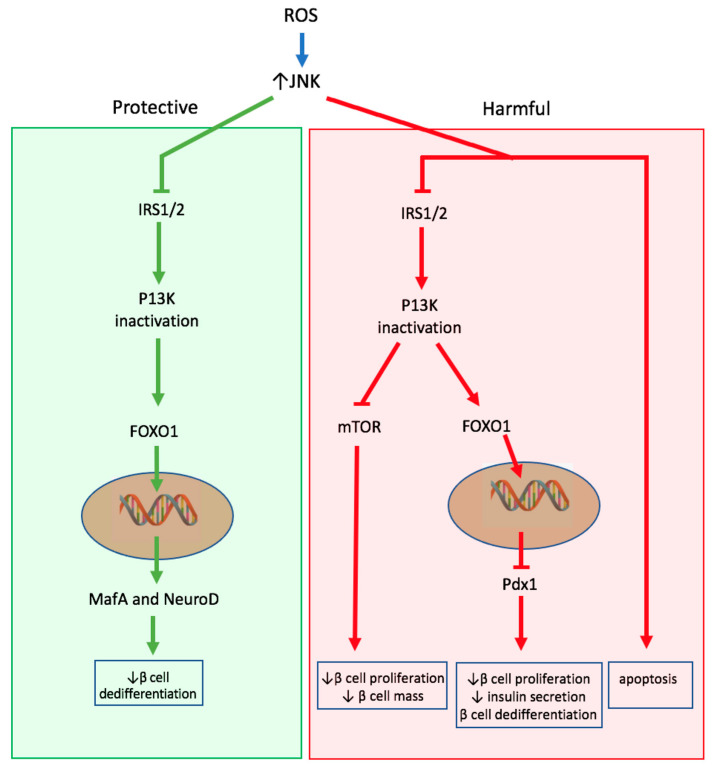
Downstream effects of upregulation of c-Jun N-terminal kinase (JNK) via oxidative stress. The upregulation of JNK have both protective and harmful effects. The upregulation of JNK results in inhibition of the IRS1/2/P13K pathway, resulting in the inhibition of mTOR and nuclear translocation of forkhead box protein O1 (FOXO1). In turn, FOXO1 nuclear translocation results in Pdx1 nuclear exclusion. Overall, these effects result in decreased β cell mass, insulin secretion, and increased β cell dedifferentiation. The upregulation of FOXO1 also has protective effects through its ability to increase expression of β cell mature identity genes including MafA and NeuroD.

References

    1. Saklayen M.G. The Global Epidemic of the Metabolic Syndrome. Curr. Hypertens Rep. 2018;20:12. doi: 10.1007/s11906-018-0812-z. - DOI - PMC - PubMed
    1. Hudish L.I., Reusch J.E., Sussel L. beta Cell dysfunction during progression of metabolic syndrome to type 2 diabetes. J. Clin. Investig. 2019;129:4001–4008. doi: 10.1172/JCI129188. - DOI - PMC - PubMed
    1. Hasnain S.Z., Prins J.B., McGuckin M.A. Oxidative and endoplasmic reticulum stress in beta-cell dysfunction in diabetes. J. Mol. Endocrinol. 2016;56:R33–R54. doi: 10.1530/JME-15-0232. - DOI - PubMed
    1. Gurgul-Convey E., Mehmeti I., Plotz T., Jorns A., Lenzen S. Sensitivity profile of the human EndoC-betaH1 beta cell line to proinflammatory cytokines. Diabetologia. 2016;59:2125–2133. doi: 10.1007/s00125-016-4060-y. - DOI - PubMed
    1. Liguori I., Russo G., Curcio F., Bulli G., Aran L., Della-Morte D., Gargiulo G., Testa G., Cacciatore F., Bonaduce D., et al. Oxidative stress, aging, and diseases. Clin. Interv. Aging. 2018;13:757–772. doi: 10.2147/CIA.S158513. - DOI - PMC - PubMed