. 2021 Feb 3;10(2):161.
doi: 10.3390/pathogens10020161.

Evaluation of Antibody Response in Symptomatic and Asymptomatic COVID-19 Patients and Diagnostic Assessment of New IgM/IgG ELISA Kits

Affiliations

Evaluation of Antibody Response in Symptomatic and Asymptomatic COVID-19 Patients and Diagnostic Assessment of New IgM/IgG ELISA Kits

Hadeel T Al-Jighefee et al. Pathogens. .

Abstract

This study aims to study the immune response and evaluate the performances of four new IgM and five IgG enzyme-linked immunosorbent assay (ELISA) kits for detecting anti-severe acute respiratory syndrome coronavirus 2 (SARS-CoV-2) antibodies against different antigens in symptomatic and asymptomatic coronavirus disease 2019 (COVID-19) patients. A total of 291 samples collected from symptomatic and asymptomatic RT-PCR-confirmed patients were used to evaluate the ELISA kits' performance (EDI, AnshLabs, DiaPro, NovaLisa, and Lionex). The sensitivity was measured at three different time-intervals post symptoms onset or positive SARS-CoV-2 RT-PCR test (≤14, 14-30, >30 days). The specificity was investigated using 119 pre-pandemic serum samples. The sensitivity of all IgM kits gradually decreased with time, ranging from 48.7% (EDI)-66.4% (Lionex) at ≤14 days, 29.1% (NovaLisa)-61.8% (Lionex) at 14-30 days, and 6.0% (AnshLabs)-47.9% (Lionex) at >30 days. The sensitivity of IgG kits increased with time, peaking in the latest interval (>30 days) at 96.6% (Lionex). Specificity of IgM ranged from 88.2% (Lionex)-99.2% (EDI), while IgG ranged from 75.6% (DiaPro)-98.3% (Lionex). Among all RT-PCR-positive patients, 23 samples (7.9%) were seronegative by all IgG kits, of which only seven samples (30.4%) had detectable IgM antibodies. IgM assays have variable and low sensitivity, thus considered a poor marker for COVID-19 diagnosis. IgG assays can miss at least 8% of RT-PCR-positive cases.

Keywords: COVID-19; ELISA; IgG; IgM; SARS-CoV-2; asymptomatic; sensitivity; serology; specificity; symptomatic.


Conflict of interest statement

The authors declare no conflict of interest.

Figures
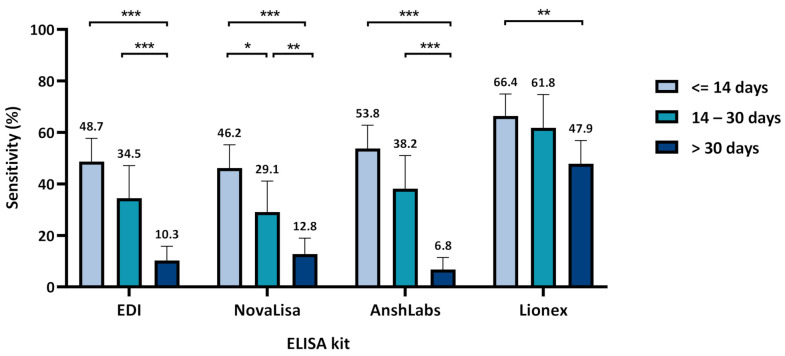
Figure 1
Figure 1
Assays sensitivity according to time of sample collection after symptoms onset or positive severe acute respiratory syndrome coronavirus 2 (SARS-CoV-2) RT-PCR for both symptomatic and asymptomatic patients. Chi-squared test was used to detect the presence of a statistically significant difference in the sensitivity between the time-intervals for each assay, * p < 0.05, ** p < 0.01, *** p < 0.001.
Figure 2
Figure 2
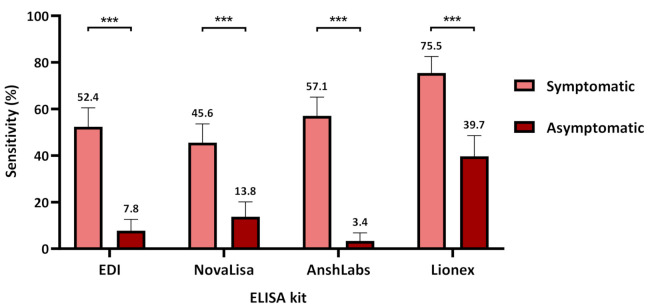
Assays sensitivity according to coronavirus disease 2019 (COVID-19) patient classification (symptomatic or asymptomatic). Chi-squared was used to calculate the significance between the sensitivities in symptomatic and asymptomatic patients for each kit, *** p < 0.001.
Figure 3
Figure 3
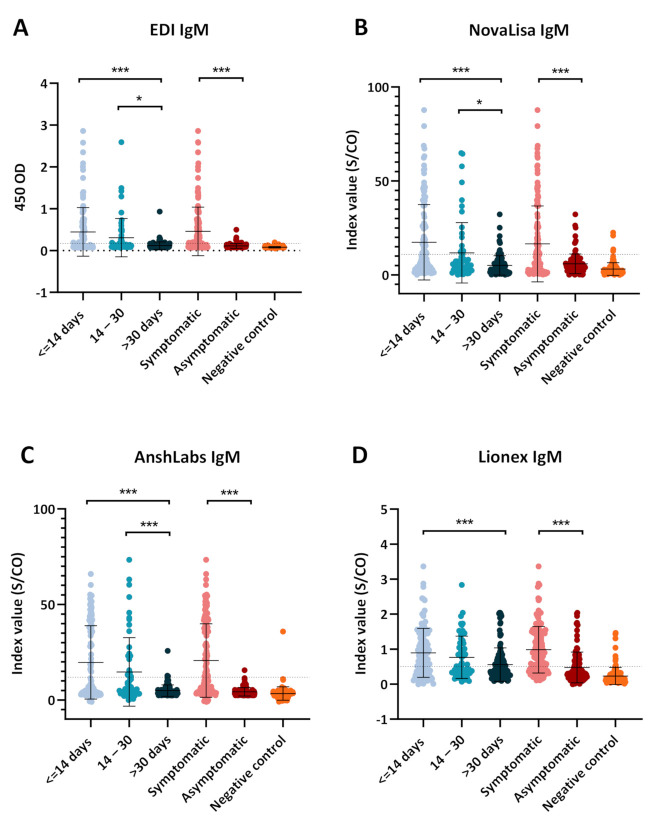
Dot plot distribution of the IgM ELISA index values according to the different time points of sampling (≤14, 14–30, >30 days) and coronavirus disease 2019 (COVID-19) patient classification (symptomatic or asymptomatic). Each dot plot represents the index values obtained with each serological assay: (A) EDI™, (B) NovaLisa, (C) AnshLabs, and (D) Lionex. Results are expressed as a ratio of the sample signal to the cutoff for all tests except the EDI™ assay, which is expressed in optical density. One-way analysis of variance (ANOVA) was used to compare the differences between groups, * p < 0.05, *** p < 0.001.
Figure 4
Figure 4
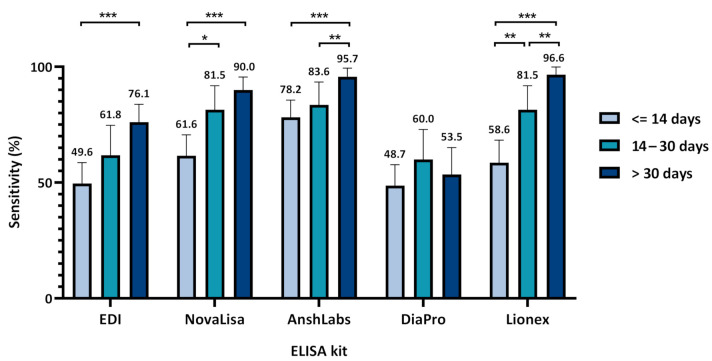
Assays sensitivity according to time of sampling after symptoms onset or positive severe acute respiratory syndrome coronavirus 2 (SARS-CoV-2) RT–PCR test. Chi-squared test was used to detect the presence of a statistically significant difference in the sensitivity between the time-intervals for each assay, * p < 0.05, ** p < 0.01, *** p < 0.001.
Figure 5
Figure 5
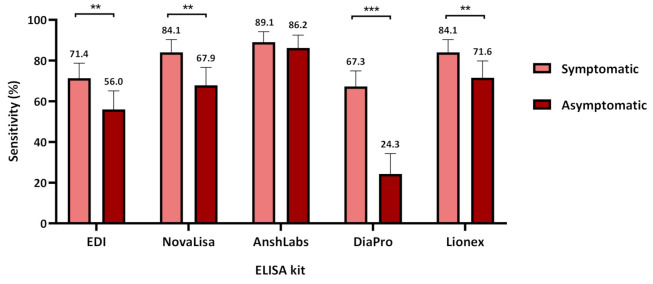
Assays sensitivity according to coronavirus disease 2019 COVID-19 patient classification (symptomatic or asymptomatic). Chi-squared was used to calculate the significance between the sensitivities in symptomatic and asymptomatic patients for each assay, ** p < 0.01, *** p < 0.001.
Figure 6
Figure 6
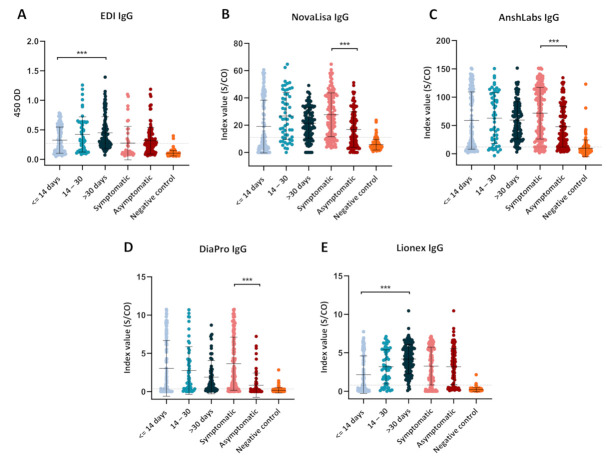
Dot plot distribution of the IgG ELISA index values according to the different time points of sampling (≤14, 14–30, >30 days) and coronavirus disease 2019 (COVID-19) patient classification (symptomatic or asymptomatic). Each dot plot represents the index values obtained with each serological assay: (A) EDI™, (B) NovaLisa, (C) AnshLabs, (D) DiaPro, and (E) Lionex. Results are expressed as a ratio of the sample signal to the cutoff for all tests except the EDI™ assay, which is expressed in optical density. One-way analysis of variance (ANOVA) was used to compare the differences between groups, *** p < 0.001.
Figure 7
Figure 7
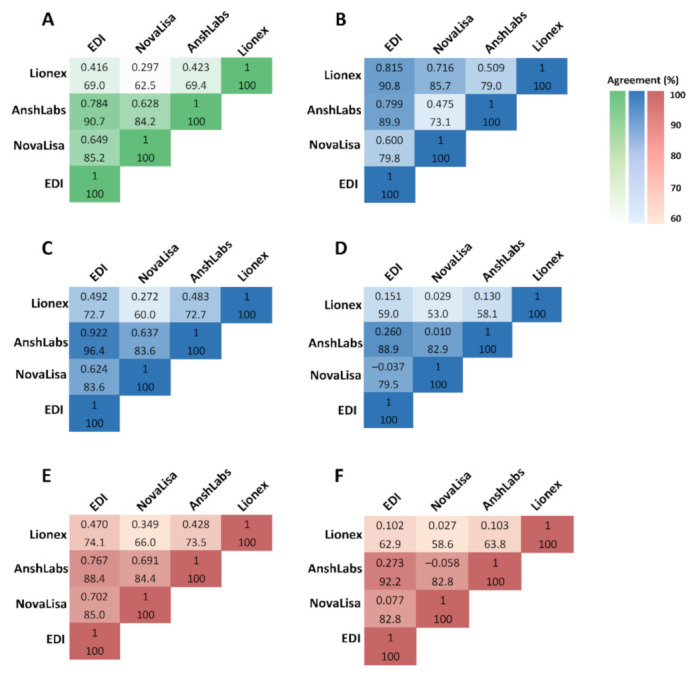
Concordance assessment for the overall agreement and kappa (k) among all IgM ELISA tests. (A) Overall agreement, (B) agreement in samples collected ≤14 DPSO/DPD, (C) agreement in samples collected 14–30 DPSO/DPD, (D) agreement in samples collected >30 DPSO/DPD, (E) agreement in samples collected from symptomatic coronavirus disease 2019 (COVID-19) patients, (F) agreement in samples collected from asymptomatic COVID-19 patients.
Figure 8
Figure 8
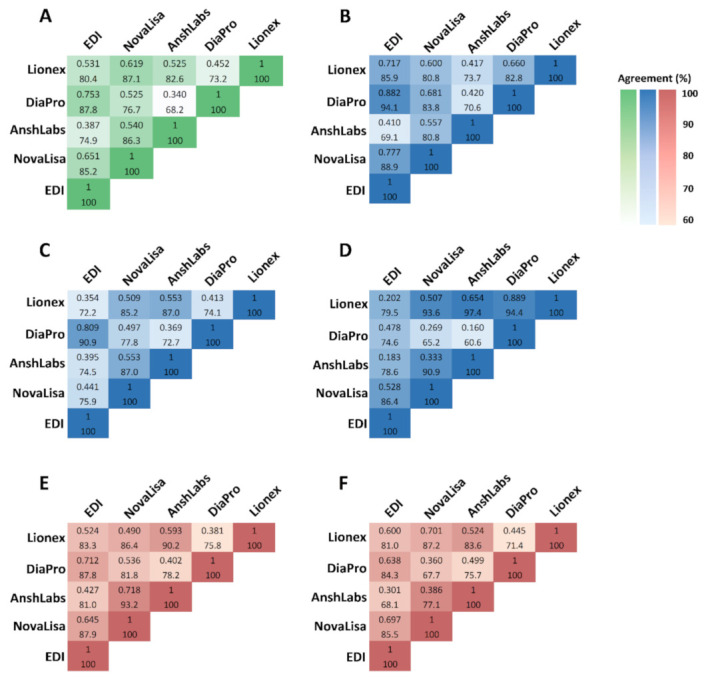
Concordance assessment for the overall agreement and kappa (k) among all IgG ELISA tests. (A) Overall agreement, (B) agreement in samples collected ≤14 DPSO/DPD, (C) agreement in samples collected 14–30 DPSO/DPD, (D) agreement in samples collected >30 DPSO/DPD, (E) agreement in samples collected from symptomatic coronavirus disease 2019 (COVID-19) patients, (F) agreement in samples collected from asymptomatic COVID-19 patients.

References

    1. Dobaño C., Vidal M., Santano R., Jiménez A., Chi J., Barrios D., Ruiz-Olalla G., Melero N.R., Carolis C., Parras D., et al. Highly sensitive and specific multiplex antibody assays to quantify immunoglobulins M, A and G against SARS-CoV-2 antigens. bioRxiv. 2020 doi: 10.1128/JCM.01731-20. - DOI - PMC - PubMed
    1. Adams E.R., Anand R., Andersson M.I., Auckland K., Baillie J.K., Barnes E., Bell J., Berry T., Bibi S., Carroll M., et al. Evaluation of antibody testing for SARS-Cov-2 using ELISA and lateral flow immunoassays. medRxiv. 2020 doi: 10.1101/2020.04.15.20066407. - DOI
    1. Karpiński T.M., Ożarowski M., Seremak-Mrozikiewicz A., Wolski H., Wlodkowic D. The 2020 race towards SARS-CoV-2 specific vaccines. Theranostics. 2021;11:1690–1702. doi: 10.7150/thno.53691. - DOI - PMC - PubMed
    1. Sewell H.F., Agius R.M., Kendrick D., Stewart M. Covid-19 vaccines: Delivering protective immunity. BMJ. 2020;371:m4838. doi: 10.1136/bmj.m4838. - DOI - PubMed
    1. Winter A.K., Hegde S.T. The important role of serology for COVID-19 control. Lancet Infect. Dis. 2020;20:758–759. doi: 10.1016/S1473-3099(20)30322-4. - DOI - PMC - PubMed

LinkOut - more resources