. 2021 Feb 3;18(4):1424.
doi: 10.3390/ijerph18041424.

Bite Force in Elderly with Full Natural Dentition and Different Rehabilitation Prosthesis

Affiliations

Bite Force in Elderly with Full Natural Dentition and Different Rehabilitation Prosthesis

Licia Manzon et al. Int J Environ Res Public Health. .

Abstract

(1) Background: This study aimed to investigate maximum bite force (MBF) in elderly patients with natural full dentition (FD), patients rehabilitated with Traditional Complete Dentures (CD), with overdentures (IRO) and edentulous patients (ED). We also tested whether MBF changes are associated with gender, age of the patients and body mass index (BMI) as result of altered food; (2) Methods: Three hundred and sixty-eight geriatric patients were included. We studied two types of prostheses: (a) IRO with telescopic attachments. (b) CD (heat polymerized polymethyl methacrylate resin). The MBF was measured using a digital dynamometer with a bite fork; (3) Results: We found that MBF is higher in males than females, regardless of teeth presence or absence (p < 0.01). In patients with CD or IRO, there are no differences between males and females; prostheses improve MBF compared to edentulous patients (p < 0.0001) and this effect is greater with IRO prostheses (p < 0.0001); the chewing force of FD subjects remains greater (p < 0.0001); there are no differences among chewing strength based on different BMI categories, although FD subjects have a reduced incidence of obesity; there is a significant negative correlation between MBF and age (p = 0.038; R = 0.145), and no correlation between MBF and BMI; (4) Conclusions: This study showed that MBF improves more in patients using IRO prostheses, although not reaching the MBF of FD subjects. MBF does not correlate with BMI, although we found increased percentages of obesity in edentulous subjects or those with prostheses. Thus, old people wearing prostheses require special attention by a nutritionist to avoid risk of malnutrition.

Keywords: elderly; natural dentition; oral rehabilitation; prosthesis.


Conflict of interest statement

The authors declare no conflict of interest.

Figures
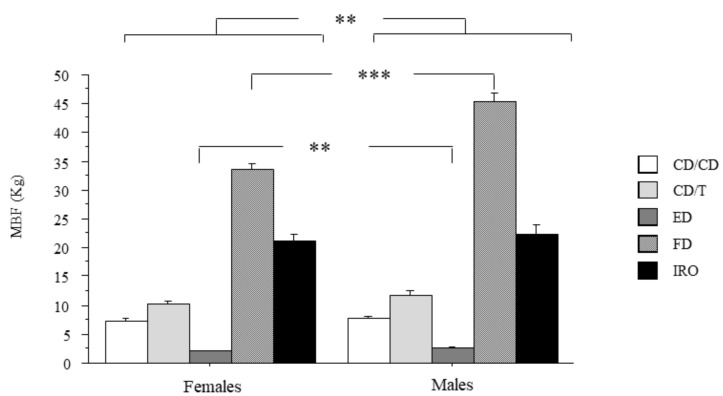
Figure 1
Figure 1
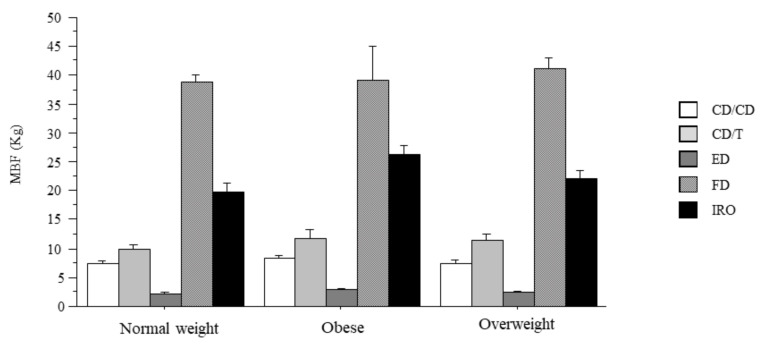
Bite force and gender. Maximal bite force according to gender. MBF: maximal bite force; subjects with natural full dentition (FD); subjects wearing implant-retained overdentures (IRO); subjects with natural teeth in one arch and wearing traditional complete dentures (CD) in opposite dental arch (CD/T); subjects wearing CD in both arches (CD/CD); edentulous patients in both arches (ED). Data are the mean ± SEM. Asterisk (*) indicates significant difference between the groups. ** p < 0.01; *** p < 0.001.
Figure 2
Figure 2
Bite force and body mass index (BMI). Maximal bite force according to body mass index classification. MBF: maximal bite force; subjects with natural full dentition (FD); subjects wearing implant-retained overdentures (IRO); subjects with natural teeth in one arch and wearing traditional complete dentures (CD) in opposite dental arch (CD/T); subjects wearing CD in both arches (CD/CD); edentulous patients in both arches (ED). Data are the mean ± SEM.
Figure 3
Figure 3
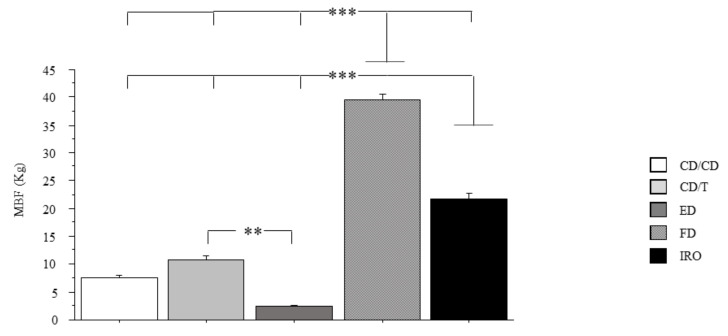
Bite force and prostheses. Maximal bite force in the three types of prostheses. MBF: maximal bite force; subjects with natural full dentition (FD); subjects wearing implant-retained overdentures (IRO); subjects with natural teeth in one arch and wearing traditional complete dentures (CD) in opposite dental arch (CD/T); subjects wearing CD in both arches (CD/CD); edentulous patients in both arches (ED). Data are the mean ± SEM. Asterisk (*) indicates significant difference between the groups. ** p < 0.01; *** p < 0.001.
Figure 4
Figure 4
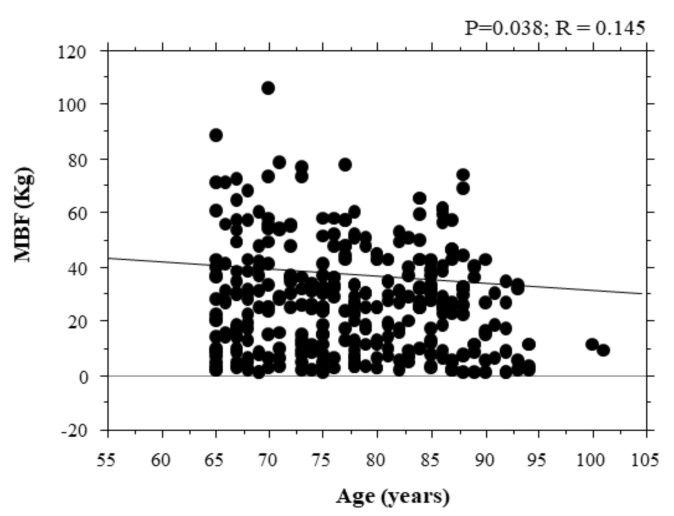
Correction of bite force with age. Correlations of maximal bite force with age of the subjects. MBF: maximal bite force; R = coefficient of correlation; P = p-value (p).
Figure 5
Figure 5
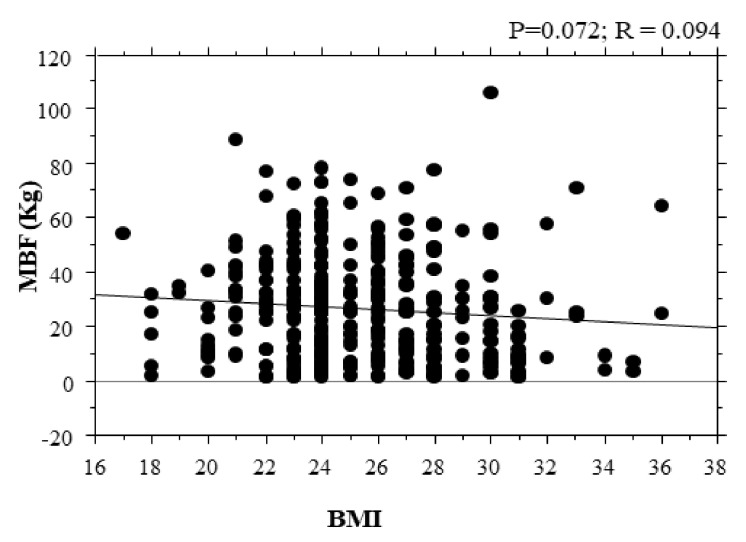
Correction of bite force with BMI. Correlations of maximal bite force with body mass index. MBF: maximal bite force; BMI: body mass index; R= coefficient of correlation; P = p-value (p).

References

    1. Supiyev A., Kossumov A., Utepova L., Kushugulova A., Nurgozhin T., Zhumadilov Z. Elderly population. J. Nutr. Health Aging. 2013;17:869.
    1. Eto M., Miyauchi S. Relationship between occlusal force and falls among community-dwelling elderly in Japan: A cross-sectional correlative study. BMC Geriatr. 2018;18:111. doi: 10.1186/s12877-018-0805-4. - DOI - PMC - PubMed
    1. Weijenberg R.A.F., Delwel S., Van Ho B., Van Der Maarel-Wierink C.D., Lobbezoo F. Mind your teeth—The relationship between mastication and cognition. Gerodontology. 2019;36:2–7. doi: 10.1111/ger.12380. - DOI - PMC - PubMed
    1. De Angelis F., Basili S., Giovanni F., Dan Trifan P., Di Carlo S., Manzon L. Influence of the oral status on cardiovascular diseas-es in an older Italian population. Int. J. Immunopathol. Pharmacol. 2018;32:394632017751786. - PMC - PubMed
    1. Su Y., Yuki M., Hirayama K., Sato M., Han T. Denture Wearing and Malnutrition Risk Among Community-Dwelling Older Adults. Nutrients. 2020;12:151. doi: 10.3390/nu12010151. - DOI - PMC - PubMed

LinkOut - more resources