


Personalized Estimates of Brain Structural Variability in Individuals With Early Psychosis
- PMID: 33547470
- PMCID: PMC8266574
- DOI: 10.1093/schbul/sbab005
Personalized Estimates of Brain Structural Variability in Individuals With Early Psychosis
Abstract
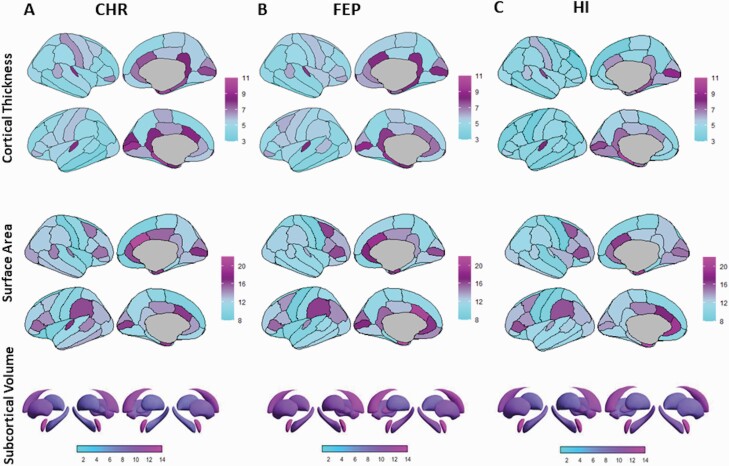
Background: Early psychosis in first-episode psychosis (FEP) and clinical high-risk (CHR) individuals has been associated with alterations in mean regional measures of brain morphology. Examination of variability in brain morphology could assist in quantifying the degree of brain structural heterogeneity in clinical relative to healthy control (HC) samples.
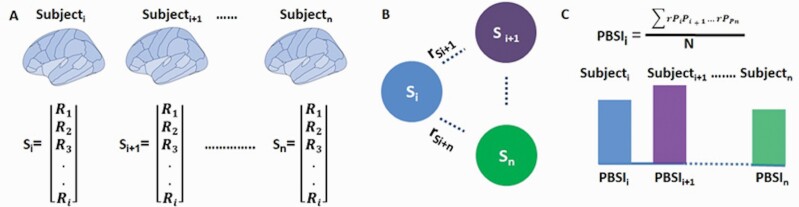
Methods: Structural magnetic resonance imaging data were obtained from CHR (n = 71), FEP (n = 72), and HC individuals (n = 55). Regional brain variability in cortical thickness (CT), surface area (SA), and subcortical volume (SV) was assessed with the coefficient of variation (CV). Furthermore, the person-based similarity index (PBSI) was employed to quantify the similarity of CT, SA, and SV profile of each individual to others within the same diagnostic group. Normative modeling of the PBSI-CT, PBSI-SA, and PBSI-SV was used to identify CHR and FEP individuals whose scores deviated markedly from those of the healthy individuals.
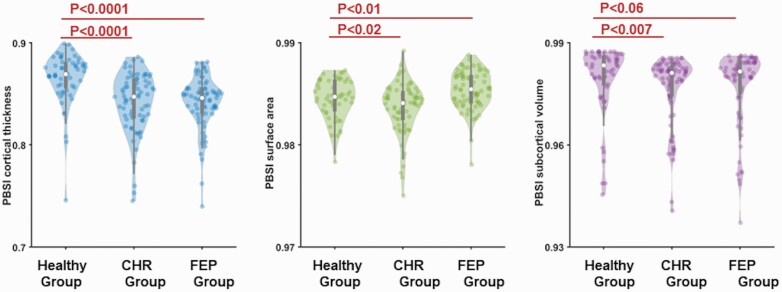
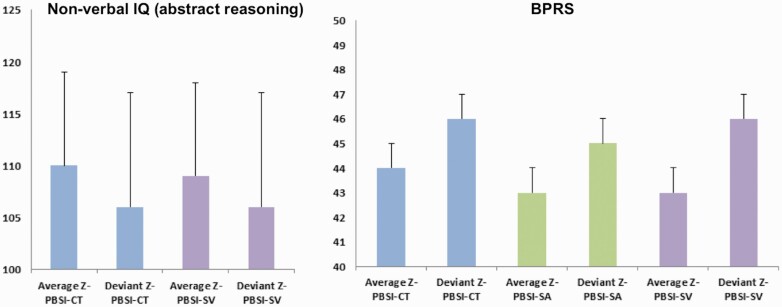
Results: There was no effect of diagnosis on the CV for any regional measure (P > .38). CHR and FEP individuals differed significantly from the HC group in terms of PBSI-CT (P < .0001), PBSI-SA (P < .0001), and PBSI-SV (P = .01). In the clinical groups, normative modeling identified 32 (22%) individuals with deviant PBSI-CT, 12 (8.4%) with deviant PBSI-SA, and 21 (15%) with deviant PBSI-SV; differences of small effect size indicated that individuals with deviant PBSI scores had lower IQ and higher psychopathology.
Conclusions: Examination of brain structural variability in early psychosis indicated heterogeneity at the level of individual profiles and encourages further large-scale examination to identify individuals that deviate markedly from normative reference data.
Keywords: brain morphology; coefficient of variation; early psychosis; heterogeneity; person-based similarity index.
© The Author(s) 2021. Published by Oxford University Press on behalf of the Maryland Psychiatric Research Center.
Figures
References
-
- American Psychiatric Association. Diagnostic and Statistical Manual of Mental Disorders. 5th ed. Arlington, VA: American Psychiatric Publishing; 2013.
-
- De Herdt A, Wampers M, Vancampfort D, et al. . Neurocognition in clinical high risk young adults who did or did not convert to a first schizophrenic psychosis: a meta-analysis. Schizophr Res. 2013;149(1–3):48–55. - PubMed
-
- Bora E, Lin A, Wood SJ, Yung AR, McGorry PD, Pantelis C. Cognitive deficits in youth with familial and clinical high risk to psychosis: a systematic review and meta-analysis. Acta Psychiatr Scand. 2014;130(1):1–15. - PubMed
Publication types
MeSH terms
Grants and funding
LinkOut - more resources
Full Text Sources
Other Literature Sources
Medical
