


Human Leukocyte Antigen Class II associations in late-onset Myasthenia Gravis
- PMID: 33547763
- PMCID: PMC7951107
- DOI: 10.1002/acn3.51309
Human Leukocyte Antigen Class II associations in late-onset Myasthenia Gravis
Abstract
Objective: Genetic factors predisposing to late-onset myasthenia gravis (LOMG) have not been clearly defined yet. However, genome-wide association studies identified Human Leukocyte Antigen (HLA) Class II alleles as a hotspot in this disease subtype. The aim of this study was to analyze the correlations of HLA Class II alleles with clinical data and titin antibodies in this patient subgroup.
Methods: This study consecutively enrolled anti-acetylcholine receptor antibody-positive, non-thymoma patients with generalized LOMG. All patients were of Italian ancestry. HLA-DRB1 and -DQB1 genotyping and serum titin antibody testing were performed in this population.
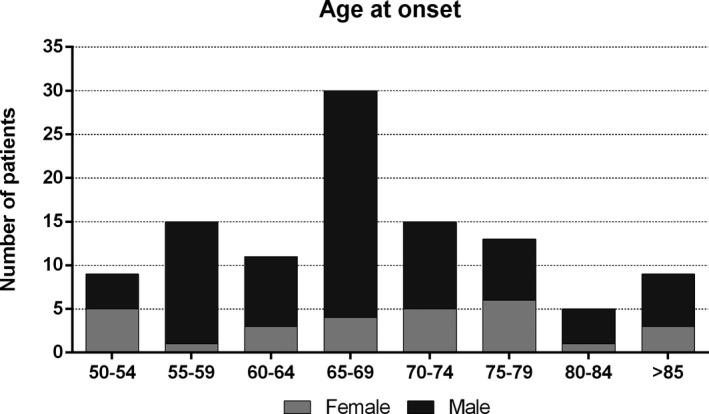
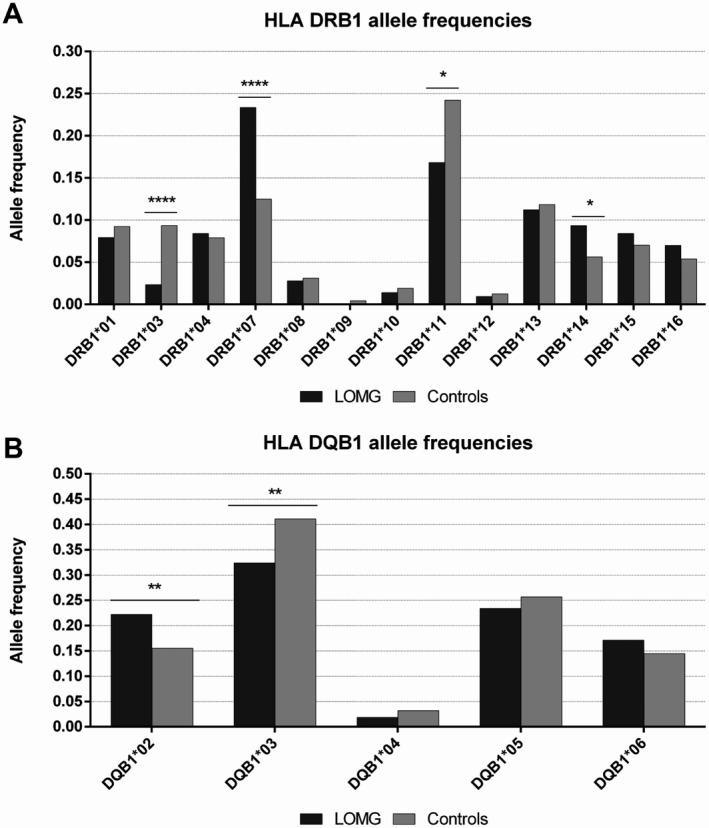
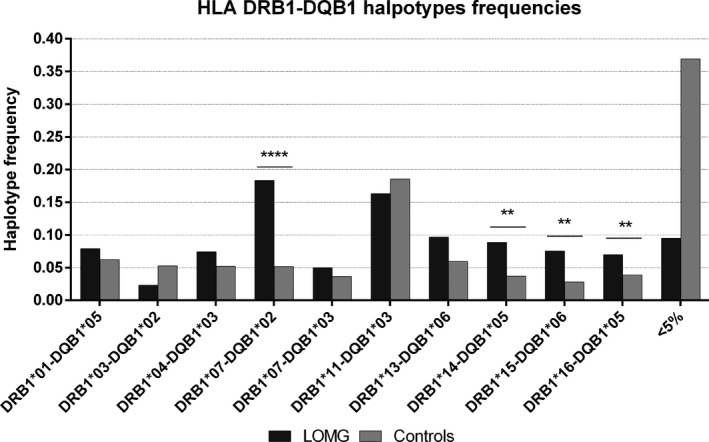
Results: A total of 107 patients (females: 28/107, 26.2%; median age of onset: 68 years, range: 50-92) were included. We found a positive association with HLA-DRB1*07 (P = 1.1 × 10⁻⁵ ), HLA-DRB1*14 (P = 0.0251) and HLA-DQB1*02 (P = 0.0095). HLA-DRB1*03, HLA-DRB1*11, and HLA-DQB1*03 were protective alleles (P = 7.9 × 10⁻⁵ , P = 0.0104, and P = 0.0067, respectively). By conditional haplotype analysis, HLA-DRB1*07-DQB1*02 was found to be the major risk haplotype (OR = 4.10; 95% C.I.: 2.80-5.99; P = 6.01 × 10⁻¹¹ ). The mean age at onset was 73.4 years in DRB1*07 homozygotes, 69.7 years in heterozygotes, and 66.6 in non-carriers (P = 0.0488). DRB1*07 carriers and non-carriers did not differ in disease severity and response to therapy. Titin antibodies were detected in 61.4% of the cases, having no association with HLA alleles or specific clinical characteristics.
Interpretation: In our study, we identified the HLA DRB1*07-DQB1*02 haplotype as a predisposing factor for the development of generalized LOMG in the Italian population.
© 2021 The Authors. Annals of Clinical and Translational Neurology published by Wiley Periodicals LLC on behalf of American Neurological Association.
Conflict of interest statement
The authors report no disclosures.
Figures
References
-
- Gilhus NE, Tzartos S, Evoli A, et al. Myasthenia gravis. Nat Rev Dis Primers 2019;5(1):30. - PubMed
-
- Gilhus NE, Verschuuren JJ. Myasthenia gravis: subgroup classification and therapeutic strategies. Lancet Neurol 2015;14(10):1023–1036. - PubMed
-
- Somnier FE. Increasing incidence of late‐onset anti‐AChR antibody‐seropositive myasthenia gravis. Neurology 2005;65(6):928–930. - PubMed
-
- Matsui N, Nakane S, Nakagawa Y, et al. Increasing incidence of elderly onset patients with myasthenia gravis in a local area of Japan. J Neurol Neurosurg Psychiatry 2009;80(10):1168–1171. - PubMed
-
- Casetta I, Fallica E, Govoni V, et al. Incidence of myasthenia gravis in the province of Ferrara: a community‐based study. Neuroepidemiology 2004;23(6):281–284. - PubMed
Publication types
MeSH terms
Substances
LinkOut - more resources
Full Text Sources
Other Literature Sources
Medical
Research Materials