


Epigallocatechin-3-gallate, an active ingredient of Traditional Chinese Medicines, inhibits the 3CLpro activity of SARS-CoV-2
- PMID: 33548314
- PMCID: PMC7859723
- DOI: 10.1016/j.ijbiomac.2021.02.012
Epigallocatechin-3-gallate, an active ingredient of Traditional Chinese Medicines, inhibits the 3CLpro activity of SARS-CoV-2
Abstract
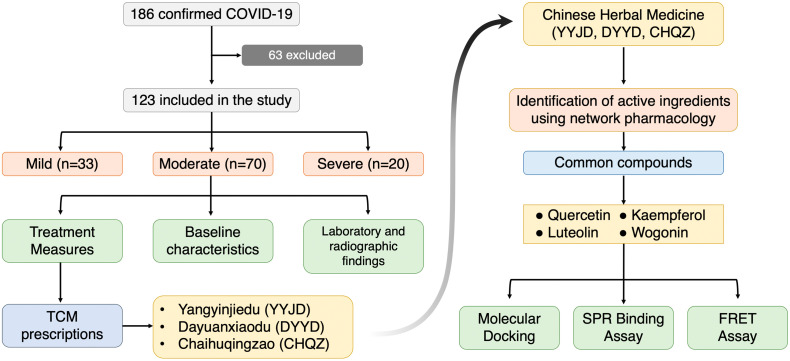
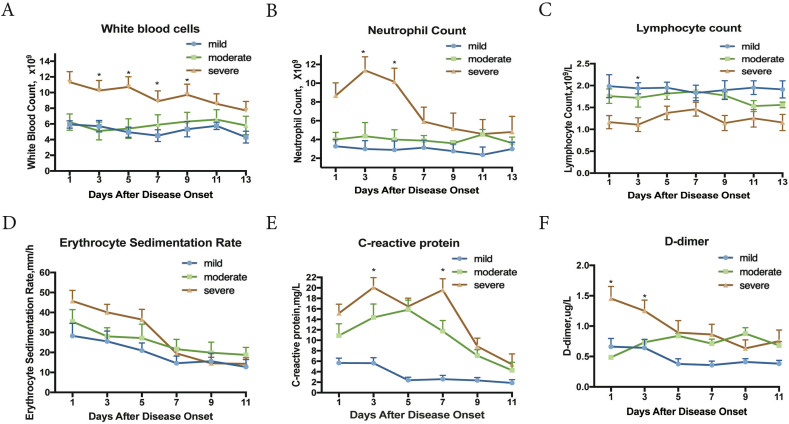
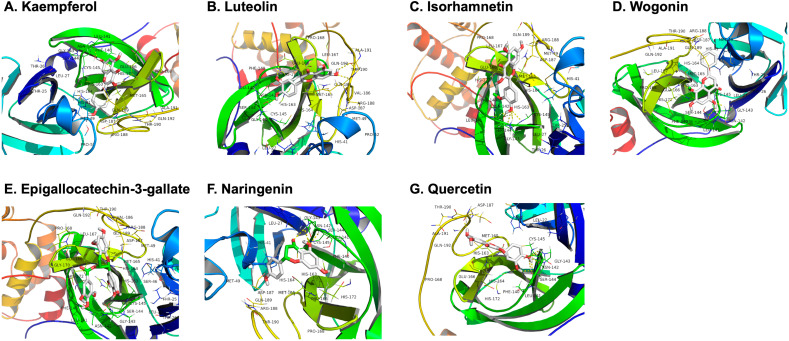
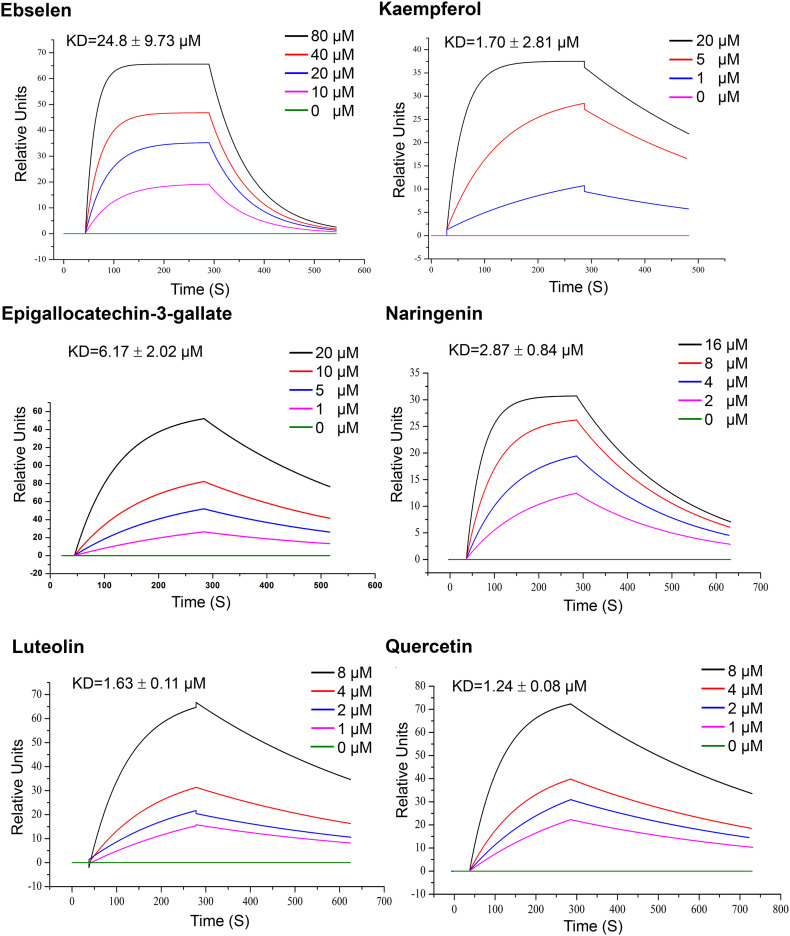
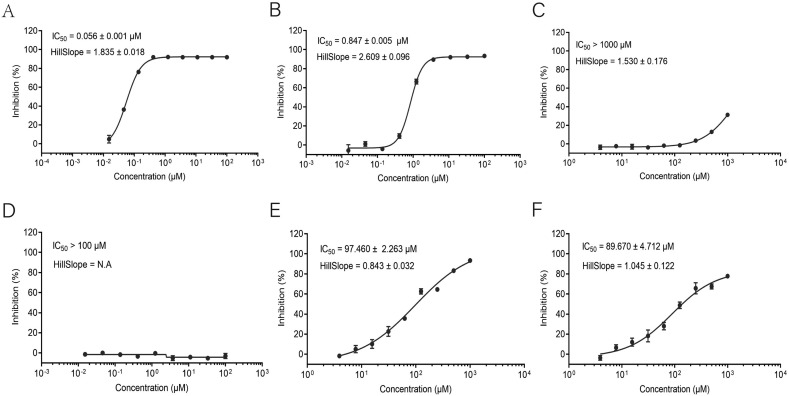
SARS-CoV-2 is the etiological agent responsible for the ongoing pandemic of coronavirus disease 2019 (COVID-19). The main protease of SARS-CoV-2, 3CLpro, is an attractive target for antiviral inhibitors due to its indispensable role in viral replication and gene expression of viral proteins. The search of compounds that can effectively inhibit the crucial activity of 3CLpro, which results to interference of the virus life cycle, is now widely pursued. Here, we report that epigallocatechin-3-gallate (EGCG), an active ingredient of Chinese herbal medicine (CHM), is a potent inhibitor of 3CLpro with half-maximum inhibitory concentration (IC50) of 0.874 ± 0.005 μM. In the study, we retrospectively analyzed the clinical data of 123 cases of COVID-19 patients, and found three effective Traditional Chinese Medicines (TCM) prescriptions. Multiple strategies were performed to screen potent inhibitors of SARS-CoV-2 3CLpro from the active ingredients of TCMs, including network pharmacology, molecular docking, surface plasmon resonance (SPR) binding assay and fluorescence resonance energy transfer (FRET)-based inhibition assay. The SPR assay showed good interaction between EGCG and 3CLpro with KD ~6.17 μM, suggesting a relatively high affinity of EGCG with SARS-CoV-2 3CLpro. Our results provide critical insights into the mechanism of action of EGCG as a potential therapeutic agent against COVID-19.
Keywords: Epigallocatechin-3-gallate; SARS-CoV-2; Traditional Chinese Medicine.
Copyright © 2021. Published by Elsevier B.V.
Conflict of interest statement
Declaration of competing interest The authors declare no conflict of interest.
Figures
References
-
- Hui D.S., E. I.A., Madani T.A., Ntoumi F., Kock R., Dar O., Ippolito G., McHugh T.D., Memish Z.A., Drosten C., Zumla A., Petersen E. The continuing 2019-nCoV epidemic threat of novel coronaviruses to global health - the latest 2019 novel coronavirus outbreak in Wuhan, China. Int J Infect Dis. 2020;91:264–266. - PMC - PubMed
-
- Zhou P., Yang X.L., Wang X.G., Hu B., Zhang L., Zhang W., Si H.R., Zhu Y., Li B., Huang C.L., Chen H.D., Chen J., Luo Y., Guo H., Jiang R.D., Liu M.Q., Chen Y., Shen X.R., Wang X., Zheng X.S., Zhao K., Chen Q.J., Deng F., Liu L.L., Yan B., Zhan F.X., Wang Y.Y., Xiao G.F., Shi Z.L. A pneumonia outbreak associated with a new coronavirus of probable bat origin. Nature. 2020;579(7798):270–273. - PMC - PubMed
-
- Lu R., Zhao X., Li J., Niu P., Yang B., Wu H., Wang W., Song H., Huang B., Zhu N., Bi Y., Ma X., Zhan F., Wang L., Hu T., Zhou H., Hu Z., Zhou W., Zhao L., Chen J., Meng Y., Wang J., Lin Y., Yuan J., Xie Z., Ma J., Liu W.J., Wang D., Xu W., Holmes E.C., Gao G.F., Wu G., Chen W., Shi W., Tan W. Genomic characterisation and epidemiology of 2019 novel coronavirus: implications for virus origins and receptor binding. Lancet. 2020;395(10224):565–574. - PMC - PubMed
-
- Q. Li, X. Guan, P. Wu, X. Wang, L. Zhou, Y. Tong, R. Ren, K.S.M. Leung, E.H.Y. Lau, J.Y. Wong, X. Xing, N. Xiang, Y. Wu, C. Li, Q. Chen, D. Li, T. Liu, J. Zhao, M. Liu, W. Tu, C. Chen, L. Jin, R. Yang, Q. Wang, S. Zhou, R. Wang, H. Liu, Y. Luo, Y. Liu, G. Shao, H. Li, Z. Tao, Y. Yang, Z. Deng, B. Liu, Z. Ma, Y. Zhang, G. Shi, T.T.Y. Lam, J.T. Wu, G.F. Gao, B.J. Cowling, B. Yang, G.M. Leung, Z. Feng, Early transmission dynamics in Wuhan, China, of novel coronavirus-infected pneumonia, N Engl J Med 382(13) (2020) 1199–1207. - PMC - PubMed
MeSH terms
Substances
LinkOut - more resources
Full Text Sources
Other Literature Sources
Miscellaneous
