. 2021 Feb 6;9(1):39.
doi: 10.1186/s40168-020-00991-x.

Antibiotic-associated dysbiosis affects the ability of the gut microbiota to control intestinal inflammation upon fecal microbiota transplantation in experimental colitis models

Affiliations

Antibiotic-associated dysbiosis affects the ability of the gut microbiota to control intestinal inflammation upon fecal microbiota transplantation in experimental colitis models

Francesco Strati et al. Microbiome. .

Abstract

Background: The gut microbiota plays a central role in host physiology and in several pathological mechanisms in humans. Antibiotics compromise the composition and functions of the gut microbiota inducing long-lasting detrimental effects on the host. Recent studies suggest that the efficacy of different clinical therapies depends on the action of the gut microbiota. Here, we investigated how different antibiotic treatments affect the ability of the gut microbiota to control intestinal inflammation upon fecal microbiota transplantation in an experimental colitis model and in ex vivo experiments with human intestinal biopsies.

Results: Murine fecal donors were pre-treated with different antibiotics, i.e., vancomycin, streptomycin, and metronidazole before FMT administration to colitic animals. The analysis of the gut microbiome, fecal metabolome, and the immunophenotyping of colonic lamina propria immune cells revealed that antibiotic pre-treatment significantly influences the capability of the microbiota to control intestinal inflammation. Streptomycin and vancomycin-treated microbiota failed to control intestinal inflammation and were characterized by the blooming of pathobionts previously associated with IBD as well as with metabolites related to the presence of oxidative stress and metabolism of simple sugars. On the contrary, the metronidazole-treated microbiota retained its ability to control inflammation co-occurring with the enrichment of Lactobacillus and of innate immune responses involving iNKT cells. Furthermore, ex vivo cultures of human intestinal lamina propria mononuclear cells and iNKT cell clones from IBD patients with vancomycin pre-treated sterile fecal water showed a Th1/Th17 skewing in CD4+ T-cell populations; metronidazole, on the other hand, induced the polarization of iNKT cells toward the production of IL10.

Conclusions: Diverse antibiotic regimens affect the ability of the gut microbiota to control intestinal inflammation in experimental colitis by altering the microbial community structure and microbiota-derived metabolites. Video Abstract.

Keywords: Antibiotics; FMT; Gut microbiota; IBD; iNKT.


Conflict of interest statement

The authors declare no competing interests.

Figures
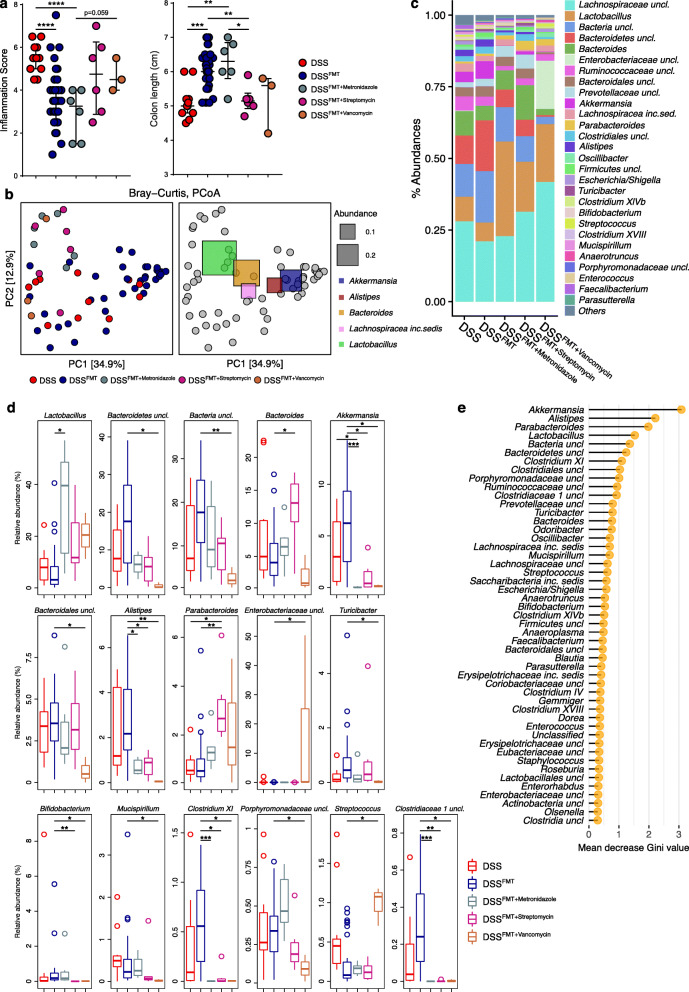
Fig. 1
Fig. 1
Experimental colitis outcome and gut microbiota composition upon FMT with antibiotics pre-conditioned microbiota in DSS colitic animals. a Experimental colitis outcome as measured by inflammation scores and colon length. b PCoA of beta-diversity as measured by Bray-Curtis dissimilarity. In the right panel, PCoA generated as in the left panel showing the five most abundant, fully classified, genera superimposed as colored squares, with size being proportional to the mean relative abundance of the taxon across all samples (in gray). c Mean relative abundance at genus level of the gut microbiota among groups. All genera with relative abundance < 0.1% are reported together and labeled as “others.” d Most abundant genera (with relative abundance > 0.1%) showing significant differences in their relative abundance among groups. P values were FDR corrected. *p < 0.05, **p < 0.01, *** < 0.005; Wilcoxon rank-sum test. e Random forest analysis. Bacterial taxa with the highest discriminatory power sorted by mean decrease GINI value
Fig. 2
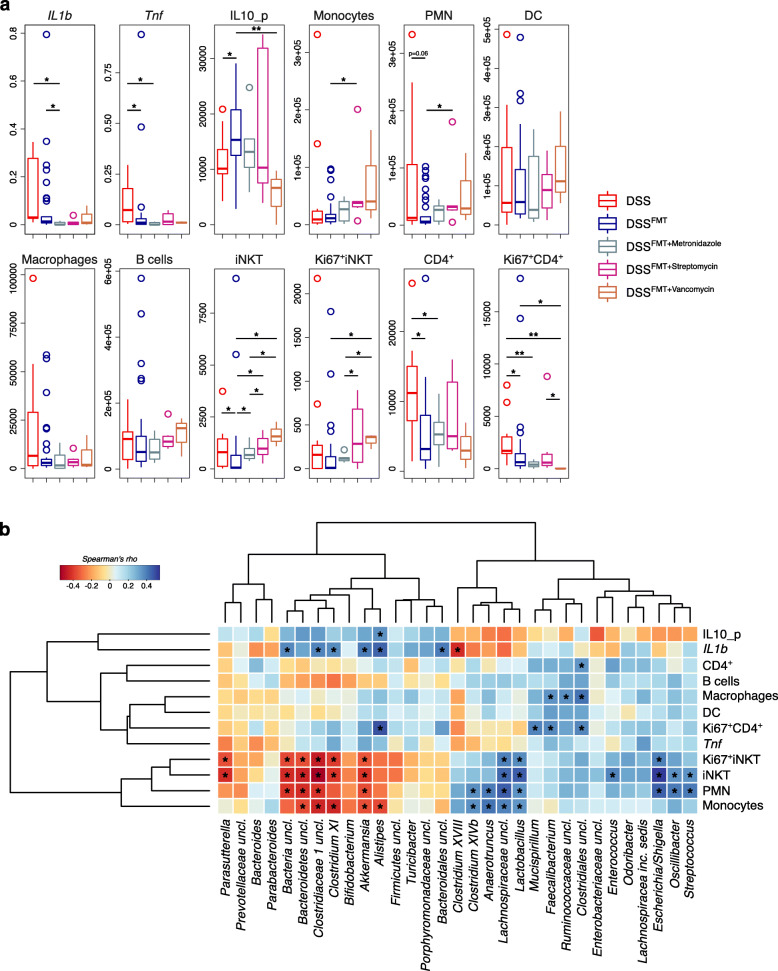
Fig. 2
Immunophenotyping and co-occurrence of the gut microbiota with immune cell populations in DSS colitic recipients after FMT with antibiotics pre-conditioned microbiota. a Inflammation markers levels and absolute abundances of innate and adaptive immune cells isolated from the colonic lamina propria of DSS, DSSFMT, DSSFMT + Metronidazole, DSSFMT + Streptomycin, and DSSFMT + Vancomycin animals. *p < 0.05, **p < 0.01, *** < 0.001; Wilcoxon rank-sum test. b Heatmap of Spearman’s ρ (ρs) correlations between the relative abundance of the most represented bacterial genera (with relative abundance > 0.1%) in the gut microbiota of colitic animals after treatments with the indicated immunological parameters. The significant correlations with an FDR-corrected p < 0.05 are indicated with an asterisk (*)
Fig. 3
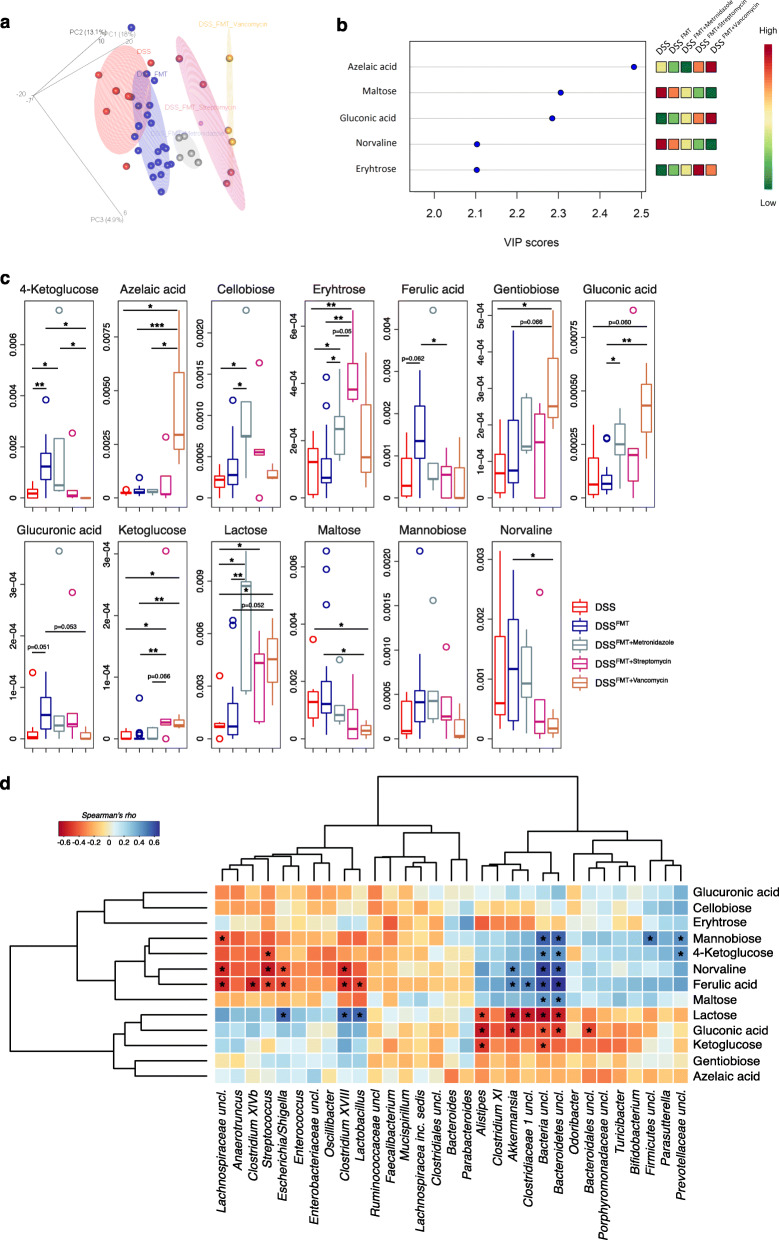
Fig. 3
Metabolomics analysis and co-occurrence of the gut microbiota with microbiota-derived metabolites in DSS colitic recipients after FMT with antibiotics pre-conditioned microbiota. a Partial least square discriminant analysis showing clustered samples according to the type of antibiotic treatment. b Metabolites that differentiate samples according to treatment with a variable important in projection (VIP) score > 2. c Metabolites with the highest discriminative power for the classification of samples (VIP score > 2) according to treatment. *p < 0.05, **p < 0.01, *** < 0.001; Wilcoxon rank-sum test. d Heatmap of Spearman’s ρ (ρs) correlations between the relative abundance of the most represented bacterial genera (with relative abundance > 0.1%) in the gut microbiota of colitic animals after treatments with the metabolites with the highest discriminatory power. The significant correlations with an FDR-corrected p < 0.05 are indicated with an asterisk (*)
Fig. 4
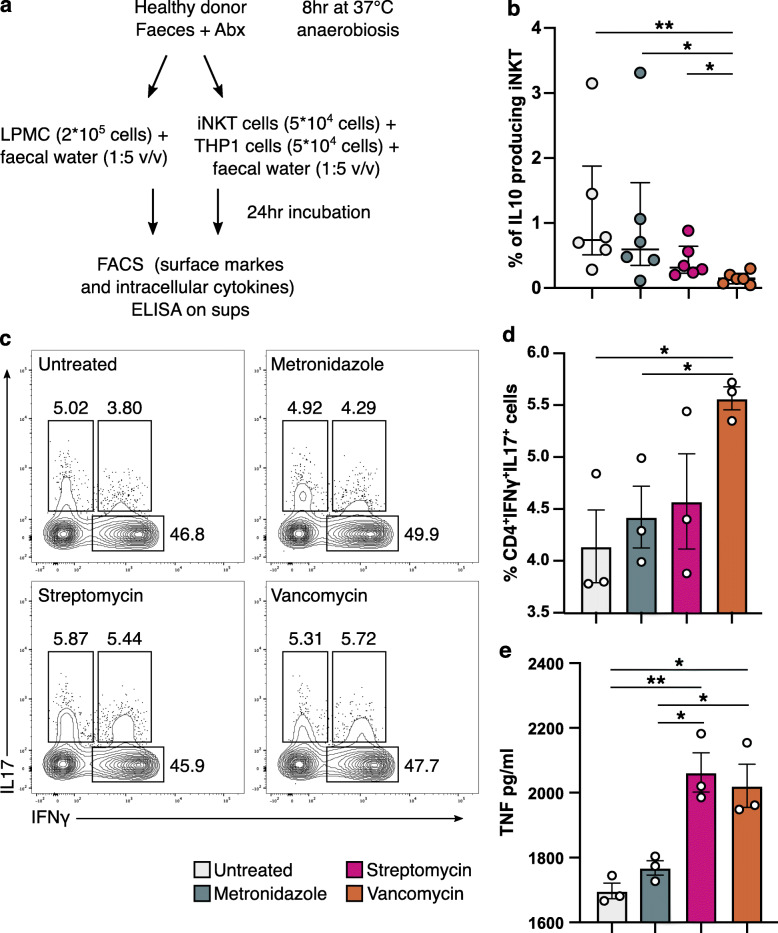
Fig. 4
Ex vivo LPMC and iNKT cells stimulation assay with sterile filtered fecal water from antibiotic pre-conditioned human healthy donor’s microbiota. a Schematic representation of the experiment. b Frequencies of IL10 producing iNKT cells upon exposure to sterile fecal water from antibiotic pre-conditioned healthy donor’s microbiota. *p < 0.05, **p < 0.01, Mann-Whitney U test. c Representative contour plots. d Frequencies of IFNγ and IL17 secreting CD4+ T-cells from UC LPMC upon exposure to sterile fecal water from antibiotic preconditioned healthy donor’s microbiota. e TNF secretion of UC LPMC upon exposure to sterile fecal water from antibiotic preconditioned healthy donor’s microbiota. *p < 0.05, **p < 0.01, unpaired t test. One representative experiment out of at least two is shown
Fig. 5
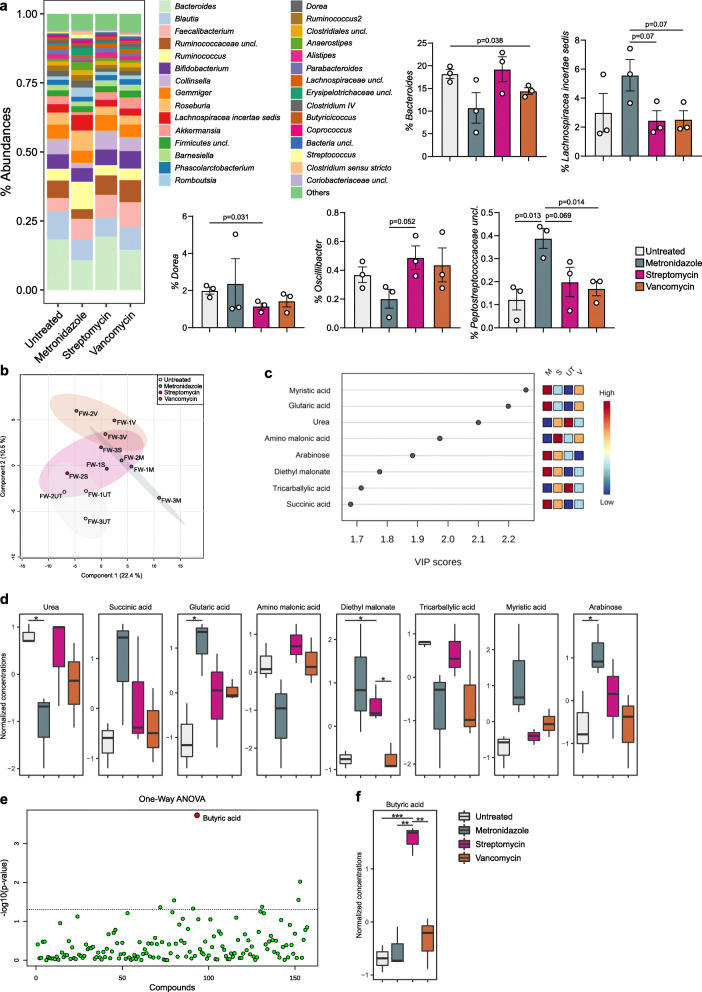
Fig. 5
Gut microbiota composition and metabolomics analysis of the antibiotics-conditioned human fecal samples used for the ex vivo experiments. a Mean relative abundance at genus level of the antibiotics-conditioned human gut microbiota. All genera with relative abundance < 0.5% are reported together and labeled as “others.” b Significantly different taxa identified in the antibiotics-conditioned human gut microbiota. Exact p values are shown; unpaired t test. c Partial least square discriminant analysis showing clustered fecal water samples according to the type of antibiotic treatment. d Metabolites that differentiate samples according to treatment by variable important in projection (VIP) scores. e Normalized concentrations of metabolites with the highest discriminative power (VIP score > 1.5) for the classification of samples according to the type of treatment. f One-way analysis of variance; red dots indicate the significant metabolites (p < 0.05) after FDR-correction. g Normalized concentration of butyric acid as measured in FW samples. *p < 0.05, **p < 0.01, *** < 0.001; unpaired t test

References

    1. Kamada N, Seo SU, Chen GY, Nunez G. Role of the gut microbiota in immunity and inflammatory disease. Nat Rev Immunol. 2013;13(5):321–335. doi: 10.1038/nri3430. - DOI - PubMed
    1. Modi SR, Collins JJ, Relman DA. Antibiotics and the gut microbiota. J Clin Invest. 2014;124(10):4212–4218. doi: 10.1172/JCI72333. - DOI - PMC - PubMed
    1. Baumler AJ, Sperandio V. Interactions between the microbiota and pathogenic bacteria in the gut. Nature. 2016;535(7610):85–93. doi: 10.1038/nature18849. - DOI - PMC - PubMed
    1. Rakoff-Nahoum S, Paglino J, Eslami-Varzaneh F, Edberg S, Medzhitov R. Recognition of commensal microflora by toll-like receptors is required for intestinal homeostasis. Cell. 2004;118(2):229–241. doi: 10.1016/j.cell.2004.07.002. - DOI - PubMed
    1. Scott NA, Andrusaite A, Andersen P, Lawson M, Alcon-Giner C, Leclaire C, Caim S, Le Gall G, Shaw T, Connolly JPR, et al. Antibiotics induce sustained dysregulation of intestinal T cell immunity by perturbing macrophage homeostasis. Sci Transl Med. 2018;10(464):eaao4755. doi: 10.1126/scitranslmed.aao4755. - DOI - PMC - PubMed

Publication types

MeSH terms