


Obesity as a risk factor for unfavourable outcomes in critically ill patients affected by Covid 19
- PMID: 33549439
- PMCID: PMC7677044
- DOI: 10.1016/j.numecd.2020.11.012
Obesity as a risk factor for unfavourable outcomes in critically ill patients affected by Covid 19
Abstract
Background and aims: Recent studies show that obesity is a risk factor for hospital admission and for critical care need in patients with coronavirus disease 2019 (COVID-19). The aim was to determine whether obesity is a risk factor for unfavourable health outcomes in patients affected by COVID-19 admitted to ICU.
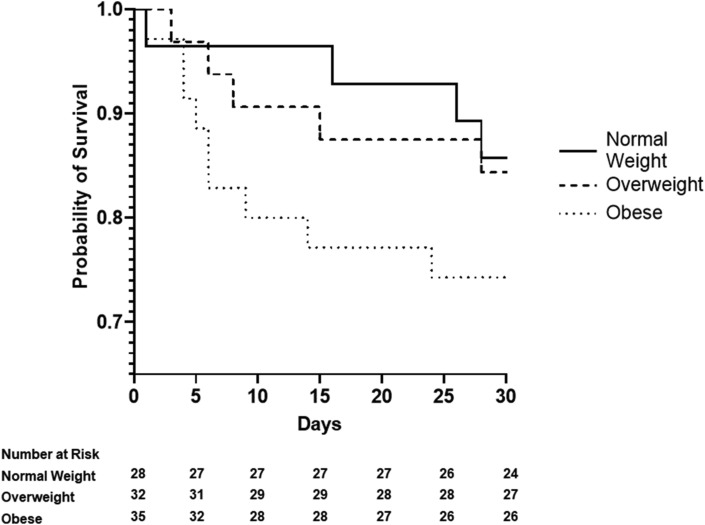
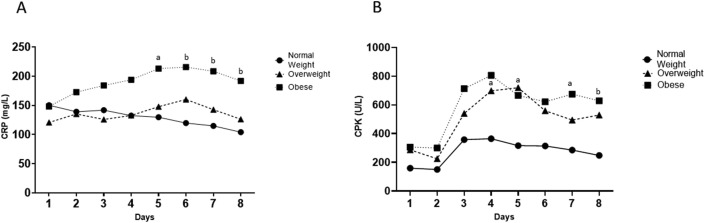
Methods and results: 95 consecutive patients with COVID-19 (78 males and 18 females) were admitted to ICU and included in the study. Height, weight, BMI, Sequential Organ Failure Assessment (SOFA) and Acute Physiology and Chronic Health Evaluation II (APACHE II) scores, CRP, CPK, ICU and hospital length of stay and comorbidities were evaluated. Participants with obesity had a lower 28 day survival rate from ICU admission than normal weight subjects. Cox proportional hazard model-derived estimates, adjusted for age, gender and comorbidity, confirmed the results of the survival analysis (HR:5.30,95%C.I.1.26-22.34). Obese subjects showed longer hospital and ICU stay as compared with normal weight counterpart.Subjects with obesity showed significantly higher CRP and CPK levels than normal weight subjects.
Conclusion: In individuals with obesity, careful management and prompt intervention in case of suspected SARS-CoV-2 infection is necessary to prevent the progression of the disease towards severe outcomes and the increase of hospital treatment costs.
Keywords: Body mass index; COVID-19; Intensive care unit; Obesity; SARS-CoV-2.
Copyright © 2020 The Italian Diabetes Society, the Italian Society for the Study of Atherosclerosis, the Italian Society of Human Nutrition and the Department of Clinical Medicine and Surgery, Federico II University. Published by Elsevier B.V. All rights reserved.
Conflict of interest statement
Declaration of Competing Interest None.
Figures
Comment in
-
Leptin as a potential prognostic marker of the severity of COVID-19 infection in obese patients.Nutr Metab Cardiovasc Dis. 2022 Mar;32(3):743-744. doi: 10.1016/j.numecd.2021.12.003. Epub 2021 Dec 10. Nutr Metab Cardiovasc Dis. 2022. PMID: 35109999 Free PMC article. No abstract available.
References
-
- Wu Z., McGoogan J.M. Characteristics of and important lessons from the coronavirus disease 2019 (COVID-19) outbreak in China: summary of a report of 72,314 cases from the Chinese Center for Disease Control and Prevention. JAMA. 2020;323:1239–1242. - PubMed
-
- Cai Q., Chen F., Wang T., Luo F., Liu X., Wu Q. Obesity and COVID-19 severity in a designated hospital in Shenzhen, China. Diabetes Care. 2020;43:1392–1398. - PubMed
-
- Petrilli C.M., Jones S.A., Yang J., Rajagopalan H., O’Donnell L., Chernyak Y. Factors associated with hospitalization and critical illness among 4,103 patients with Covid-19 disease in New York City. Br Med J. 2020;22:369.
-
- Di Castelnuovo A., Bonaccio M., Costanzo S., Gialluisi A., Antinori A., Berselli N. COvid-19 RISk and Treatments (CORIST) collaboration. Common cardiovascular risk factors and in-hospital mortality in 3,894 patients with COVID-19: survival analysis and machine learning-based findings from the multicentre Italian CORIST Study. Nutr Metab Cardiovasc Dis. 2020;30:1899–1913. - PMC - PubMed
MeSH terms
LinkOut - more resources
Full Text Sources
Other Literature Sources
Medical
Research Materials
Miscellaneous
