Meta-Analysis
. 2021 Mar;82(3):329-338.
doi: 10.1016/j.jinf.2021.01.022. Epub 2021 Feb 4.

COVID-19 in immunocompromised patients: A systematic review of cancer, hematopoietic cell and solid organ transplant patients

Affiliations
Meta-Analysis

COVID-19 in immunocompromised patients: A systematic review of cancer, hematopoietic cell and solid organ transplant patients

Jennifer A Belsky et al. J Infect. 2021 Mar.

Abstract

Background: The clinical impact of severe coronavirus disease 2019 (COVID-19), caused by severe acute respiratory syndrome coronavirus 2 (SARS-CoV-2), in immunocompromised patients has not been systematically evaluated.

Methods: We reviewed current literature reporting on COVID-19 in cancer (CA), hematopoietic cell (HCT), and solid organ transplant (SOT) patients and compared their clinical data and outcomes to the general population. For adult CA, HCT and SOT patients, an extensive search strategy retrieved all articles published until July 20, 2020 by combining the terms coronavirus, coronavirus infection, COVID-19, and SARS-CoV-2 in PubMed, Cochrane, and Web of Science, and following the Preferred Reporting Items for Systematic Reviews and Meta-analysis guidelines. For the pediatric CA cohort, a global COVID-19 registry was used. For the general population cohort, a large meta-analysis was used to compare pooled prevalence estimates, and two large meta-analyses were utilized to serve as pooled comparators for hospitalized COVID-19 patients.

Findings: Compared to the general population, adult CA and SOT patients with COVID-19 had higher comorbidities, greater levels of inflammatory markers at diagnosis, and higher rates of intensive care and hospital mortality. Pediatric CA patients and HCT patients with COVID-19 tended to have clinical presentations and outcomes similar to the general population.

Interpretation: To our knowledge, this is the first systematic review evaluating COVID-19 phenotype and outcomes in immunocompromised patients and comparing them to the general population, which shows that hospital outcomes appear to be worse in adult CA and SOT patients, potentially due to their higher co-morbidity burden.

Funding: None.


Conflict of interest statement

Declaration of Competing Interest The authors report no conflicts of interest relevant to the published work.

Figures
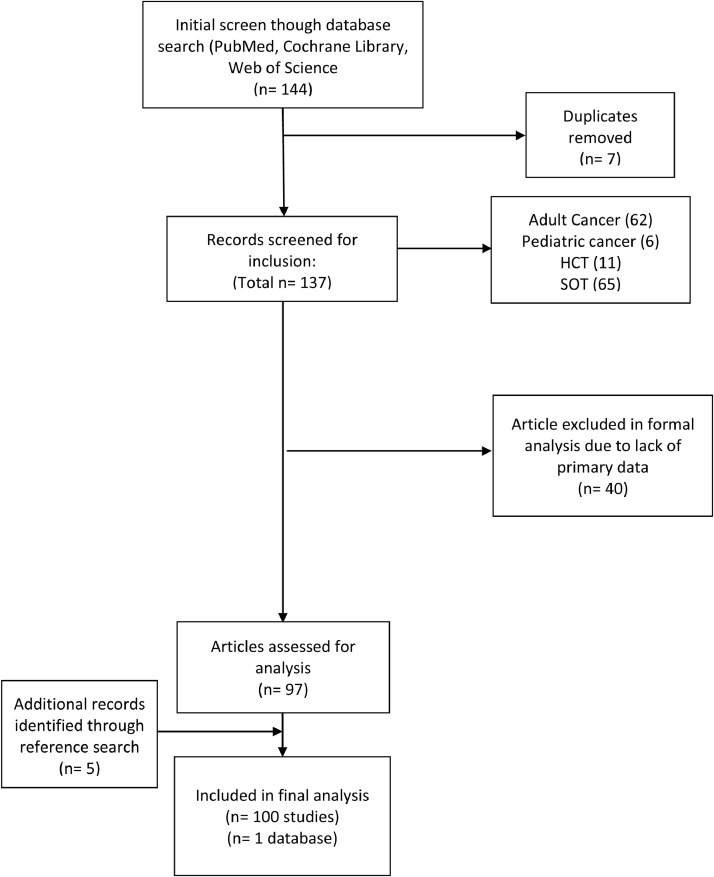
Fig. 1
Fig. 1
PRISMA Diagram.
Fig. 2
Fig. 2
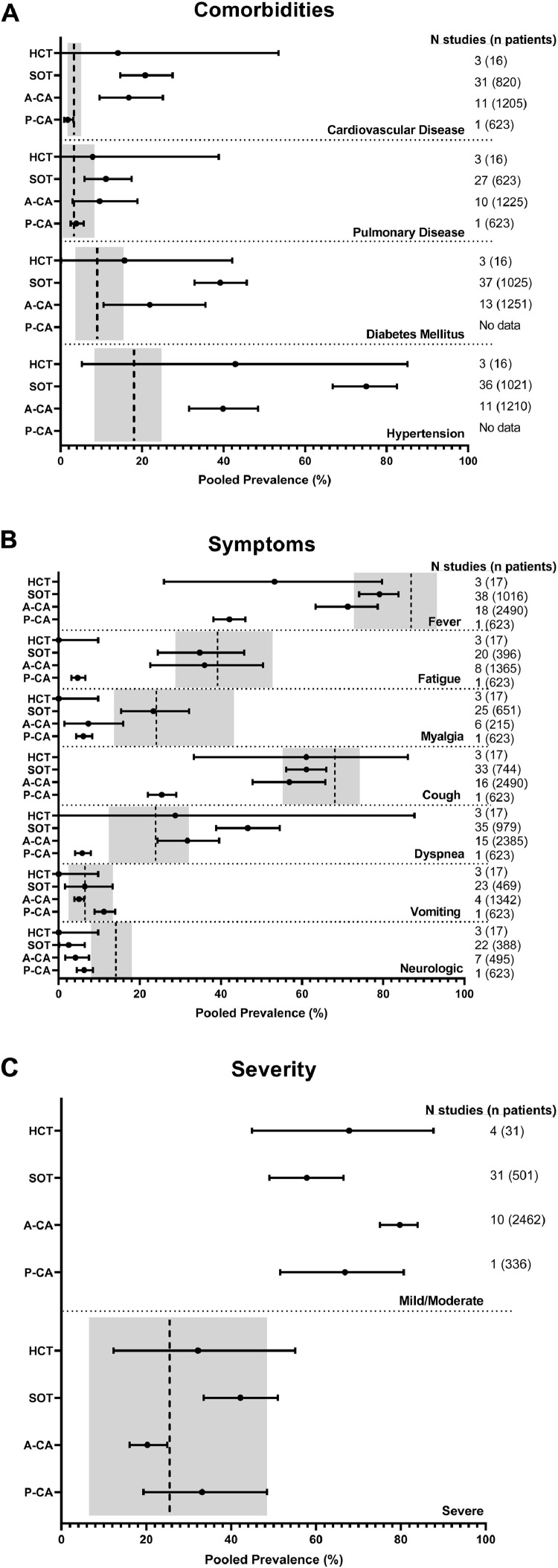
Characteristics of immunocompromised patients with COVID-19 compared to the general population with COVID-19. Pooled prevalence estimates from multiple studies in HCT, SOT, A-CA, and P-CA patients for (Panel A) patient comorbidities, (Panel B) COVID-19 symptoms, and (Panel C) COVID-19 severity are depicted as dots with bars indicating the 95% confidence intervals. The vertical hatched line indicates the comparable pooled prevalence for the similar measure in the general population with 95% confidence intervals indicated by the gray box as reported by Pormohammad et al. For Fig. 2C, data from the Pormohammad et al. meta-analysis only permitted pooled prevalence comparison for severe disease, not mild/moderate.
Fig. 3
Fig. 3
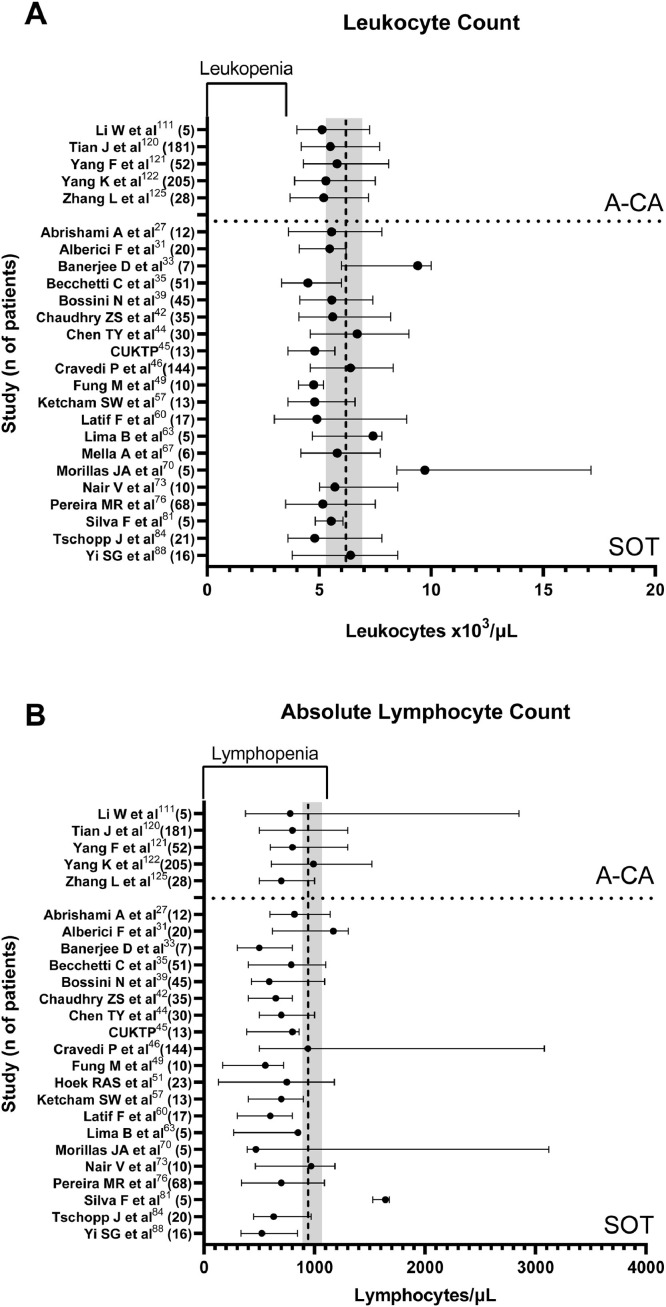
Leukocyte indices of SOT recipients and A-CA patients with COVID-19. The reported median (filled circle) and interquartile range (line) for (Panel A) leukocyte count (leukocytes x103/μL) and (Panel B) absolute lymphocyte counts (lymphocytes/μL) as reported in studies where this data was reported as such or could be calculated from individual patient data. These time of collection of these laboratory values differed amongst studies.  Where multiple values were reported, the value with greatest severity was selected for comparison.  The vertical hatched line indicates the comparable median in the general population with interquartile range indicated by the gray box as reported by Pormohammad et al.  The inverted bracket on the upper x axis indicates the leukopenia and lymphopenia ranges for A and B, respectively. CUKTP: Columbia University Kidney Transplant Program.
Fig. 4
Fig. 4
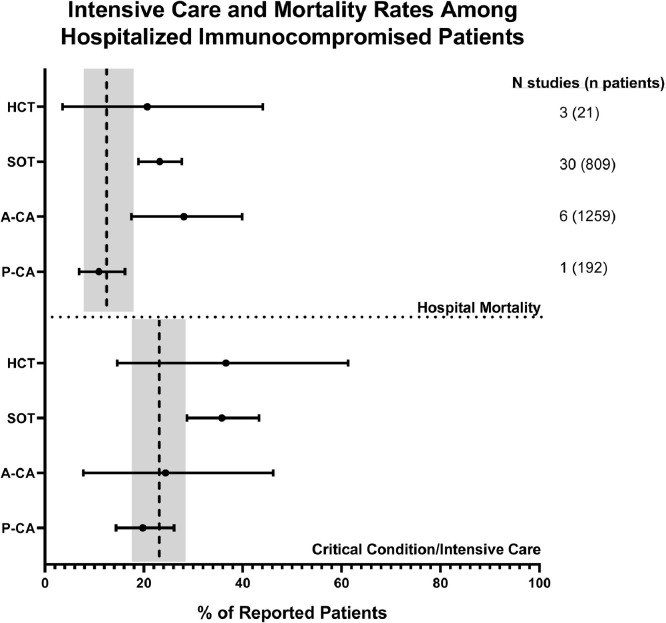
Intensive care and mortality rates among hospitalized immunocompromised patients. Pooled prevalence estimates of need for intensive care and mortality were calculated from patient data exclusively on hospitalized immunocompromised patients from those studies where such data was explicitly reported. The pooled prevalence is depicted as a filled circle with the bar representing 95% confidence intervals. Data from two large studies, (total n = 11,721) of hospitalized COVID-19 patients from the general population were utilized to calculate comparable pooled prevalence estimates (vertical hatched line) and 95% confidence intervals (respective gray bars).

References

    1. Organization W.H. WHO Coronavirus disease (COVID-19) dashboard. 2020. https://covid19.who.int/(accessed 9/11/2020.
    1. Zhou Y., Yang Q., Chi J. Comorbidities and the risk of severe or fatal outcomes associated with coronavirus disease 2019: a systematic review and meta-analysis. Int J Infect Dis. 2020;99:47–56. - PMC - PubMed
    1. Richardson S., Hirsch J.S., Narasimhan M. Presenting characteristics, comorbidities, and outcomes among 5700 patients hospitalized with COVID-19 in the New York City Area. JAMA. 2020 - PMC - PubMed
    1. Grasselli G., Zangrillo A., Zanella A. Baseline characteristics and outcomes of 1591 patients infected with SARS-CoV-2 admitted to ICUs of the Lombardy region, Italy. JAMA. 2020 - PMC - PubMed
    1. Zhang J.J.Y., Lee K.S., Ang L.W., Leo Y.S., Young B.E. Risk factors of severe disease and efficacy of treatment in patients infected with COVID-19: a systematic review, meta-analysis and meta-regression analysis. Clin Infect Dis. 2020 - PMC - PubMed