Review
. 2021 May;82(5):362-370.
doi: 10.1016/j.humimm.2021.01.004. Epub 2021 Feb 5.

Review of the immune mechanisms of preeclampsia and the potential of immune modulating therapy

Affiliations
Review

Review of the immune mechanisms of preeclampsia and the potential of immune modulating therapy

Ai-Ris Y Collier et al. Hum Immunol. 2021 May.

Abstract

Successful pregnancy relies on maternal immunologic tolerance mechanisms limit maladaptive immune responses against the semi-allogeneic fetus and placenta and support fetal growth. Preeclampsia is a common disorder of pregnancy that affects 4-10% of pregnancies and is a leading cause of maternal and neonatal morbidity and mortality. Preeclampsia clinically manifests as maternal hypertension, proteinuria, and progressive multi-organ injury likely triggered by hypoxic injury to the placenta, resulting in local and systemic anti-angiogenic and inflammatory factor production. Despite the steady rising rates of preeclampsia in the United States, effective treatment options are limited to delivery, which improves maternal status often at the cost of prematurity in the newborn. Preeclampsia also increases the lifelong risk of cardiovascular disease for both mother and infant. Thus, identifying new therapeutic targets is a high priority area to improve maternal, fetal, and infant health outcomes. Immune abnormalities in the placenta and in the maternal circulation have been reported to precede the clinical onset of disease. In particular, excessive systemic and placental complement activation and impaired adaptive T cell tolerance with Th1/Th2/Th17/Treg imbalance has been reported in humans and in animal models of preeclampsia. In this review, we focus on the evidence for the immune origins of preeclampsia, discuss the promise of immune modulating therapy for prevention or treatment, and highlight key areas for future research.

Keywords: Complement; Immune modulation; Preeclampsia; Pregnancy; Regulatory T cells.


Conflict of interest statement

Declaration of Competing Interest Dr. Karumanchi is co-listed as co-inventors on patents related to preeclampsia biomarkers that are held at Beth Israel Deaconess Medical Center. He has financial interest in Aggamin LLC and also reports serving as a consultant to Roche Diagnostics and Thermofisher. Dr. Karumanchi has received research funding from Siemens and Thermofisher. Other authors report no conflicts.

Figures
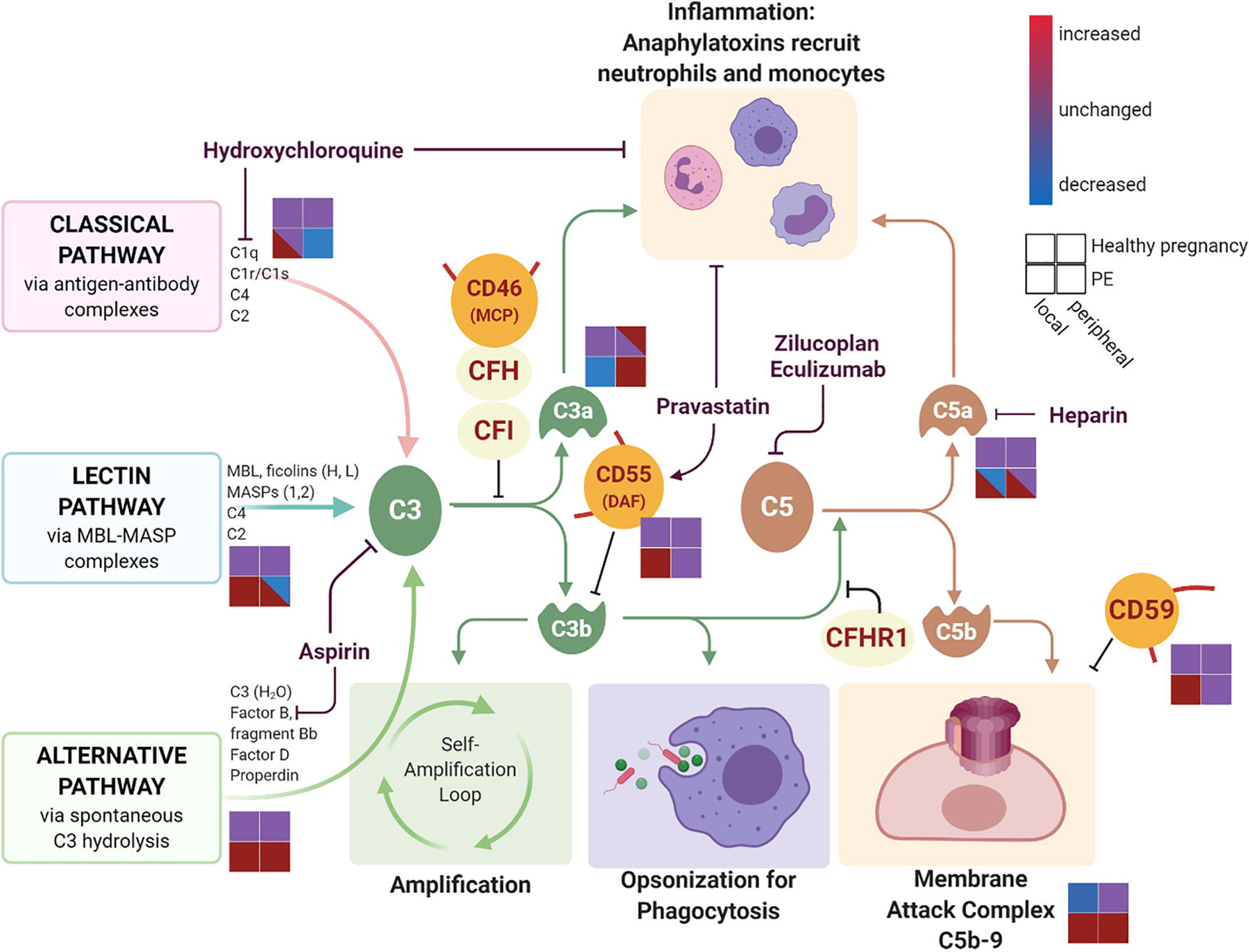
Figure 1.
Figure 1.. Local and systemic complement activation in preeclampsia and healthy pregnancy and complement-modulating medications
The complement cascade is initiated through the classical, lectin, and alternative pathways. Complement activation results in inflammation primarily mediated through anaphylatoxins C3a and C5a, pathogen opsonization for phagocytosis via C3b, and cell lysis through the terminal membrane attack complex formation. Endogenous soluble regulators of complement activation (CFH, CFI, CFHR1) and membrane-bound regulators (MCP, DAF, and CD59) work through inhibition of the complement pathway at different steps. Various pharmacologic agents also target the complement activation at different steps. Schematic for the level of complement component activation is represented for healthy pregnancy (upper two squares) and in preeclampsia (PE, lower two squares) and separated by local decidua complement activation (left squares) and peripheral complement activation (right squares). Complement component levels are increased (red), decreased (blue), or unchanged (purple) depending on the disease state and location in pregnancy. Created with BioRender.com
Figure 2.
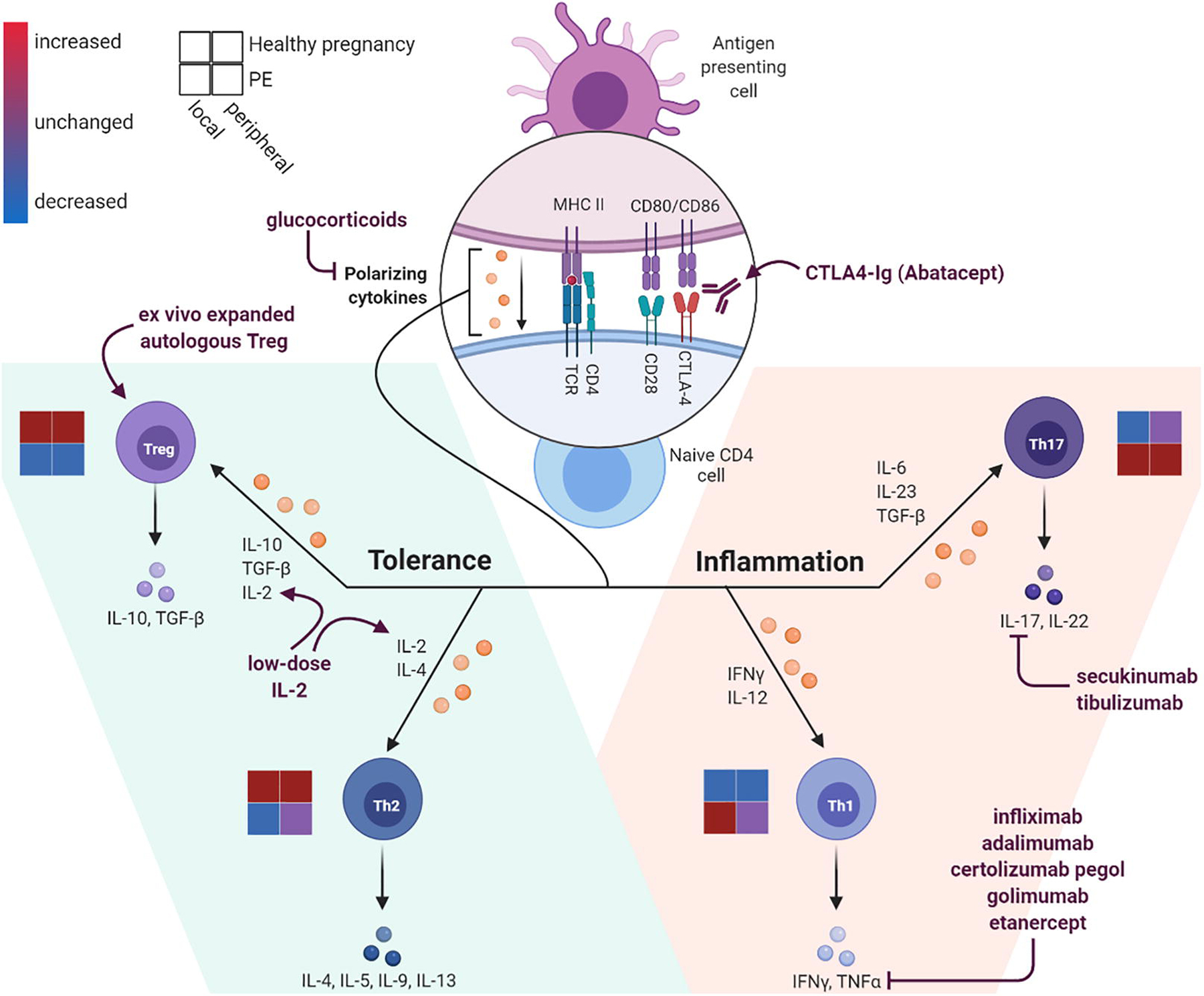
Figure 2.. T helper cell changes locally and peripherally in healthy pregnancy and preeclampsia
When naïve CD4 T cells interface with cognate antigen-MHC complexes, the presence of co-stimulatory (CD28) and co-inhibitory (CTLA-4) activation along with type of polarizing cytokines present will determine the helper T cell (Th) subset differentiation. Regulatory T cells (Treg) and Th2 polarization favors a more suppressive, immune tolerant state (left); whereas Th1 in and Th17 polarization favors a more pro-inflammatory state (right). Various immune modulating medications have been developed to promote differentiation into Treg and Th2 subsets and to inhibit inflammatory Th1 and Th17 differentiation or inhibit resultant cytokines. Schematic for the level of Th pathway activation is represented for healthy pregnancy (upper squares) and in preeclampsia (PE, lower squares) and separated by local decidua T cell activation (left squares) and peripheral T cell activation (right squares). Levels of Th subset activation are increased (red), decreased (blue), or unchanged (purple) depending on the disease state and location in pregnancy. Created with BioRender.com

References

    1. PrabhuDas M et al. Immune mechanisms at the maternal-fetal interface: perspectives and challenges vol. 16 328–334 (Nature Publishing Group, 2015). - PMC - PubMed
    1. Ander SE, Diamond MS & Coyne CB Immune responses at the maternal-fetal interface. Sci. Immunol 4, (2019). - PMC - PubMed
    1. Khosrotehrani K & Bianchi DW Multi-lineage potential of fetal cells in maternal tissue: A legacy in reverse. J. Cell Sci (2005) doi:10.1242/jcs.02332. - DOI - PubMed
    1. Bianchi DW et al. Genome-wide fetal aneuploidy detection by maternal plasma DNA sequencing. Obs. Gynecol 119, 890–901 (2012). - PubMed
    1. Lo YM et al. Maternal plasma DNA sequencing reveals the genome-wide genetic and mutational profile of the fetus. Sci Transl Med 2, 61ra91 (2010). - PubMed