


Efficacy and safety of allogenic canine adipose tissue-derived mesenchymal stem cell therapy for insulin-dependent diabetes mellitus in four dogs: A pilot study
- PMID: 33551441
- PMCID: PMC8111340
- DOI: 10.1292/jvms.20-0195
Efficacy and safety of allogenic canine adipose tissue-derived mesenchymal stem cell therapy for insulin-dependent diabetes mellitus in four dogs: A pilot study
Abstract
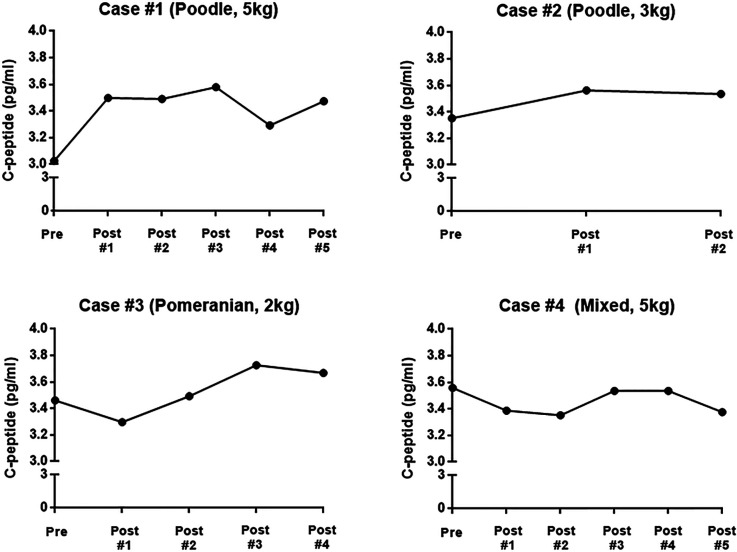
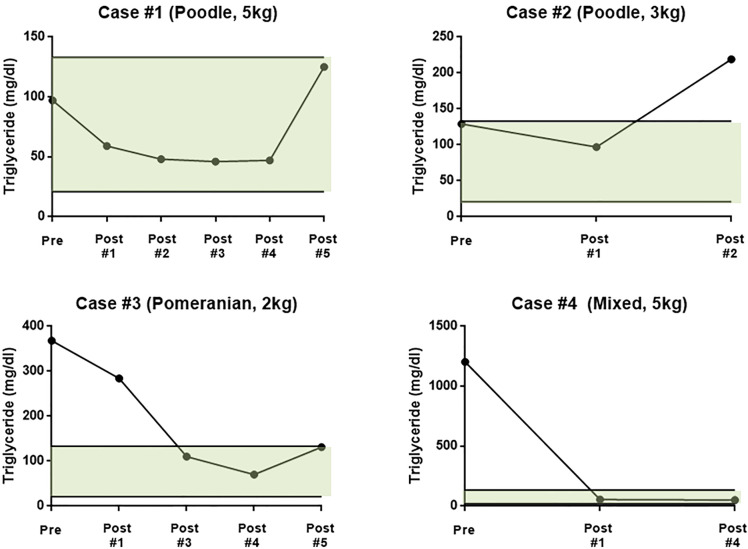
Mesenchymal stem cells (MSCs) possess regenerative and immunomodulatory properties and can control the immune dysregulation that leads to β-cell destruction. Stem-cell transplantation could thus manage insulin-dependent diabetes mellitus (IDDM) in dogs. In this pilot study, we aimed to assess canine adipose tissue-derived MSCs (cAT-MSCs) transplantation as a treatment for canine diabetes mellitus. This study included four dogs with over a year of insulin treatment for IDDM, following diagnosis at the Veterinary Medicine Teaching Hospital of Seoul National University. Allogenic cAT-MSCs were infused intravenously three or five times monthly to dogs with IDDM. Blood and urine samples were obtained monthly. General clinical symptoms, including changes in body weight, vitality, appetite, and water intake were assessed. Three of the four owners observed improvement of vitality after stem cell treatment. Two of the four dogs showed improvement in appetite and body weight, polyuria, and polydipsia. C-peptide has increased by about 5-15% in three of the cases, and fructosamine and HbA1c levels have improved in two of the cases. Hyperlipidemia was resolved in two of the dogs, and there was no concurrent bacterial cystitis in any of the dogs. C-peptide secretion and lipid metabolism are associated with diabetic complications. Improvement in these parameters following the treatment suggests that cAT-MSC transplantation in dogs with IDDM might help to improve their insulin secretory capacity and prevent diabetic complications.
Keywords: C-peptide; diabetes mellitus; dog; hyperlipidemia; mesenchymal stem cell.
Conflict of interest statement
The authors have nothing to disclose.
Figures
References
-
- Ahlgren K. M., Fall T., Landegren N., Grimelius L., von Euler H., Sundberg K., Lindblad-Toh K., Lobell A., Hedhammar Å., Andersson G., Hansson-Hamlin H., Lernmark Å., Kämpe O.2014. Lack of evidence for a role of islet autoimmunity in the aetiology of canine diabetes mellitus. PLoS One 9: e105473. doi: 10.1371/journal.pone.0105473 - DOI - PMC - PubMed
-
- Alejandro R., Feldman E. C., Shienvold F. L., Mintz D. H.1988. Advances in canine diabetes mellitus research: etiopathology and results of islet transplantation. J. Am. Vet. Med. Assoc. 193: 1050–1055. - PubMed
-
- Atkins C. E., Hill J. R., Johnson R. K.1979. Diabetes mellitus in the juvenile dog: a report of four cases. J. Am. Vet. Med. Assoc. 175: 362–368. - PubMed
-
- Atkins C. E., LeCompte P. M., Chin H. P., Hill J. R., Ownby C. L., Brownfield M. S.1988. Morphologic and immunocytochemical study of young dogs with diabetes mellitus associated with pancreatic islet hypoplasia. Am. J. Vet. Res. 49: 1577–1581. - PubMed
MeSH terms
LinkOut - more resources
Full Text Sources
Other Literature Sources
Medical
Miscellaneous
