


SARS-CoV-2 is rapidly inactivated at high temperature
- PMID: 33551702
- PMCID: PMC7856623
- DOI: 10.1007/s10311-021-01187-x
SARS-CoV-2 is rapidly inactivated at high temperature
Abstract
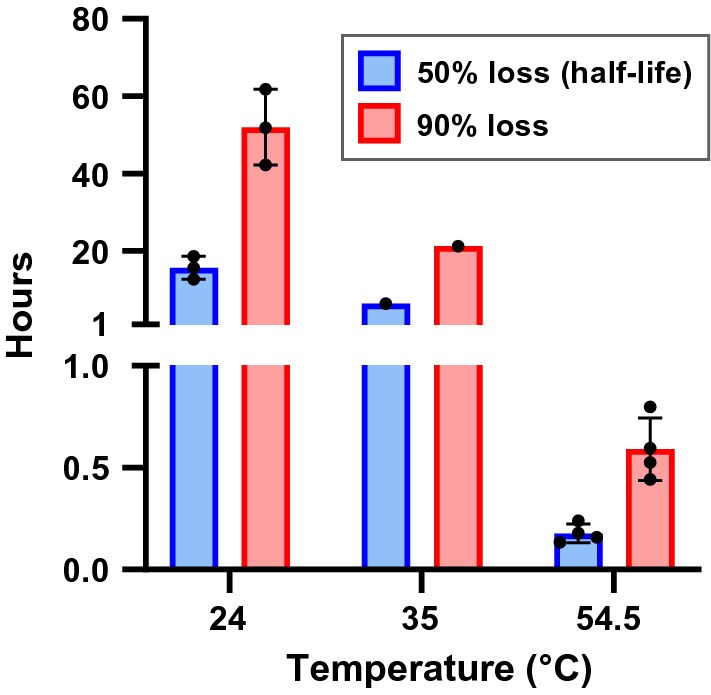
In the absence of a vaccine, preventing the spread of the severe acute respiratory syndrome coronavirus 2 (SARS-CoV-2) is the primary means to reduce the impact of the 2019 coronavirus disease (COVID-19). Multiple studies have reported the presence of SARS-CoV-2 genetic material on surfaces suggesting that fomite transmission of SARS-CoV-2 is feasible. High temperature inactivation of virus has been previously suggested, but not shown. In the present study, we investigated the environmental stability of SARS-CoV-2 in a clinically relevant matrix dried onto stainless steel at a high temperature. The results show that at 54.5 °C, the virus half-life was 10.8 ± 3.0 min and the time for a 90% decrease in infectivity was 35.4 ± 9.0 min. These findings suggest that in instances where the environment can reach temperatures of at least 54.5 °C, such as in vehicle interior cabins when parked in warmer ambient air, that the potential for exposure to infectious virus on surfaces could be decreased substantially in under an hour.
Keywords: COVID-19; Coronavirus; Environmental decay; Heat; SARS-CoV-2; Viral inactivation.
© The Author(s) 2021.
Conflict of interest statement
Conflicts of interestThe authors declare no conflict of interest. DHS S & T staff performed a review of this manuscript prior to submission and provided editorial feedback.
Figures
References
-
- Ben-Shmuel A, Brosh-Nissimov T, Glinert I, Bar-David E, Sittner A, Poni R, Cohen R, Achdout H, Tamir H, Yahalom-Ronen Y, Politi B, Melamed S, Vitner E, Cherry L, Israeli O, Beth-Din A, Paran N, Israely T, Yitzhaki S, Levy H, Weiss S. Detection and infectivity potential of severe acute respiratory syndrome coronavirus 2 (SARS-CoV-2) environmental contamination in isolation units and quarantine facilities. Clin Microbiol Infect. 2020;26(12):1658–1662. doi: 10.1016/j.cmi.2020.09.004. - DOI - PMC - PubMed
-
- Biryukov J, Boydston JA, Dunning RA, Yeager JJ, Wood S, Reese AL, Ferris A, Miller D, Weaver W, Zeitouni NE, Phillips A, Freeburger D, Hooper I, Ratnesar-Shumate S, Yolitz J, Krause M, Williams G, Dawson DG, Herzog A, Dabisch P, Wahl V, Hevey MC, Altamura LA. Increasing temperature and relative humidity accelerates inactivation of SARS-CoV-2 on surfaces. mSphere. 2020 doi: 10.1128/mSphere.00441-20. - DOI - PMC - PubMed
-
- Chia PY, Coleman KK, Tan YK, Ong SWX, Gum M, Lau SK, Lim XF, Lim AS, Sutjipto S, Lee PH, Son TT, Young BE, Milton DK, Gray GC, Schuster S, Barkham T, De PP, Vasoo S, Chan M, Ang BSP, Tan BH, Leo YS, Ng OT, Wong MSY, Marimuthu K, Singapore T, Novel Coronavirus Outbreak Research (2020) Detection of air and surface contamination by SARS-CoV-2 in hospital rooms of infected patients. Nat Commun 11(1): 2800 DOI: 10.1038/s41467-020-16670-2 - PMC - PubMed
-
- Ford Motor Company (2020) Packing heat: how ford’s latest tech helps police vehicles neutralize COVID-19. Retrieved from 25 Aug 2020 https://media.ford.com/content/fordmedia/fna/us/en/news/2020/05/27/ford-...
LinkOut - more resources
Full Text Sources
Other Literature Sources
Medical
Miscellaneous