Review
. 2021 Jan 21:11:612396.
doi: 10.3389/fendo.2020.612396. eCollection 2020.

Natural Compounds in Sex Hormone-Dependent Cancers: The Role of Triterpenes as Therapeutic Agents

Affiliations
Review

Natural Compounds in Sex Hormone-Dependent Cancers: The Role of Triterpenes as Therapeutic Agents

Codruţa Şoica et al. Front Endocrinol (Lausanne). .

Abstract

Sex hormone-dependent cancers currently contribute to the high number of cancer-related deaths worldwide. The study and elucidation of the molecular mechanisms underlying the progression of these tumors was a double-edged sword, leading to the expansion and development of new treatment options, with the cost of triggering more aggressive, therapy resistant relapses. The interaction of androgen, estrogen and progesterone hormones with specific receptors (AR, ER, PR) has emerged as a key player in the development and progression of breast, ovarian, prostate and endometrium cancers. Sex hormone-dependent cancers share a common and rather unique carcinogenesis mechanism involving the active role of endogenous and exogenous sex hormones to maintain high mitotic rates and increased cell proliferation thus increasing the probability of aberrant gene occurrence and accumulation highly correlated with abnormal cell division and the occurrence of malignant phenotypes. Cancer related hormone therapy has evolved, currently being associated with the blockade of other signaling pathways often associated with carcinogenesis and tumor progression in cancers, with promising results. However, despite the established developments, there are still several shortcomings to be addressed. Triterpenes are natural occurring secondary metabolites biosynthesized by various pathways starting from squalene cyclization. Due to their versatile therapeutic potential, including the extensively researched antiproliferative effect, these compounds are most definitely a cornerstone in the research and development of new natural/semisynthetic anticancer therapies. The present work thoroughly describes the ongoing research related to the antitumor activity of triterpenes in sex hormone-dependent cancers. Also, the current review highlights both the biological activity of various triterpenoid compounds and their featured mechanisms of action correlated with important chemical structural features.

Keywords: antiproliferative activity; hormone-dependent cancers; phytocompounds; therapeutic agents; triterpenes.


Conflict of interest statement

The authors declare that the research was conducted in the absence of any commercial or financial relationships that could be construed as a potential conflict of interest.

Figures
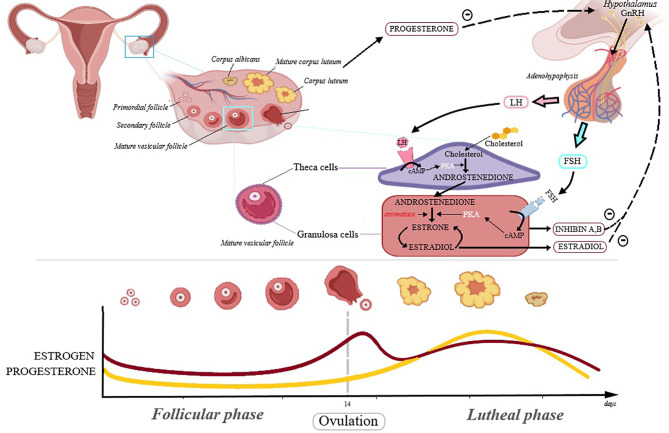
Figure 1
Figure 1
The hormonal interaction at ovary level. In the first phase of the menstrual cycle, called follicular phase, the follicle-stimulating hormone (FSH) concentration is increasing as follicles maturate, reaching a maximum during ovulation. FSH binds to the FSH receptor in the granulosa cells influencing androstenedione conversion to estradiol. The luteinizing hormone (LH) triggers ovulation and its levels are maximum during this phase. LH binds to the LH receptors from theca cells and promotes conversion of cholesterol into androstenedione. Inhibin A and B are members of transforming growth factor beta (TGFB) family and regulate FSH activity. The corpus luteum is formed after ovulation and secrets progesterone. During most of the menstrual cycle, the neuroendocrine output (from hypothalamus and adenohypophysis) is modulated by negative feed-back from progesterone and estrogen.
Figure 2
Figure 2
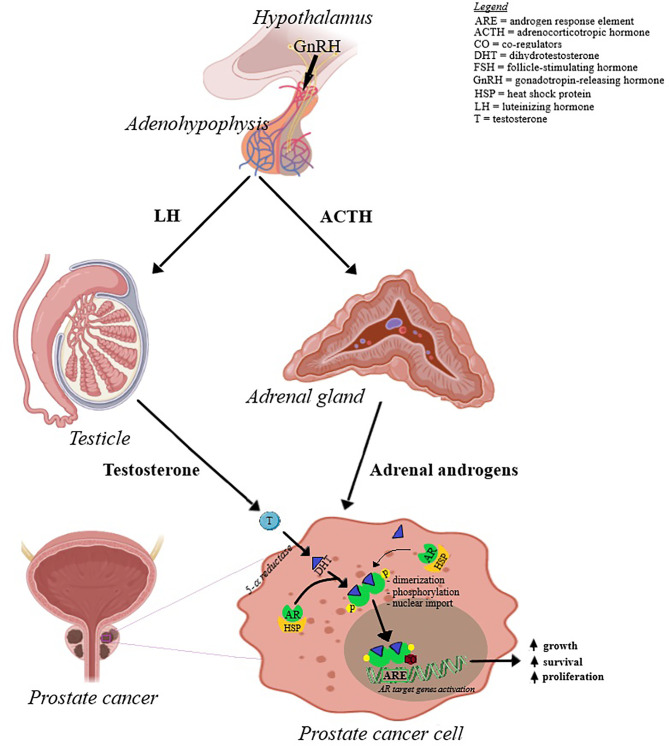
The mechanisms involved in prostate cancer development. Androgens are produced by the adrenal glands and testicles under the influence of adrenocorticotropic hormone (ACTH) and luteinizing hormone (LH), respectively. ACTH and LH release from adenohypophysis are under the control of hypothalamic gonadotropin-releasing hormone (GnRH). Androgens, mainly testosterone, is converted in dihydrotestosterone (DHT) that enters prostate cancer cell. The inactive form of androgen receptor (AR) resides in the cell cytoplasm, due to its binding to heat shock protein 90 (HSP). AR binds to the dihydrotestosterone (DHT) and dissociates from HSP. Ligand-bound AR then suffers dimerization, phosphorylation by MAPK and is translocated to the nucleus by an intrinsic nuclear localization signal. At the nuclear level, AR interacts with the androgen response element (ARE) and controls target gene expression.
Figure 3
Figure 3
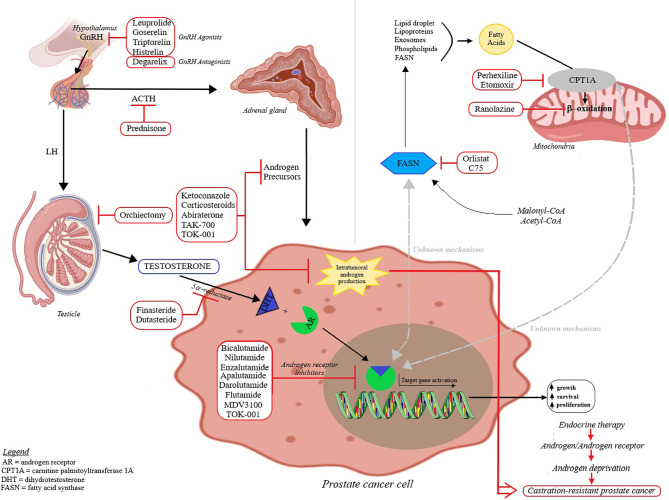
The endocrine therapy in prostate cancer and approved therapies – the mechanism of action of androgen deprivation therapy and lipid metabolism involvement in prostate cancer. The majority of the total available testosterone (90-95%) is produced by the testicles and the reminder by the adrenal glands. Testosterone is converted by 5α-reductase to dihydrotestosterone (DHT) that binds inside the cell to the androgen receptor (AR) and translocate to the nucleus. Upon binding to the androgen response element, it acts as a transcription factor and signals downstream targets. Androgens are known to regulate the activity of carnitine palmitoyltransferase 1A (CPT1A) and fatty acid synthase (FASN); the balance between fat synthesis and oxidation is also modulated by the tumor environment. A better understanding of this tumor dependency can improve the potency of anticancer agents that target lipid metabolism and can be used in combination with androgen deprivation therapy.
Figure 4
Figure 4
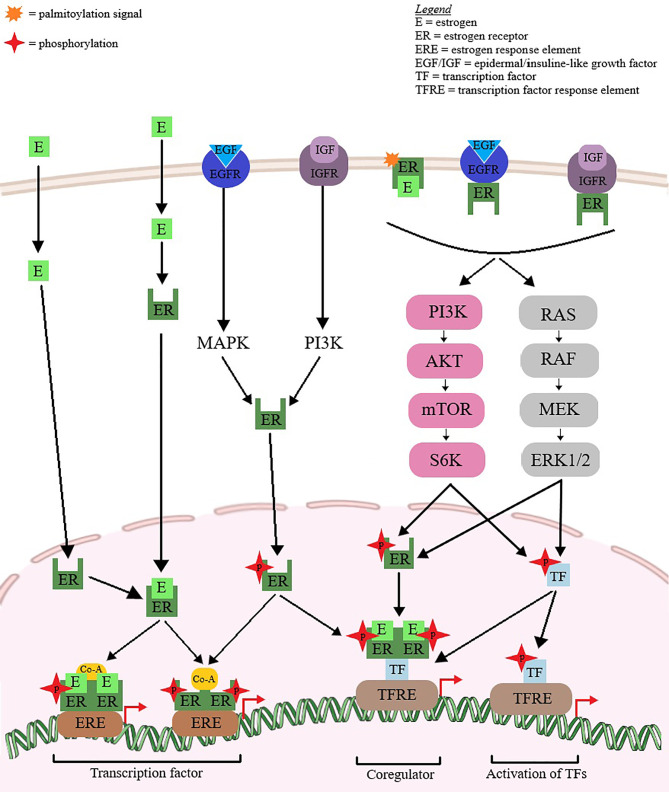
Hormone-dependent breast cancer progression via estrogen-mediated signaling pathways. Estrogen (E) binds to the estrogen receptor (ER). The ligand binding induces ER dimerization, phosphorylation and nuclear translocation to the ERE region. Coactivators are recruited and the complex affects gene transcription. ER can act as a coregulator for some transcription factors. ER phosphorylation and nuclear activity can also be produced by growth factors (EGF/IGF). The extranuclear ER can activate some transcription factor by interfering with PI3K, ERK1/2 and MAPK signaling pathways.
Figure 5
Figure 5
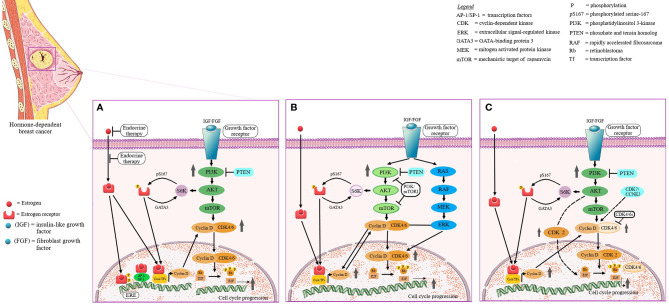
The identified signaling pathways involved in the mediation of sensitivity/resistance versus endocrine therapy. The signaling pathways that involve cyclin D—cyclin-dependent kinase 4 and 6 (CDK4/6)/6-INK4- retinoblastoma (Rb) and phosphatidylinositol-3 kinase/mechanistic target of rapamycin (PI3K/mTOR) play a central role in cell cycle progression, cellular differentiation, growth, survival and metabolism. Dysregulation of these pathways results in genetic/epigenetic alterations, increased proliferation and evasion of apoptosis, as observed in hormone receptor-positive breast cancer (HR)+, and have been involved in the development of endocrine therapy resistance. PI3K/mTOR pathway activates S6 kinase and leads to estrogen receptor (ER) signaling activation. Activation of ER pathway upregulates the protein expression of cyclin D, activates cyclin D—CDK4/6/6-INK4- Rb pathway and increases cell cycle progression (A). The resistance to PI3K/mTOR pathway inhibitors occurs via an aberrant activation of RAS/RAF/MEK/ERK pathway that produces an additional assembly of cyclin D-CDK4/6 complexes (B). In HR+ breast cancer the cyclin D - CDK4/6/6-INK4- Rb pathway, in particular cyclin D and CDK4, is overexpressed. Activation of PI3K/mTOR pathway leads to cyclin D upregulation, binding and activation of CDK2 (if CDK4/6 is absent) and consecutive Rb phosphorylation and cell cycle progression. CDK4/6 inhibitors have synergistic effects to endocrine therapy (C).
Figure 6
Figure 6
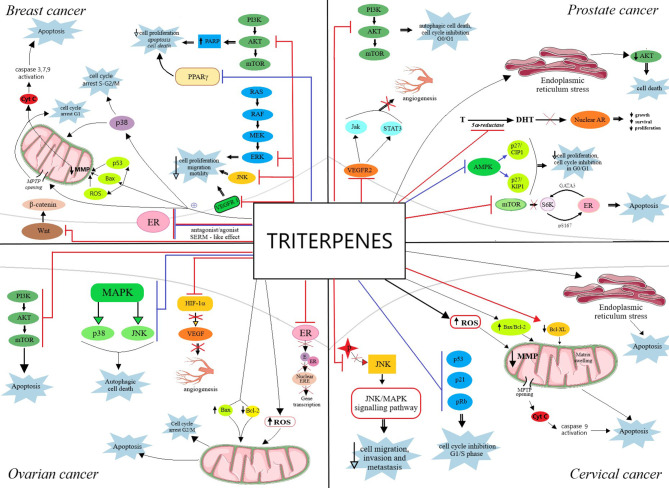
Overview of the oncogenic signaling pathways targeted by triterpenoids in reproductive hormones-dependent cancers: breast cancer, prostate cancer, ovarian cancer and cervical cancer. The red bars represent an inhibitory effect whereas blue bars represent a stimulatory effect. ER, estrogen receptor; E, estrogen; ERE, estrogen response element; AR, androgen receptor; Cyt c, cytochrome c; ROS, reactive oxygen species; T, testosterone; DHT, dihydrotestosterone. A more detailed explanation regarding the antiproliferative mechanism of action of triterpenes, in each type of cancer, is explained in detail in the main text.

References

    1. Méndez-Cuesta C, Campos A, Sánchez D, Pérez-González C, Gutiérrez S. Cytotoxic and Antitumoral Activities of Compounds Isolated from Cucurbitaceae Plants. In: Pharmacognosy - Medicinal Plants. IntechOpen; (2018). 10.5772/intechopen.82213 - DOI
    1. Król SK, Kiełbus M, Rivero-Müller A, Stepulak A. Comprehensive review on betulin as a potent anticancer agent. BioMed Res Int (2015) 2015:1–11. 10.1155/2015/584189 - DOI - PMC - PubMed
    1. Ulm M, Ramesh AV, McNamara KM, Ponnusamy S, Sasano H, Narayanan R. Therapeutic advances in hormone-dependent cancers: focus on prostate, breast and ovarian cancers. Endocr Connect (2019) 8:R10–26. 10.1530/EC-18-0425 - DOI - PMC - PubMed
    1. Folkerd EJ, Dowsett M. Influence of sex hormones on cancer progression. J Clin Oncol (2010) 28:4038–44. 10.1200/JCO.2009.27.4290 - DOI - PubMed
    1. McKenna NJ, Lanz RB, O’Malley BW. Nuclear Receptor Coregulators: Cellular and Molecular Biology*. Endocr Rev (1999) 20:321–44. 10.1210/edrv.20.3.0366 - DOI - PubMed

Publication types

MeSH terms