


Use of the six-minute walk test in exercise prescription in male patients after coronary artery bypass surgery
- PMID: 33552181
- PMCID: PMC7848618
- DOI: 10.5114/kitp.2020.102340
Use of the six-minute walk test in exercise prescription in male patients after coronary artery bypass surgery
Abstract
Introduction: It is unclear whether it is possible to determine the training load on the basis of the 6-minute walk test (6-MWT) in patients after cardiac surgery with low tolerance of physical exercise.
Aim: Use of the 6-MWT to determine an individual initial training load in walking training on a treadmill in the early phase of cardiac rehabilitation in men after coronary artery bypass graft (CABG) surgery.
Material and methods: Twenty-two men aged 54 to 74 years, up to 3 months after CABG surgery participated in walking training on a treadmill (12-15 sessions). Patients underwent the initial and final treadmill exercise stress test (TEST) and the 6-MWT. Based on 6-MWT results, the initial training load was prescribed. Before the 6-MWT and 3 minutes after its completion, lactate concentration was determined.
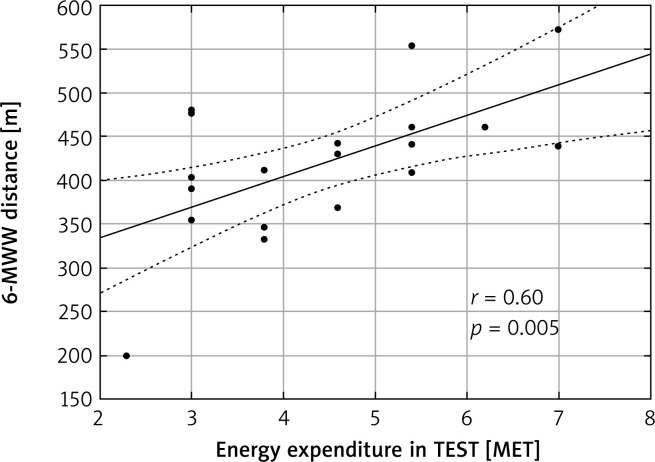
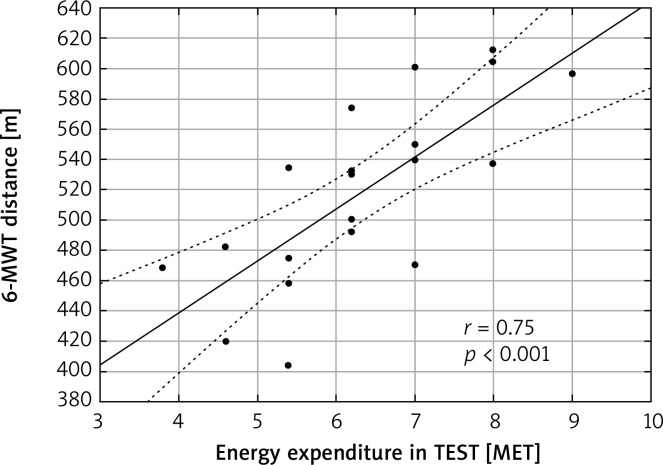
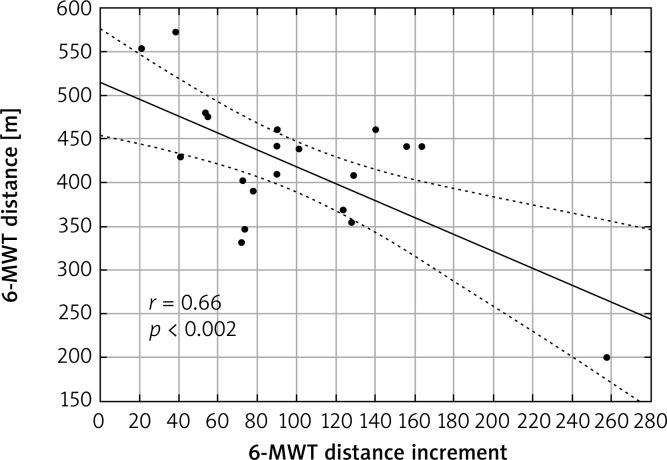
Results: The 6-MWT distance increased from 420 ±80 m to 519 ±61 m (p < 0.001), and the energy expenditure from 4.4 ±1.4 MET to 6.3 ±1.3 MET (p < 0.001). There was a positive correlation between 6-MWT distance and energy expenditure in the TEST before rehabilitation (r = 0.60, p = 0.005), and after rehabilitation (r = 0.75, p < 0.001). A negative correlation was found between the baseline 6-MWT distance and distance increment in the final 6-MWT (r = -0.66, p = 0.002). The 6-MWT did not induce hyperlactatemia.
Conclusions: The 6-MWT can be used in exercise intensity prescription, especially for determining the individual initial training load, load progression, as well as its correction during follow-up tests.
Keywords: 6-minute walk test; cardiac rehabilitation; coronary artery bypass; lactate; walking training.
Copyright: © 2021 Polish Society of Cardiothoracic Surgeons (Polskie Towarzystwo KardioTorakochirurgów) and the editors of the Polish Journal of Cardio-Thoracic Surgery (Kardiochirurgia i Torakochirurgia Polska).
Conflict of interest statement
The authors report no conflict of interest.
Figures
References
-
- Taylor A, Yang E. Comparing American and European guidelines for the initial diagnosis of stable ischaemic heart disease. Eur Heart J. 2020;41:811–815. - PubMed
-
- Casillas JM, Gudjoncik A, Gremeaux V, Aulagne J, Besson D, Laroche D. Assessment tools for personalizing training intensity during cardiac rehabilitation: literature review and practical proposals. Ann Phys Rehabil Med. 2017;60:43–49. - PubMed
-
- Cosentino F, Grant PJ, Aboyans V, Bailey CJ, Ceriello A, Delgado V, Federici M, Filippatos G, Grobbee DE, Hansen TB, Huikuri HV, Johansson I, Jüni P, Lettino M, Marx N, Mellbin LG, Östgren CJ, Rocca B, Roffi M, Sattar N, Seferović PM, Sousa-Uva M, Valensi P, Wheeler DC. 2019 ESC Guidelines on diabetes, pre-diabetes, and cardiovascular diseases developed in collaboration with the EASD. Eur Heart J. 2020;41:255–323. - PubMed
-
- Knuuti J, Wijns W, Saraste A, Capodanno D, Barbato E, Funck-Brentano C, Prescott E, Storey RF, Deaton C, Cuisset T, Agewall S, Dickstein K, Edvardsen T, Escaned J, Gersh BJ, Svitil P, Gilard M, Hasdai D, Hatala R, Mahfoud F, Masip J, Muneretto C, Valgimigli M, Achenbach S, Bax JJ. 2019 ESC Guidelines for the Diagnosis and Management of Chronic Coronary Syndromes. Eur Heart J. 2020;41:407–477. - PubMed
LinkOut - more resources
Full Text Sources
Miscellaneous
