


Short- and long-term outcomes after Kasai operation for type III biliary atresia: Twenty years of experience in a single tertiary Egyptian center-A retrospective cohort study
- PMID: 33552489
- PMCID: PMC7847812
- DOI: 10.1016/j.amsu.2021.01.052
Short- and long-term outcomes after Kasai operation for type III biliary atresia: Twenty years of experience in a single tertiary Egyptian center-A retrospective cohort study
Abstract
Kasai portoenterostomy(KPE) is the treatment of choice for the fatal devastating infantile type III biliary atresia (BA). The study aimed to analyze short-and long-term outcomes after this procedure and their predictors in a tertiary center.
Methods: We retrospectively analyzed 410 infants who underwent KPE for type III BA in the period from February 2000 to December 2019. The overall male/female ratio was 186/224.
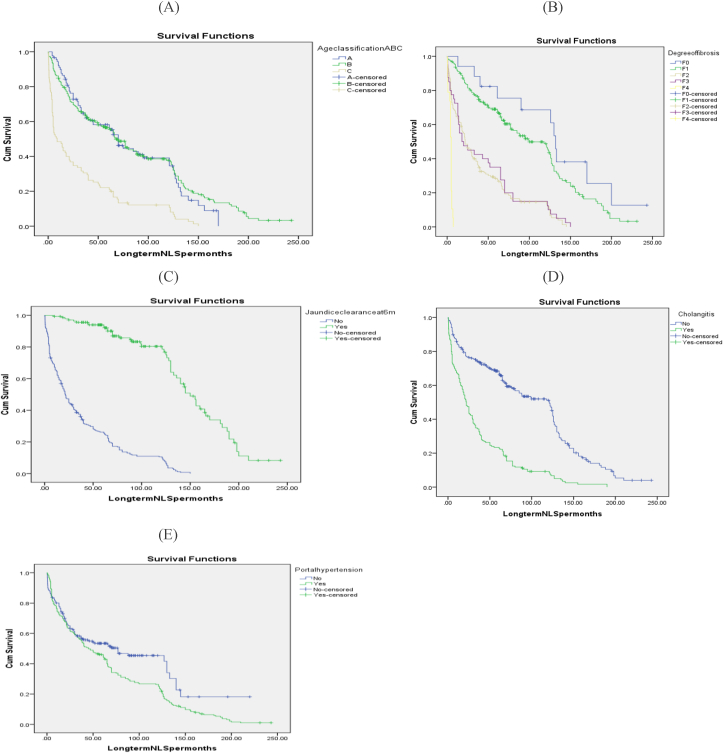
Results: The early (>6months) complications involved 187(45.6%) of our infants with a higher incidence of early cholangitis that affected 108(26.3%) of them. The jaundice clearance at the 6th post-operative month that reached 138(33.7%) of them had an independent correlation with mild portal tracts ductal and/or ductular proliferation, using postoperative steroids therapy, and absence of early postoperative cholangitis. The early infant mortality that affected 70(17.1%) of our patients was mostly from sepsis. On the other hand, late (<6months) patients complications and mortalities affected 256(62.4%) and 240(58.5%) of patients respectively; moreover, liver failure and sepsis were the most frequent causes of late mortalities in non-transplanted and transplanted cases respectively. Lastly, the long-term (20-year) native liver survival (NLS) that reached 91(22.2%) of patients had an independent correlation with age at operation ≤ 90 days, higher preoperative mean serum alb, portal tract fibrosis grades F0 and F1, absence of intraoperative bleeding, absence of post-operative cholangitis, the occurrence of jaundice clearance at the 6th postoperative month and absence of post-operative portal hypertension (PHN).
Conclusions: Sepsis had a direct effect on early and late patient mortalities after Kasai operation for type III BA; moreover, patient age at operation<90 days, higher fibrosis grades, the occurrence of postoperative cholangitis and PHN, and persistence of post-operative jaundice had negative insult on long-term postoperative outcome. So, it is crucial to modulate these factors for a better outcome.
Keywords: Biliary atresia; Long-term outcome; Short-term outcome; Survival with the native liver.
© 2021 The Authors. Published by Elsevier Ltd on behalf of IJS Publishing Group Ltd.
Conflict of interest statement
No conflict of interest to declare.
Figures
References
-
- Zhang D., Yang H.-Y., Jia J., Zhao G., Yue M., Wang J-x. Postoperative steroids after Kasai portoenterostomy for biliary atresia: a meta-analysis. Int. J. Surg. 2014;12:1203–1209. - PubMed
-
- Park C.J., Armenia S.J., Keung C.H., Compton J.T., Cowles R.A. Surgical modifications of the Kasai hepatoportoenterostomy minimize invasiveness without compromising short- and medium-term outcomes. J. Pediatr. Surg. 2019;54:537–542. - PubMed
-
- Chardot C., Carton M., Spire-Bendelac N., Pommelet C.L., Golmard J.-L., Reding R. Is the Kasai operation still indicated in children older than 3 months diagnosed with biliary atresia? J. Pediatr. 2001;138:224–228. - PubMed
-
- Davenport M., Puricelli V., Farrant P., Hadzic N., Mieli-Vergani G., Portmann B. The outcome of the older (>100 Days) infant with biliary atresia. J. Pediatr. Surg. 2004;39:575–581. - PubMed
LinkOut - more resources
Full Text Sources
Other Literature Sources
Miscellaneous
