Review
. 2020 Dec 20;8(3):2002797.
doi: 10.1002/advs.202002797. eCollection 2021 Feb.

Reactive Oxygen Species-Regulating Strategies Based on Nanomaterials for Disease Treatment

Affiliations
Review

Reactive Oxygen Species-Regulating Strategies Based on Nanomaterials for Disease Treatment

Chenyang Zhang et al. Adv Sci (Weinh). .

Abstract

Reactive oxygen species (ROS) play an essential role in physiological and pathological processes. Studies on the regulation of ROS for disease treatments have caused wide concern, mainly involving the topics in ROS-regulating therapy such as antioxidant therapy triggered by ROS scavengers and ROS-induced toxic therapy mediated by ROS-elevation agents. Benefiting from the remarkable advances of nanotechnology, a large number of nanomaterials with the ROS-regulating ability are developed to seek new and effective ROS-related nanotherapeutic modalities or nanomedicines. Although considerable achievements have been made in ROS-based nanomedicines for disease treatments, some fundamental but key questions such as the rational design principle for ROS-related nanomaterials are held in low regard. Here, the design principle can serve as the initial framework for scientists and technicians to design and optimize the ROS-regulating nanomedicines, thereby minimizing the gap of nanomedicines for biomedical application during the design stage. Herein, an overview of the current progress of ROS-associated nanomedicines in disease treatments is summarized. And then, by particularly addressing these known strategies in ROS-associated therapy, several fundamental and key principles for the design of ROS-associated nanomedicines are presented. Finally, future perspectives are also discussed in depth for the development of ROS-associated nanomedicines.

Keywords: ROS generation; ROS scavenger; nanomaterials; reactive oxygen species; therapy.


Conflict of interest statement

The authors declare no conflict of interest.

Figures
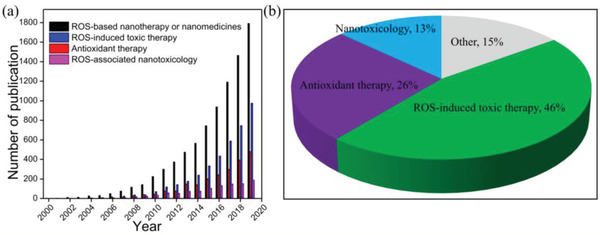
Figure 1
Figure 1
a) Number of ROS‐based nanotherapeutic modalities or nanomedicine publications worldwide according to the Web of Science Core Collection. b) Pie chart of ROS‐based nanotherapeutic modalities or nanomedicine publications in the field of ROS‐associated antioxidant therapy, ROS‐induced toxic therapy, and ROS‐associated nanotoxicology.
Figure 2
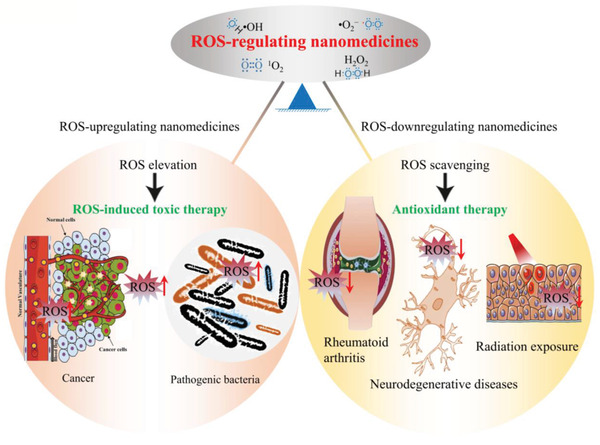
Figure 2
ROS‐regulating nanomedicine for ROS‐induced toxic therapy and antioxidant therapy. The ROS‐upregulating nanomedicine with unique ROS‐elevation ability for the treatment of various pathological disfunctions such as cancer and bacterial infection, etc. Adapted with permission.[ 300 ] Copyright 2018, Springer Nature. The ROS‐downregulating nanomedicine with unique ROS‐scavenging ability for the treatment of various pathological disfunctions such as rheumatoid arthritis, neurodegenerative diseases and radiation exposure‐induced injury, etc. Adapted with permission.[ 301 ] Copyright 2017, Elsevier B.V. Adapted with permission.[ 302 ] Copyright 2018, American Chemical Society.
Figure 3
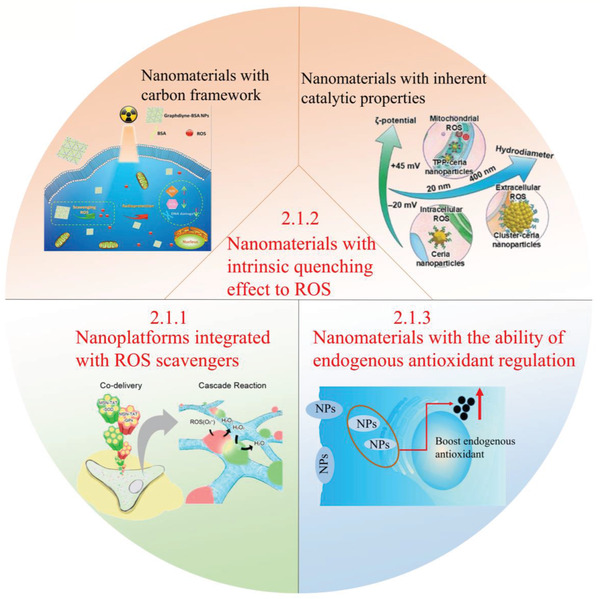
Figure 3
Strategies based on ROS‐scavenging nanomedicines for disease treatments. Effective approaches based on ROS‐scavenging nanomedicines for antioxidant therapy: 1) Nanoplatforms integrated with ROS scavengers. Adapted with permission.[ 53 ] Copyright 2016, American Chemical Society. 2) Nanomaterials with intrinsic quenching effect to ROS: i) Nanomaterials with carbon framework. Adapted with permission.[ 92 ] Copyright 2018, American Chemical Society. ii) Nanomaterials with inherent catalytic properties. Adapted with permission.[ 117 ] Copyright 2018, Wiley‐VCH. 3) Nanomaterials with the ability of endogenous antioxidant regulation.
Figure 4
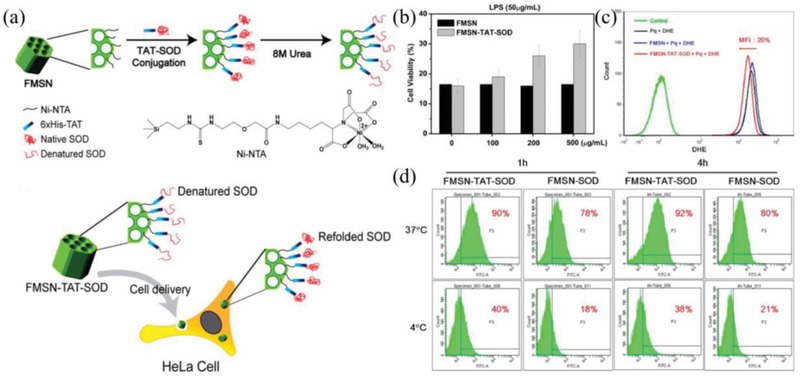
Figure 4
a) Schematic illustration for the synthesis of FMSN‐TAT‐SOD and subsequently provide a protective effect on cells against oxidative stress. b) MTT assay. c) Detection of ROS generation. d) The cellular uptake of NPs determined by FACS analysis. Reproduced with permission.[ 55 ] Copyright 2013, American Chemical Society.
Figure 5
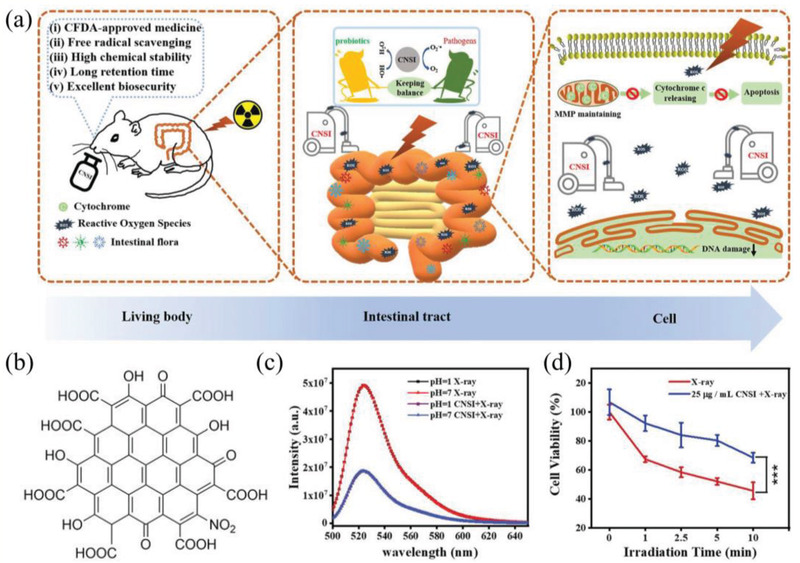
Figure 5
a) CNSI for intestinal radioprotection. b) The chemical structure of CNSI. c) ROS scavenging ability of CNSI in different pH solutions. d) Cell viability of IEC‐6 cells with different treatments. Reproduced with permission.[ 90 ] Copyright 2020, WILEY‐VCH.
Figure 6
Figure 6
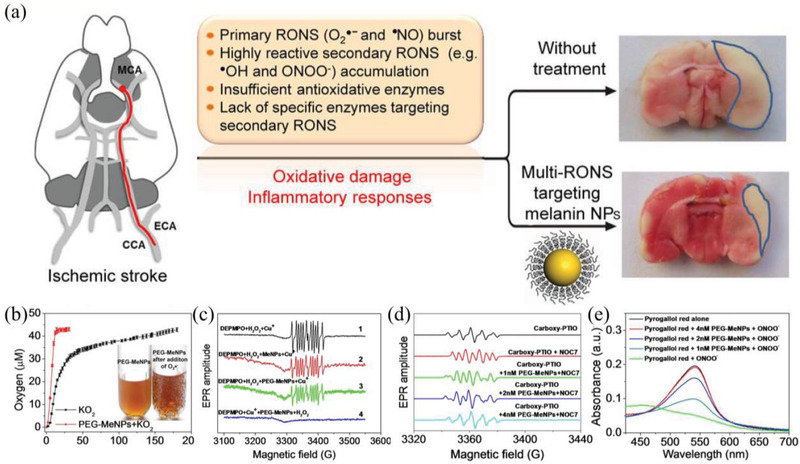
a) Melanin NPs to protect brain from injury in ischemic stroke. b) O2 production with or without PEG‐MeNPs. c) EPR spectra of DEPMPO‐OH obtained by trapping OH. d) The antioxidative activity of PEG‐MeNPs toward NO. e) ONOO scavenging effect of PEG‐MeNPs. Reproduced with permission.[ 104 ] Copyright 2017, American Chemical Society.
Figure 7
Figure 7
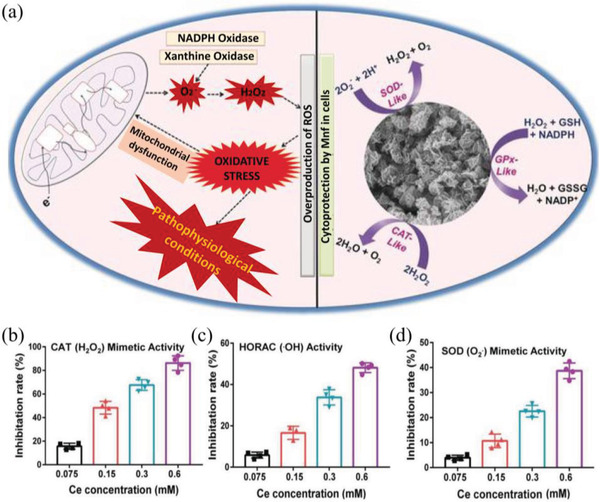
a) A remarkable redox modulatory effect in human cells of Mn3O4 nanozyme with the catalytic activity of three antioxidant enzymes: CAT, GPx, and SOD. Reproduced with permission.[ 110 ] Copyright 2017, Wiley‐VCH. b) ROS scavenging activity of ceria NPs mimics catalase (CAT), c) eliminate OH, and d) SOD. Reproduced with permission.[ 119 ] Copyright 2019 WILEY‐VCH.
Figure 8
Figure 8
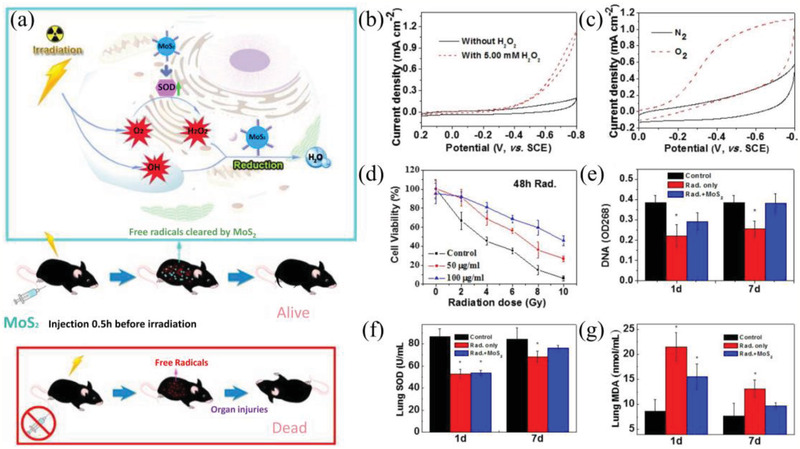
a) Cysteine‐protected MoS2 dots with highly catalytic activity as radioprotectants in protection against IR. b) CVs of a glassy carbon electrode (GCE) modified with cysteine‐protected MoS2 dots in the presence (dotted) and absence (solid) of 5.00 × 10−3 m H2O2 in N2‐saturated 0.01 m pH 7.4 phosphate‐buffered saline (PBS) c) CVs of GCE modified with cysteine‐protected MoS2 dots in N2‐ (solid) and O2‐saturated (dotted) 0.01 m pH 7.4 PBS. d) Radiation dose‐dependent protection in vitro with different injected doses (50 and 100 µg mL−1) or without treatment of cysteine‐protected MoS2 dots. e) DNA damage of mice 1 and 7 days after treatment with cysteine‐protected MoS2 dots. f) SOD levels and g) MDA levels in lung. Reproduced with permission.[ 128 ] Copyright 2016, American Chemical Society.
Figure 9
Figure 9
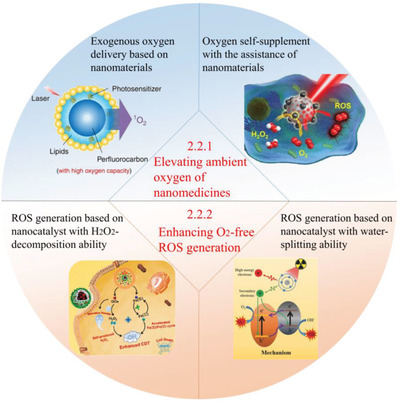
Strategies based on ROS‐enhanced nanomedicines for ROS‐induced toxic therapy. 1) Elevating ambient oxygen of nanomedicines: i) Exogenous oxygen delivery based on nanomaterials. Adapted with permission.[ 150 ] Copyright 2015, Springer Nature. ii) Oxygen self‐supplement with the assistance of nanomaterials. Adapted with permission.[ 181 ] Copyright 2017, American Chemical Society. (2) Enhancing O2‐free ROS generation: i) ROS generation based on nanocatalyst with H2O2‐decomposition ability. Adapted with permission.[ 196 ] Copyright 2018, American Chemical Society. ii) ROS generation based on nanocatalyst with water‐splitting ability. Adapted with permission.[ 225 ] Copyright 2017, WILEY‐VCH.
Figure 10
Figure 10
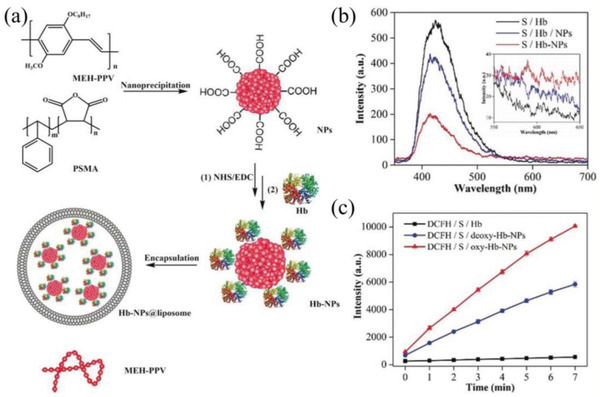
a) Schematic illustration of the preparation of Hb‐NPs@liposome. b) Luminescence spectra of luminol in the presence of Hb, a mixture of Hb and NPs, and Hb‐NPs; inset shows the enlarged view of the fluorescence intensity of MEH‐PPV NPs. c) Evaluation of ROS yield. Reproduced with permission.[ 160 ] Copyright 2019, Wiley‐VCH.
Figure 11
Figure 11
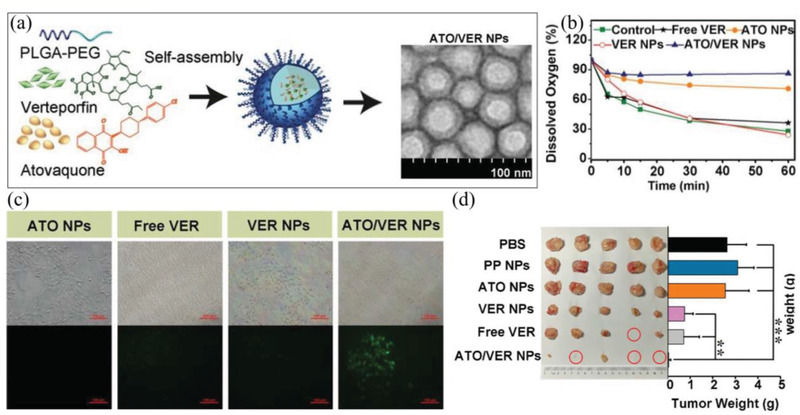
a) Schematic illustration of the preparation of the ATO/VER NPs and representative TEM images of the ATO/VER NPs. b) Determination of 4T1 cell oxygen consumption by measurement of DO content 4 h after administration without laser irradiation. The initial value was taken to be 100%. c) Determination of intracellular ROS generation (green fluorescence) by an inverted fluorescence microscope. d) Representative images of the excised tumors after different treatments. Reproduced with permission.[ 173 ] Copyright 2019, WILEY‐VCH.
Figure 12
Figure 12
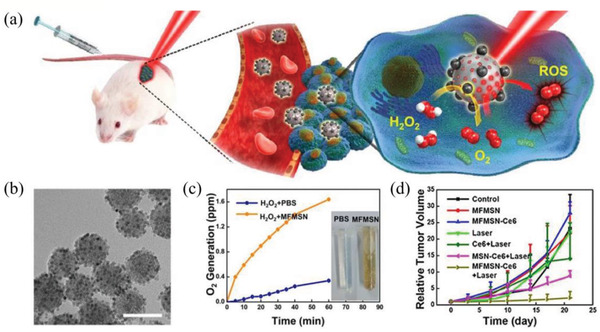
a) Schematic illustration of MFMSNs. b) TEM image of MFMSNs. Scale bar, 60 nm. c) O2 generation after treating with MFMSNs in PBS. d) Tumor volume changes. Reproduced with permission.[ 181 ] Copyright 2017, American Chemical Society.
Figure 13
Figure 13
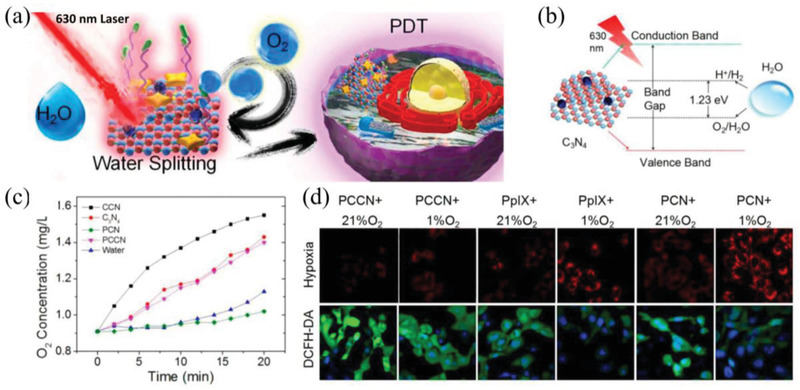
a) Schematic diagram of 630 nm light‐driven water splitting enhanced PDT. b) Schematic illustration of the C3N4‐mediated water splitting process. c) O2 generation curve. d) CLSM images of PDT‐induced hypoxia reversion and intracellular ROS generation. Reproduced with permission.[ 187 ] Copyright 2016, American Chemical Society.
Figure 14
Figure 14
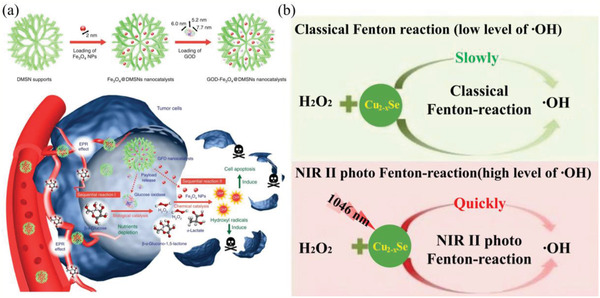
a) Fabrication and catalytic‐therapeutic schematics of sequential GFD NCs. Reproduced with permission.[ 195 ] Copyright 2017, Springer Nature. b) Schematic comparison of the classical Fenton reaction and the NIR‐II photo‐Fenton reaction. Reproduced with permission.[ 189 ] Copyright 2019, WILEY‐VCH.
Figure 15
Figure 15
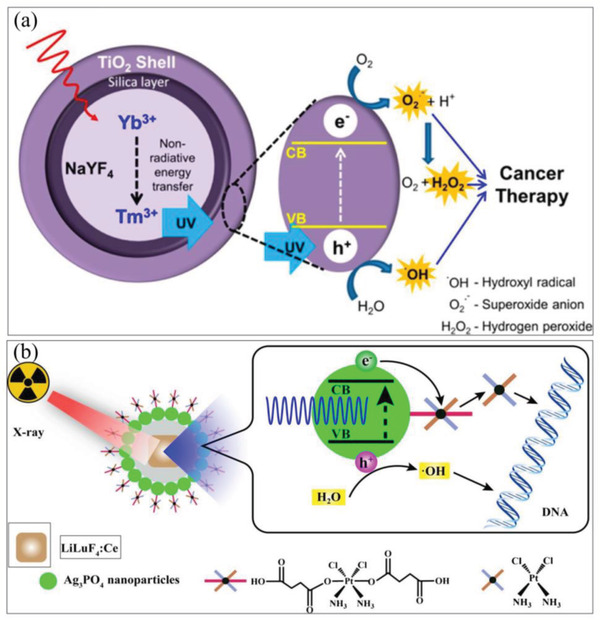
a) Photocatalytic killing schematics of TiO2‐UCN. Reproduced with permission.[ 216 ] Copyright 2015, American Chemical Society. b) Mechanisms underlying the effects of X‐ray‐induced toxic therapy with LiLuF4:Ce@SiO2@Ag3PO4@Pt(IV) NPs (LAPNP). Reproduced with permission.[ 223 ] Copyright 2018, American Chemical Society.
Figure 16
Figure 16
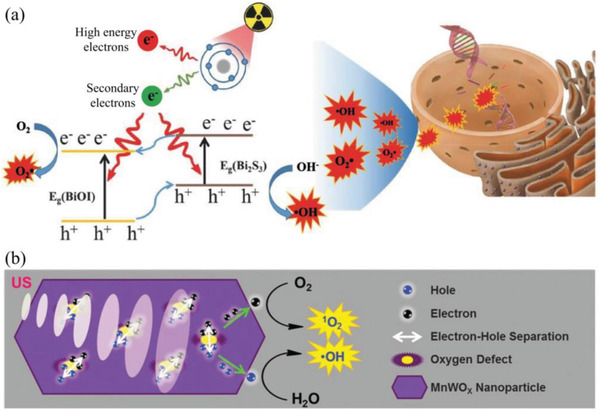
a) The scheme of X‐ray‐induced photodynamic therapy mechanism. Reproduced with permission.[ 225 ] Copyright 2017, WILEY‐VCH. b) The proposed mechanism of ROS generation by MnWOX NPs under US irradiation. Reproduced with permission.[ 229 ] Copyright 2019, WILEY‐VCH.

References

    1. Bayr H., Crit. Care Med. 2005, 33, S498. - PubMed
    1. Ferreira C. A., Ni D., Rosenkrans Z. T., Cai W., Nano Res. 2018, 11, 4955. - PMC - PubMed
    1. Gomberg M., J. Am. Chem. Soc. 1900, 22, 757.
    1. Commoner B., Townsend J., Pake G. E., Nature 1954, 174, 689. - PubMed
    1. Yang B., Chen Y., Shi J., Chem. Rev. 2019, 119, 4881. - PubMed

LinkOut - more resources