


Survival and Complications in Pediatric Patients With Cancer and COVID-19: A Meta-Analysis
- PMID: 33552980
- PMCID: PMC7861039
- DOI: 10.3389/fonc.2020.608282
Survival and Complications in Pediatric Patients With Cancer and COVID-19: A Meta-Analysis
Abstract
Background: The pandemic caused by the novel severe acute respiratory syndrome coronavirus 2 (SARS-CoV-2) has affected all age groups, including the pediatric population, in 3-5% of all cases. We performed a meta-analysis to understand the survival and associated complications in pediatric cancer patients as well as their hospitalization, intensive care, and ventilation care (supplemental oxygen/endotracheal intubation) needs.
Methods: A systematic search was performed using MEDLINE, TRIP Database, International Clinical Trials Registry Platform (WHO), The Cochrane Library, Wiley, LILACS, and Google Scholar. Additionally, a search using the snowball method was performed in Nature, New England Journal of Medicine, Science, JAMA, ELSEVIER editorial, Oxford University Press, The Lancet, and MedRxiv. Searches were conducted until July 18, 2020. A total of 191 cancer patients with coronavirus disease 2019 (COVID-19) were integrated from 15 eligible studies. In a sub-analysis, patients were stratified into two groups: hematological cancer and solid tumors. Outcome measures were overall survival, risk of hospitalized or needing intensive care, and need for ventilatory support in any modality. The random effects statistical analysis was performed with Cochran's chi square test. The odds ratio (OR) and heterogeneity were calculated using the I2 test.
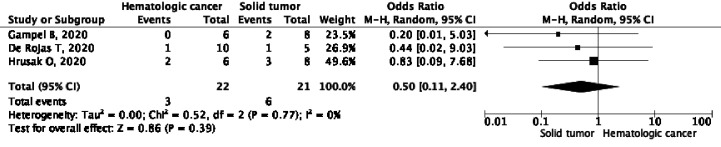
Results: The overall survival was 99.4%. There were no statistically significant differences in the risk of hospitalization between hematological malignancies and solid tumors (95% confidence interval [CI] 0.48-18.3; OR = 2.94). The risk of being admitted to the intensive care unit was also not different between hematological malignancies and other tumors (95% CI 0.35-5.81; OR = 1.42). No differences were found for the need of ventilatory support (95% CI 0.14-3.35; OR = 0.68). Although all the studies were cross-sectional, the mortality of these patients was 0.6% at the time of analysis.
Conclusions: In the analyzed literature, survival in the studied group of patients with COVID-19 was very high. Suffering from hematological neoplasia or other solid tumors and COVID-19 was not a risk factor in children with cancer for the analyzed outcomes.
Keywords: childhood cancer; coronavirus disease 2019; intensive care; meta-analysis; mortality; severe acute respiratory syndrome coronavirus 2; systematic review; ventilation.
Copyright © 2021 Dorantes-Acosta, Ávila-Montiel, Klünder-Klünder, Juárez-Villegas and Márquez-González.
Conflict of interest statement
The authors declare that the research was conducted in the absence of any commercial or financial relationships that could be construed as a potential conflict of interest.
Figures


References
-
- Hopkins J. Coronavirus Resource Center. COVID-19 Dashboard by the Center for Systems Science and Engineering (CSSE) at Johns Hopkins University. (2020). Available at: https://coronavirus.jhu.edu/map.html, September 1, 2020.
-
- Balduzzi A, Brivio E, Rovelli A, Rizzari C, Gasperini S, Melzi ML, et al. Lessons after the early management of the COVID-19 outbreak in a pediatric transplant and hemato-oncology center embedded within a COVID-19 dedicated hospital in Lombardia, Italy. Estote parati Bone Marrow Transplant (2020) 10:1–6. 10.2139/ssrn.3559560 - DOI - PMC - PubMed
Publication types
LinkOut - more resources
Full Text Sources
Other Literature Sources
Miscellaneous
