Review
. 2021 Feb 1;8(2):28-56.
doi: 10.15698/mic2021.02.741.

Biofilms by bacterial human pathogens: Clinical relevance - development, composition and regulation - therapeutical strategies

Affiliations
Review

Biofilms by bacterial human pathogens: Clinical relevance - development, composition and regulation - therapeutical strategies

Adina Schulze et al. Microb Cell. .

Abstract

Notably, bacterial biofilm formation is increasingly recognized as a passive virulence factor facilitating many infectious disease processes. In this review we will focus on bacterial biofilms formed by human pathogens and highlight their relevance for diverse diseases. Along biofilm composition and regulation emphasis is laid on the intensively studied biofilms of Vibrio cholerae, Pseudomonas aeruginosa and Staphylococcus spp., which are commonly used as biofilm model organisms and therefore contribute to our general understanding of bacterial biofilm (patho-)physiology. Finally, therapeutical intervention strategies targeting biofilms will be discussed.

Keywords: Pseudomonas aeruginosa; Vibrio cholerae; biofilm; biofilm-associated disease; nosocomial infections; staphylococci; treatment.


Conflict of interest statement

Conflict of Interest: The authors declare no conflict of interest.

Figures
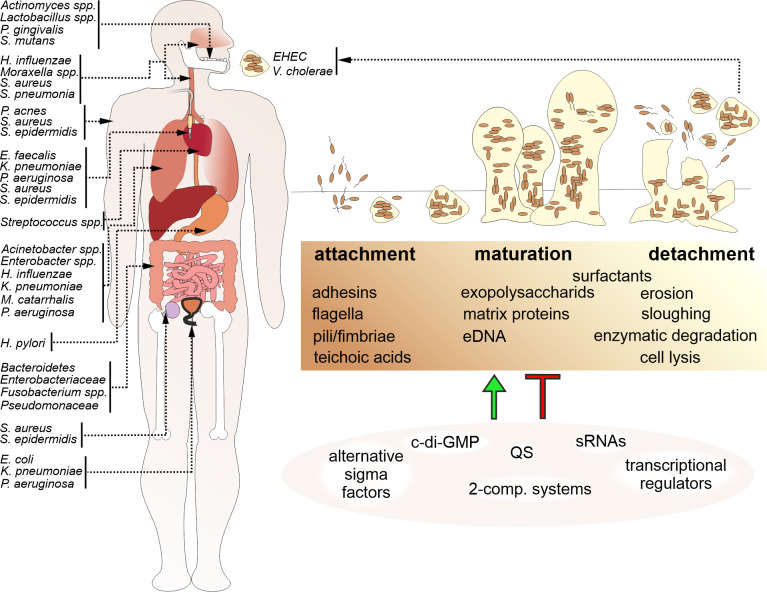
Figure 1
Figure 1. FIGURE 1: Biofilm formation is a common feature among bacterial human pathogens.
Bacterial biofilms by human pathogens are found on various tissues of the human body, on medical devices, e.g. catheters or prostheses, and in the environment, representing a reservoir for new infections. A schematic overview indicating representative bacterial species associated with biofilm-related diseases and their occurrence in the body (arrows) is presented on the left. Biofilm formation (upper right) is a multistep process organized in an attachment, maturation and detachment phase. Biofilm formation is controlled and modulated by several factors including bacterial surface molecules, secreted matrix effectors, as well as environmental components and stressors. Thus, it is not surprising that bacterial biofilm regulation (lower right) involves the interplay of several positive and negative regulatory cascades including quorum sensing systems (QS), regulatory small RNAs (sRNAs), alternative sigma factors, two-component systems and second messengers, such as c-di-GMP.

References

    1. Høiby N. A Personal History of Research on Microbial Biofilms and Biofilm Infections. Pathog Dis. 2014;70(3):205–11. doi: 10.1111/2049-632X.12165. - DOI - PubMed
    1. Jamal M, Ahmad W, Andleeb S, Jalil F, Imran M, Nawaz MA, Hussain T, Ali M, Rafiq M, Kamil MA. Bacterial biofilm and associated infections. J Chin Med Assoc. 2018;81(1):7–11. doi: 10.1016/j.jcma.2017.07.012. - DOI - PubMed
    1. Tamayo R, Patimalla B, Camilli A. Growth in a biofilm induces a hyperinfectious phenotype in Vibrio cholerae. Infect Immun. 2010;78(8):3560–3569. doi: 10.1128/IAI.00048-10. - DOI - PMC - PubMed
    1. Seper A, Fengler VH, Roier S, Wolinski H, Kohlwein SD, Bishop AL, Camilli A, Reidl J, Schild S. Extracellular nucleases and extracellular DNA play important roles in Vibrio cholerae biofilm formation. Mol Microbiol. 2011;82(4):1015–1037. doi: 10.1111/j.1365-2958.2011.07867.x. - DOI - PMC - PubMed
    1. Colwell RR, Huq A, Islam MS, Aziz KM, Yunus M, Khan NH, Mahmud A, Sack RB, Nair GB, Chakraborty J, Sack DA, Russek-Cohen E. Reduction of cholera in Bangladeshi villages by simple filtration. Proc Natl Acad Sci U S A. 2003;100(3):1051–1055. doi: 10.1073/pnas.0237386100. - DOI - PMC - PubMed

LinkOut - more resources