Review
. 2021 Feb 2:26:100937.
doi: 10.1016/j.bbrep.2021.100937. eCollection 2021 Jul.

Shelterin complex gene: Prognosis and therapeutic vulnerability in cancer

Affiliations
Review

Shelterin complex gene: Prognosis and therapeutic vulnerability in cancer

Vikas Kumar Bhari et al. Biochem Biophys Rep. .

Abstract

Telomere encompasses a (TTAGGG)n tandem repeats, and its dysfunction has emerged as the epicenter of driving carcinogenesis by promoting genetic instability. Indeed, they play an essential role in stabilizing chromosomes and therefore protecting them from end-to-end fusion and DNA degradation. Telomere length homeostasis is regulated by several key players including shelterin complex genes, telomerase, and various other regulators. Targeting these regulatory players can be a good approach to combat cancer as telomere length is increasingly correlated with cancer initiation and progression. In this review, we have aimed to describe the telomere length regulator's role in prognostic significance and important drug targets in breast cancer. Moreover, we also assessed alteration in telomeric function by various telomere length regulators and compares this to the regulatory mechanisms that can be associated with clinical biomarkers in cancer. Using publicly available software we summarized mutational and CpG island prediction analysis of the TERT gene breast cancer patient database. Studies have reported that the TERT gene has prognostic significance in breast cancer progression however mechanistic approaches are not defined yet. Interestingly, we reported using the UCSC Xena web-based tool, we confirmed a positive correlation of shelterin complex genes TERF1 and TERF2 in recurrent free survival, indicating the critical role of these genes in breast cancer prognosis. Moreover, the epigenetic landscape of DNA damage repair genes in different breast cancer subtypes also being analyzed using the UCSC Xena database. Together, these datasets provide a comprehensive resource for shelterin complex gene profiles and define epigenetic landscapes of DNA damage repair genes which reveals the key role of shelterin complex genes in breast cancer with the potential to identify novel and actionable targets for treatment.

Keywords: DNA damage; Shelterin complex; Telomere; hTERT.


Conflict of interest statement

None.

Figures
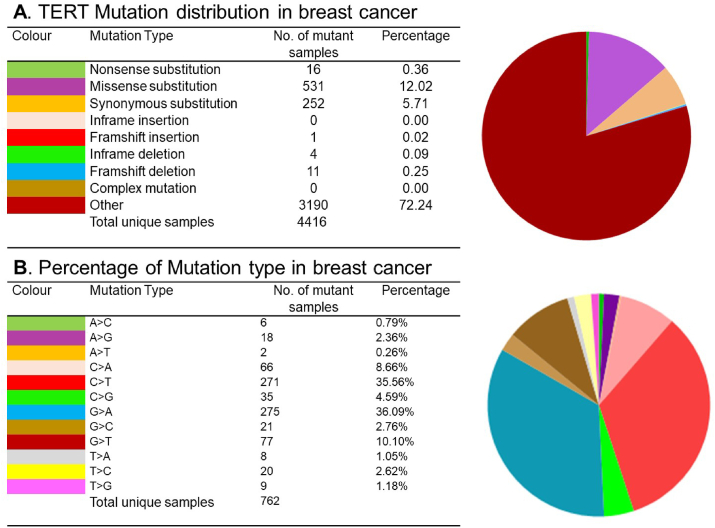
Fig. 1
Fig. 1
COSMIC database analysis of TERT mutation distributions and its types A. TERT mutations showed in the pie chart illustrate mostly missense and non-sense in BC. B. TERT coding strands largely included G > A (36.09%) and C > T (35.56%) mutations. TERT, Human telomerase reverse transcriptase; BC, breast cancer. TERT, Human telomerase reverse transcriptase; BC, breast cancer.
Fig. 2
Fig. 2
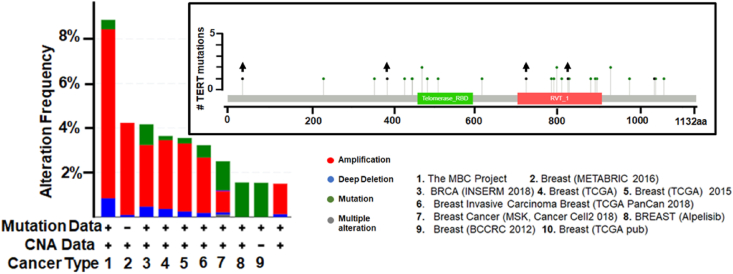
TERT mutation analysis and visualization using cBioportal database. Accumulated alterations of TERT in BC are summarized in the graph in individual studies deposited in the database. Furthermore, the distribution of these alterations are shown in the inset, black arrows showing nonsense mutations while others showing missense mutation. TERT, telomerase reverse transcriptase; BC, breast cancer.
Fig. 3
Fig. 3
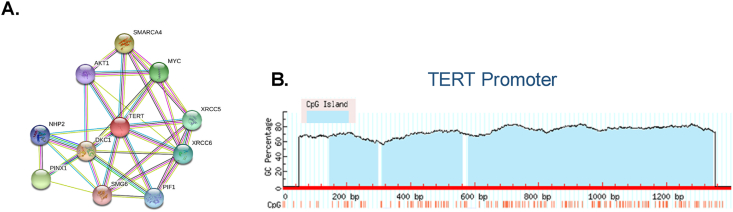
Bioinformatics analysis of CpG island prediction on TERT gene promoter and interaction network using the STRING database. (A) TERT, and its strongly interacting protein interaction network derived from the STRING database. In a biological network, a node is any biological molecule and an edge indicates the interaction between the two nodes. (B) CpG island presence near the promoter of a gene is strongly associated with methylation mark recruitment. Our bioinformatics analysis provided the information that there is a heavy abundance of CpG island near the TERT gene promoter. As the TERT promoter contains a site for various transcription factors, these CpG islands may play a role in the alteration and regulation of TERT transcription. The location of the CpG islands is colored in light blue. TERT, Human Telomerase reverse transcriptase. TERT, human telomerase reverse transcriptase. (For interpretation of the references to color in this figure legend, the reader is referred to the Web version of this article.)
Fig. 4
Fig. 4
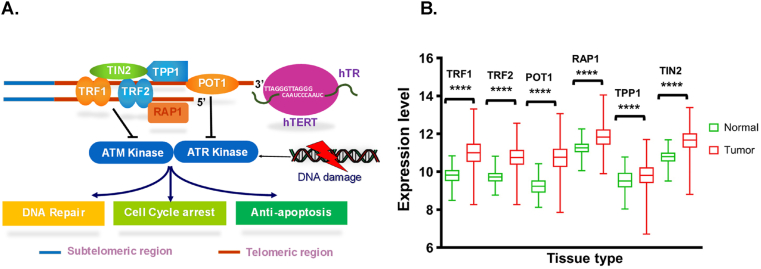
Gene expression levels of shelterin complex genes in breast cancer (TCGA TARGET GTEx RNAseq data) and their link to DDR A. Cartoon describing that shelterin complex consists of majorly six proteins – TERF1, TERF2, Rap1, TIN2, TPP1, and POT1. TERF1 and TERF2 are homodimers binding to the double-stranded telomeric DNA through the Myb domain. Rap1 is an interactive partner of TERF2. TPP1 and POT1 bind to the ssDNA telomere and protect the 3′ overhang sequence of the telomere. TIN2 acts as a bridge between TERF1/TERF2 and TPP1/POT1 and stabilizes the shelterin complex. TERF2 and POT1 block ATM and ATR kinase respectively through which shelterin complex sequesters telomere from DDR, mainly initiated by activation of ATM and ATR kinases resulting in DNA repair mechanisms. B. Shelterin complex genes mRNA expression levels of shelterin complex genes were compared between “normal” (GTEx) and tumor samples (TCGA). The middle line in the boxes represents the median value. Graph-pad Prism software was used to calculate statistical differences by two-tailed Student's t-test. ****P < 0.00001. TERF1, telomeric repeat-binding factor 1; TERF2, telomeric repeat-binding factor 2; Rap1/TERF2IP, telomeric-repeating binding factor 2-interacting factor; POT1, protection of telomeres protein 1; TPP1/ACD; Adrenocortical dysplasia protein; TIN2/TINF2, TERF1-interacting nuclear factor 2; DDR, DNA damage response, ATM, Ataxia telangiectasia mutated kinase; ATR, Ataxia telangiectasia, and Rad3.
Fig. 5
Fig. 5
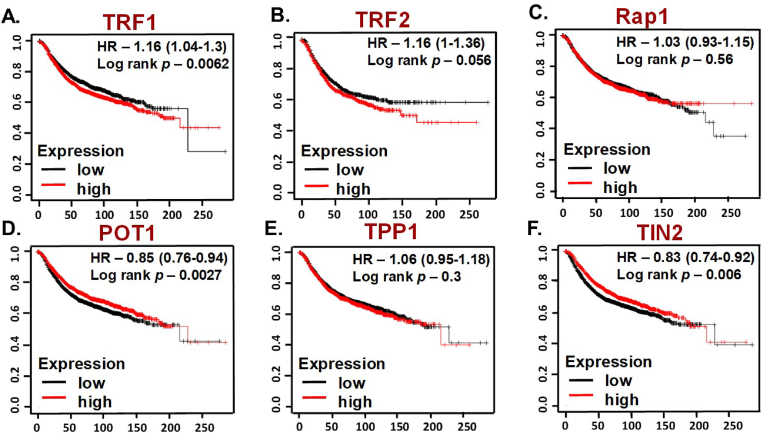
Survival analysis of shelterin complex genes in Breast cancer patients using Kaplan-Meier plotter. Survival curves of (A) TERF1 (Affymetrix ID:203448_s_at); (B) TERF2 (Affymetrix IDs: 1555185_x_at); (C) Rap1 (Affymetrix IDs:201174_s_at); (D) POT1 (Affymetrix IDs:204353_s_at); (E) TPP1 (Affymetrix IDs:204617_s_at); (F) TIN2 (Affymetrix IDs:220052_s_at). Abbreviations: TERF1, telomeric repeat-binding factor 1; TERF2.
Fig. 6
Fig. 6
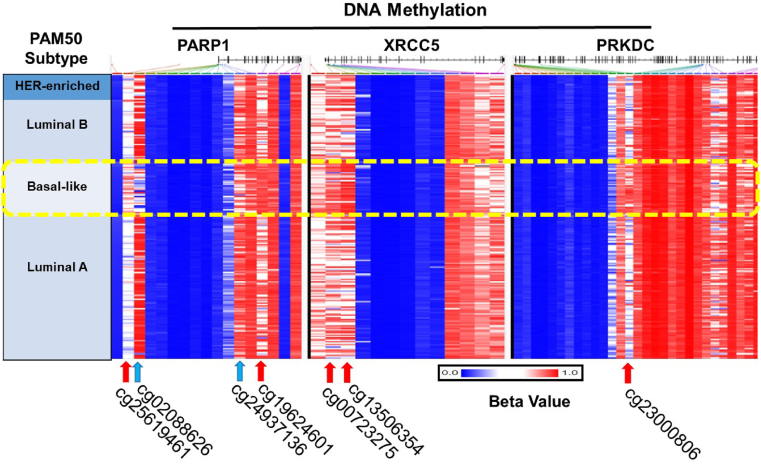
Methylation status of DNA damage repair genes correlated with TERF1 in breast cancer. UCSC Xena browser was used to analyze the DNA methylation of PARP1, XRCC5 and PRKDC correlated with TERF1 in breast cancer subtypes. DNA methylation of these genes was found to be distinctly different in the case of basal-like subtype in comparison to otherwise pattern. Red and blue arrows define hypermethylation and hypomethylation consequently. TERF1, telomeric repeat-binding factor 1; PARP1, Poly [ADP-ribose] polymerase 1; XRCC5, Ku80; PRKDC, Protein Kinase DNA Activated Catalytic subunit. (For interpretation of the references to color in this figure legend, the reader is referred to the Web version of this article.)

References

    1. Muller H.J., Herskowitz I.H. Concerning the healing of chromosome ends produced by breakage in Drosophila melanogaster. Am. Nat. 1954;88:177–208. doi: 10.1086/281830. - DOI
    1. McClintock B. The stability of broken ends of chromosomes in Zea mays. Genetics. 1941;26:234–282. http://www.ncbi.nlm.nih.gov/pubmed/17247004%0Ahttp://www.pubmedcentral.n... - PMC - PubMed
    1. Zakian V.A. The ends have arrived. Cell. 2009;139:1038–1040. doi: 10.1016/j.cell.2009.11.033. - DOI - PMC - PubMed
    1. Hayflick L., Moorhead P.S. The serial cultivation of human diploid cell strains. Exp. Cell Res. 1961;25:585–621. doi: 10.1016/0014-4827(61)90192-6. - DOI - PubMed
    1. Olovnikov A.M. Telomeres, telomerase, and aging: origin of the theory. Exp. Gerontol. 1996;31:443–448. doi: 10.1016/0531-5565(96)00005-8. - DOI - PubMed