


Benznidazole decreases the risk of chronic Chagas disease progression and cardiovascular events: A long-term follow up study
- PMID: 33554085
- PMCID: PMC7846661
- DOI: 10.1016/j.eclinm.2020.100694
Benznidazole decreases the risk of chronic Chagas disease progression and cardiovascular events: A long-term follow up study
Abstract
Background: Chagas disease (CD) remains an important endemic disease in Latin America. However, CD became globalized in recent decades. The majority of the chronically infected individuals did not receive etiologic treatment for several reasons, among them the most conspicuous is the lack of access to diagnosis. The impact of trypanocidal treatment on CD chronic phase, without cardiac involvement (indeterminate form ICF), is yet to be determined. We aimed to evaluate the effect of trypanocidal treatment with benznidazole (BZN) on the rate of progression to Chagas heart disease in patients with ICF.
Methods: This is a retrospective cohort observational study including patients with ICF treated with BZN and compared to a group of non-treated patients matched for age, sex, region of origin, and the year of cohort entry. We reviewed the medical charts of all patients followed from May 1987 to June 2020 at the outpatient center of the Evandro Chagas National Institute of Infectious Diseases (INI) of the Oswaldo Cruz Foundation (Fiocruz), Rio de Janeiro, Brazil. Patients' follow-up included at least one annual medical visit and one annual electrocardiogram (ECG). Echocardiographic exams were performed at baseline and during the follow-up. Disease progression from ICF to cardiac form was defined by changes in baseline ECG. Cumulative incidence and the incidence rate were described in the incidence analysis. Cox proportional hazards models were used to estimate hazard ratios and 95% confidence intervals for the association between BZN and CD progression, cardiovascular events or death.
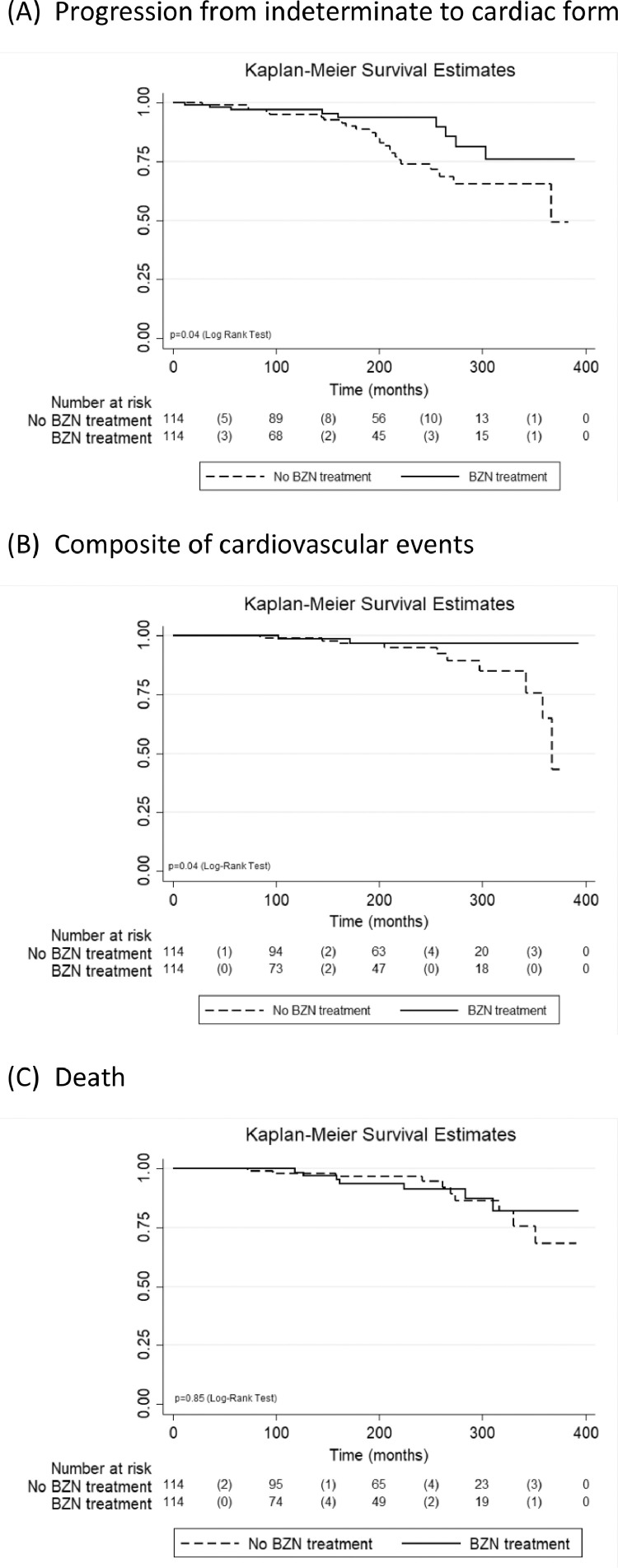
Findings: One hundred and fourteen treated patients met the study inclusion criteria. A comparison group of 114 non-treated patients matched for age, sex, region of origin, and the year of cohort entry was also included, totalizing 228 patients. Most patients included in the study were male (70.2%), and their mean age was 31.3 (+7.4) years. Over a median follow-up of 15.1 years (ranging from 1.0 to 32.4), the cumulative CD progression incidence in treated patients was 7.9% vs. 21.1% in the non-treated group (p = 0.04) and the CD progression rate was 0.49 per 1.000 patients/year in treated patients vs. 1.10 per 1.000 patients/year for non-treated patients (p = 0.02). BZN treatment was associated with a decreased risk of CD progression in both unadjusted (HR 0.46; 95%CI 0.21 to 0.98) and adjusted (HR 0.43; 95%CI 0.19 to 0.96) models and with a decreased risk of occurrence of the composite of cardiovascular events only in the adjusted (HR 0.15; 95%CI 0.03 to 0.80) model. No association was observed between BZN treatment and mortality.
Interpretation: In a long-term follow-up, BZN treatment was associated with a decreased incidence of CD progression from ICF to the cardiac form and also with a decreased risk of cardiovascular events. Therefore, our results indicate that BZN treatment for CD patients with ICF should be implemented into clinical practice.
Keywords: Benznidazole; Chagas disease; Disease progression; Electrocardiogram; Indeterminate form.
© 2020 The Authors.
Conflict of interest statement
The authors declare no conflict of interest.
Figures
References
-
- Echeverria L.E. Morillo CA.American trypanosomiasis (Chagas disease) Infect. Dis. Clin. North Am. 2019;33:119–134. - PubMed
-
- Pan American Health Organization. PAHO New guide for diagnosis and treatment of Chagas disease. 2019 [Internet]. Available in: https://www.paho.org/hq/index.php?option=com_content&view=article&id=14906:paho-issues-new-guide-for-diagnosis-and-treatment-of-chagas-disease<emid=135&lang=pt
-
- Pérez-Molina J.A., Crespillo-Andújar C., Bosch-Nicolau P., Molina I. Trypanocidal treatment of Chagas disease. Enfermedades Infecciosas y Microbiología Clínica. 2020 S0213005X20301932. - PubMed
-
- Matta Guedes P.M., Gutierrez F.R.S., Nascimento M.S.L., Do-Valle-Matta M.A., Silva J.S. Antiparasitical chemotherapy in Chagas’ disease cardiomyopathy: current evidence. Tropical Med Int Health. 2012;17(9):1057–1065. - PubMed
LinkOut - more resources
Full Text Sources
Other Literature Sources
Miscellaneous
