. 2021 Jan 22;2(1):100293.
doi: 10.1016/j.xpro.2020.100293. eCollection 2021 Mar 19.

Imaging the early zebrafish embryo centrosomes following injection of small-molecule inhibitors to understand spindle formation

Affiliations

Imaging the early zebrafish embryo centrosomes following injection of small-molecule inhibitors to understand spindle formation

Abrar A Aljiboury et al. STAR Protoc. .

Abstract

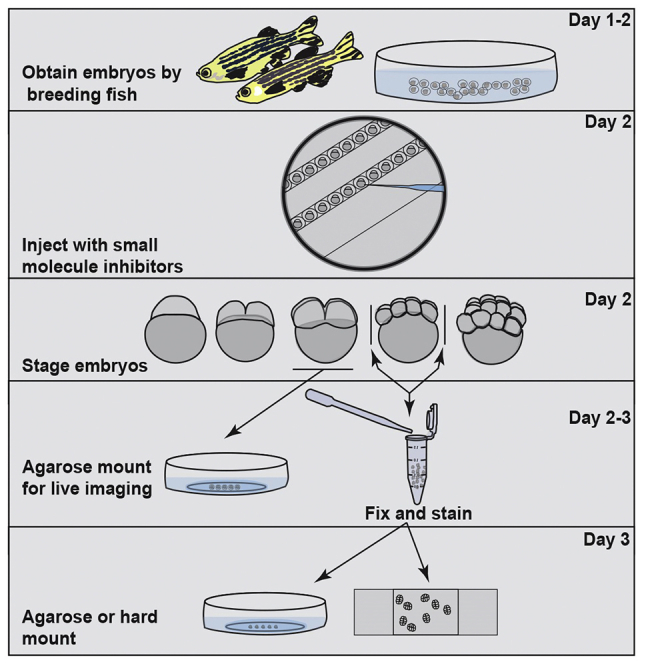
During the earliest division stages, zebrafish embryos have large cells that divide rapidly and synchronously to create a cellular layer on top of the yolk. Here, we describe a protocol for monitoring spindle dynamics during these early embryonic divisions. We outline techniques for injecting zebrafish embryos with small-molecule inhibitors toward polo-like kinases, preparing and mounting embryos for three-dimensional imaging using confocal microscopy. These techniques are used to understand how the early zebrafish embryo's centrosome constructs the mitotic spindle. For complete details on the use and execution of this protocol, please refer to Rathbun et al. (2020).

Keywords: Cell biology; Microscopy; Model organisms.


Conflict of interest statement

The authors declare no competing interests.

Figures
None
Graphical abstract
Figure 1
Figure 1
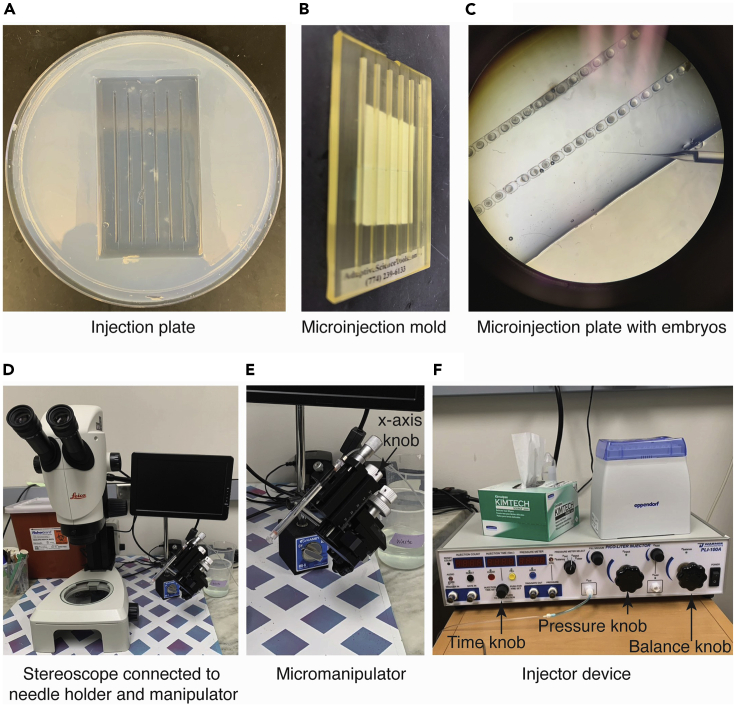
General setup of microinjection plate An example of a prepared microinjection plate (A) and the microinjection plate mold (B) used to produce the visualized troughs in the agarose plate to hold embryos is displayed. An example of the microinjection plate with embryos placed in troughs ready for injection is shown (C), the plate is rotated so the embryos run diagonally for ease of injection; Injection needle is displayed. Injection setup with stereoscope connected to needle holder (D) and manipulator (E), as well as microinjector (F) are shown.
Figure 2
Figure 2
Schematic procedure of microneedle preparation The micropipette puller device, the PUL-1000 (A) by World Precision instruments with needle pulling parameters (B) is displayed. The schematic (C) represents the pulling procedure detailed in “Injection Needle Preparation.” Briefly, open the lid (a′), slide the capillary glass through the heating filament (b′), secure the capillary glass with clamps (c′), and run the program to produce two needles with fused ends (d′).
Figure 3
Figure 3
Breeding tank setup Tank setup begins with the outer tank (A) of the breeding tank set. The inner meshed tank (B) is placed inside the outer tank. The divider (C) is placed in center slots of the meshed inner tank. The lid (D) covers the top of assembled breeding tank. Image of fully assembled breeding tank is shown (E).
Figure 4
Figure 4
Staging of zebrafish embryos to determine fixation time Zebrafish embryo developmental stages starting with the 1-cell stage (A), 2-cell stage (B), 4-cell stage (C), 8-cell stage (D), and 16-cell stage (E) are shown. Scale bar, 50 mm. Arrows indicate stage at which 8- and 16-cell stage embryos should be fixed.
Figure 5
Figure 5
Schematic of the hard-mounting procedure of zebrafish embryo cells The procedure begins by placing the embryos on glass slide (A). The needle tips of the 1 mL syringes are used to separate cells from yolk (B–D). The separated cells are oriented such that the yolk-free side (side that was not attached to yolk) is facing away from glass slide (E). The cover slip is placed on top of the cells after applying ProLong (F).
Figure 6
Figure 6
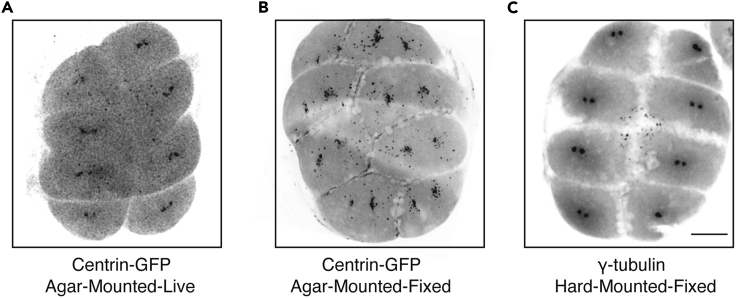
Representative confocal micrograph of 8-cell stage embryos Representative confocal maximum projection (gray inverted LUT) of an 8-cell embryo imaged using an HCX PL FLUOTAR 10×/0.32 objective. The images were taken from a live agarose-mounted centrin-GFP embryo (A), a fixed agarose-mounted centrin-GFP embryo (B) and a fixed hard-mounted embryo stained with anti-γ-tubulin antibody (C) are shown. Darker structures represent protein signal at the centrosomes. Scale bar, 100 μm.
Figure 7
Figure 7
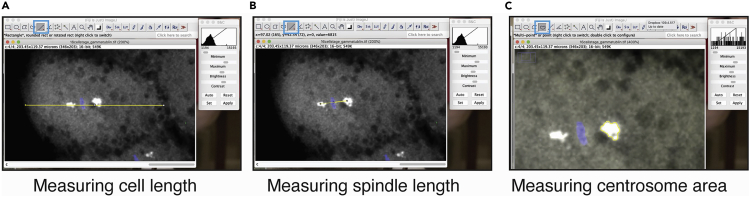
Representative images of Fiji measurements Representative zoomed in images of a 16-cell stage embryo imaged using an HCX PL FLUOTAR 10×/0.32 objective with manually labeled Fiji measurements of cell length (A), spindle length (B) and centrosome area (C). Length measurements were performed using the “straight line segment” tool highlighted with cyan box (A, B). Centrosome area was traced and measured using the “free selection” tool highlighted in cyan box (C).

References

    1. Kimmel C.B., Ballard W.W., Kimmel S.R., Ullmann B., Schilling T.F. Stages of embryonic development of the Zebrafish. Dev. Dyn. 1995;203:253–310. - PubMed
    1. JoVE Science Education Database . JoVE; 2020. Biology II: Mouse, Zebrafish, and Chick. Zebrafish Microinjection Techniques.
    1. Rathbun L.I., Aljiboury A.A., Bai X., Hall N.A., Manikas J., Amack J.D., Bembenek J.N., Hehnly H. PLK1- and PLK4-mediated asymmetric mitotic centrosome size and positioning in the early zebrafish embryo. Curr. Biol. 2020;30:4519–4527.e3. - PMC - PubMed
    1. Schindelin J., Arganda-Carreras I., Frise E., Kaynig V., Lοngair M., Pietzsch T., Preibisch S., Rueden C., Saalfeld S., Schmid B. Fiji: an open-source platform for biological-image analysis. Nat Methods. 2012;9:676–682. - PMC - PubMed
    1. Westerfield M. Fourth Edition. University of Oregon Press; 2000. The zebrafish book. A guide for the laboratory use of zebrafish (Danio rerio)

Publication types

MeSH terms

Substances

LinkOut - more resources