. 2021 Mar 2;54(5):1298-1306.
doi: 10.1021/acs.accounts.0c00852. Epub 2021 Feb 6.

Replication of Sequence Information in Synthetic Oligomers

Affiliations

Replication of Sequence Information in Synthetic Oligomers

Diego Núñez-Villanueva et al. Acc Chem Res. .

Abstract

The holy grail identified by Orgel in his 1995 Account was the development of novel chemical systems that evolve using reactions in which replication and information transfer occur together. There has been some success in the adaption of nucleic acids to make artificial analogues and in templating oligomerization reactions to form synthetic homopolymers, but replication of sequence information in synthetic polymers remains a major unsolved problem. In this Account, we describe our efforts in this direction based on a covalent base-pairing strategy to transfer sequence information between a parent template and a daughter copy. Oligotriazoles, which carry information as a sequence of phenol and benzoic acid side chains, have been prepared from bifunctional monomers equipped with an azide and an alkyne. Formation of esters between phenols and benzoic acids is used as the equivalent of nucleic base pairing to covalently attach monomer building blocks to a template oligomer. Sequential protection of the phenol side chains on the template, ester coupling of the benzoic acid side chains, and deprotection and ester coupling of the phenol side chains allow quantitative selective base-pair formation on a mixed sequence template. Copper catalyzed azide alkyne cycloaddition (CuAAC) is then used to oligomerize the monomers on the template. Finally, cleavage of the ester base pairs in the product duplex by hydrolysis releases the copy strand. This covalent template-directed synthesis strategy has been successfully used to copy the information encoded in a trimer template into a sequence-complementary oligomer in high yield.The use of covalent base pairing provides opportunities to manipulate the nature of the information transferred in the replication process. By using traceless linkers to connect the phenol and benzoic acid units, it is possible to carry out direct replication, reciprocal replication, and mutation. These preliminary results are promising, and methods have been developed to eliminate some of the side reactions that compete with the CuAAC process that zips up the duplex. In situ end-capping of the copy strand was found to be an effective general method for blocking intermolecular reactions between product duplexes. By selecting an appropriate concentration of an external capping agent, it is also possible to intercept macrocyclization of the reactive chain ends in the product duplex. The other side reaction observed is miscoupling of monomer units that are not attached to adjacent sites on the template, and optimization is required to eliminate these reactions. We are still some way from an evolvable synthetic polymer, but the chemical approach to molecular replication outlined here has some promise.


Conflict of interest statement

The authors declare no competing financial interest.

Figures
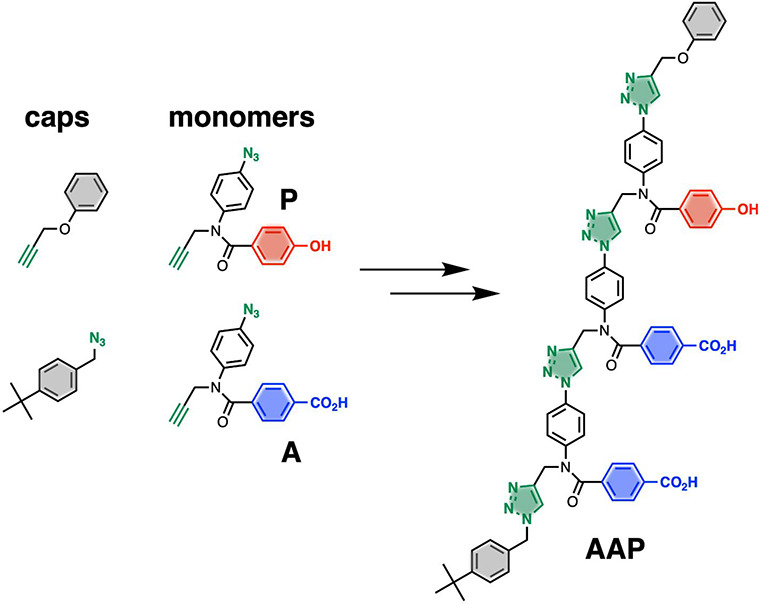
Figure 1
Figure 1
Building blocks used for the synthesis of triazole oligomers, where chemical information is encoded as the sequence of phenol (P) and benzoic acid (A) side chains. The backbone has a direction, and the sequence of an oligomer AAP is written starting from the alkyne end.
Figure 2
Figure 2
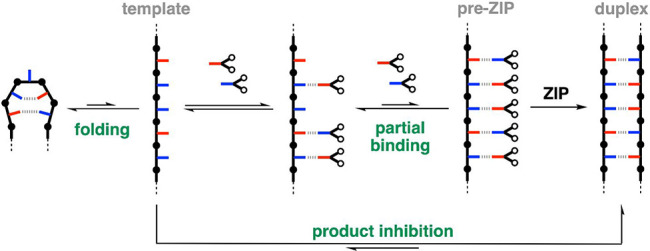
Noncovalent template-directed oligomer synthesis. The red and blue bars represent two different bases that form a base pair via noncovalent interactions represented by dashed gray lines, and the white and black dots correspond to reactive sites before and after the ZIP reaction that forms the backbone. Equilibria that compete with assembly of the key pre-ZIP intermediate are highlighted in green.
Figure 3
Figure 3
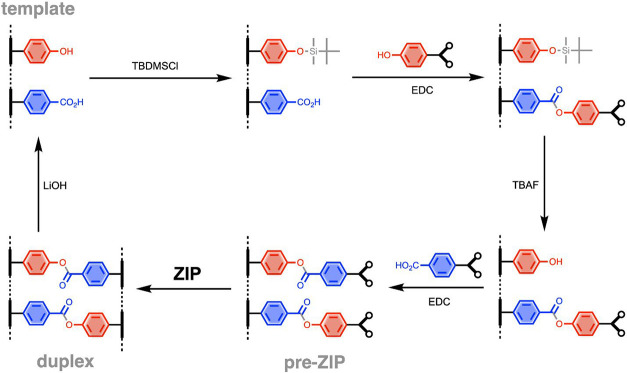
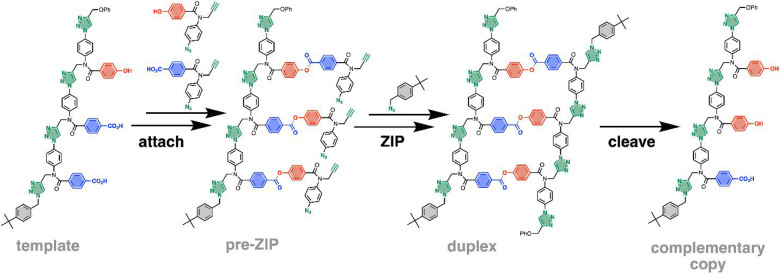
A kinetically inert base-pairing system based on ester chemistry. Selective protection followed by ester coupling attaches the phenol monomer to the template. Then deprotection followed by ester coupling step attaches the benzoic acid monomer. The base pairs are cleaved by ester hydrolysis.
Figure 4
Figure 4
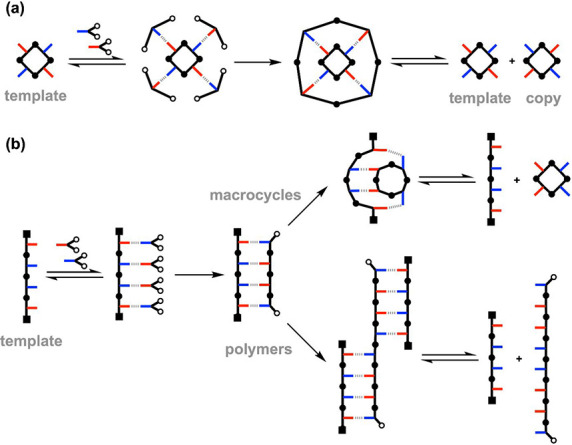
(a) In cyclic templating, the product duplex is stable, because all of the reactive sites (white dots) are consumed. (b) In linear templating, the product duplex has reactive end groups that can react further to form macrocycles or polymers.
Figure 5
Figure 5
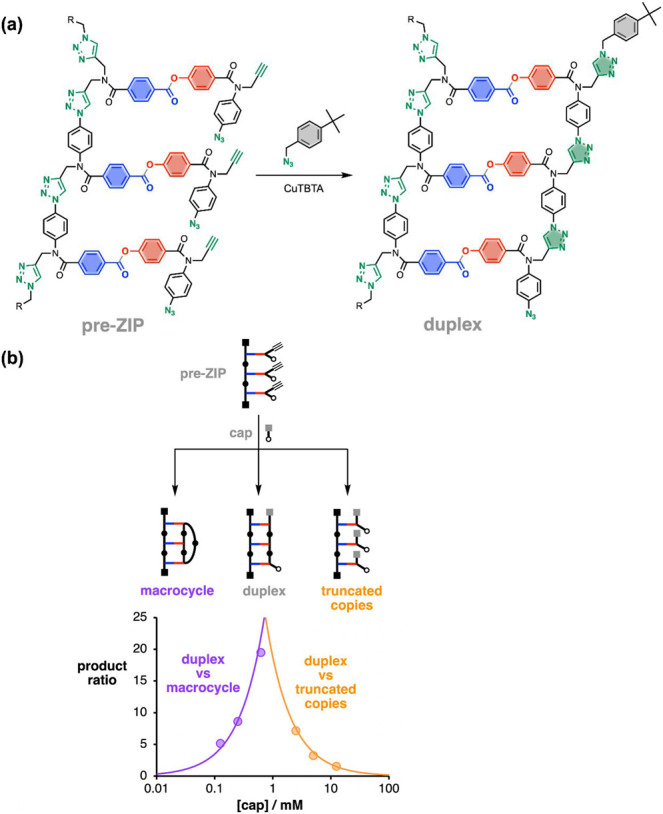
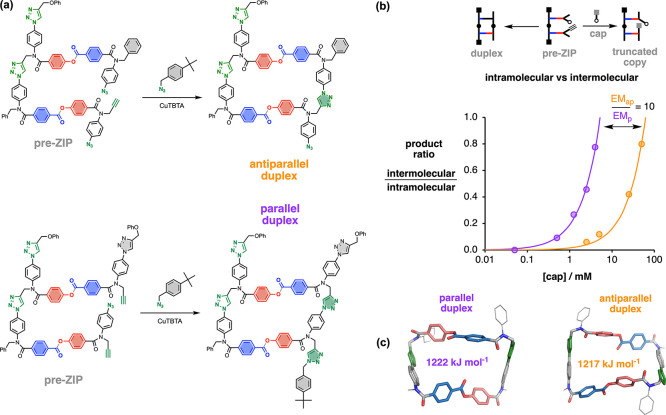
In situ capping of chain ends in the ZIP step. (a) When the CuAAC reaction is carried out on the pre-ZIP intermediate in the presence of an excess of 4-tert-butylbenzyl azide, a single major product is obtained. An antiparallel arrangement of the backbones in the duplex is shown, but the parallel product is also possible (see below). R = 3,5-di-tert-butylphenyl. (b) The effect of the concentration of the capping agent on the product distribution. The lines are the theoretical relationships obtained if the product ratio is directly proportional to the ratio of the concentration of the capping agent and the effective molarity for the intramolecular reaction leading to macrocylization (purple) or to zipping up the duplex (orange).
Figure 6
Figure 6
Precapped monomers determine the backbone direction of the product duplex. (a) The only possible product of the CuAAC reaction is (a) the antiparallel duplex when a terminal alkyne group is removed in the pre-ZIP intermediate or the parallel duplex when a terminal azide group is capped in the pre-ZIP intermediate. (b) Addition of increasing amounts of an external capping agent (4-tert-butylbenzyl azide) was used to determine values of EM through competition with the intramolecular reaction. Ten times more of the capping agent was required to compete with formation of the antiparallel duplex (orange data) than the parallel duplex (purple data). The lines are the theoretical relationships obtained if the product ratio is directly proportional to the ratio of the concentration of the capping agent and the effective molarity for the intramolecular reaction. (c) Molecular mechanics models of isomeric parallel and antiparallel duplexes suggest that the antiparallel backbone arrangement is lower in energy (MMFFs force field with chloroform solvation).
Figure 7
Figure 7
Sequence information transfer using covalent template-directed synthesis based on ester base-pair chemistry. The monomers were attached to the template (AAP) to give the pre-ZIP intermediate using the reaction sequence shown in Figure 4. A CuAAC reaction in the presence of a capping azide gave the corresponding duplex (only the major isomer is shown). The ester base pairs were cleaved by hydrolysis to regenerate the template, and capping of the terminal azide in the templated product gave the sequence-complementary copy, APP, as the major product.
Figure 8
Figure 8
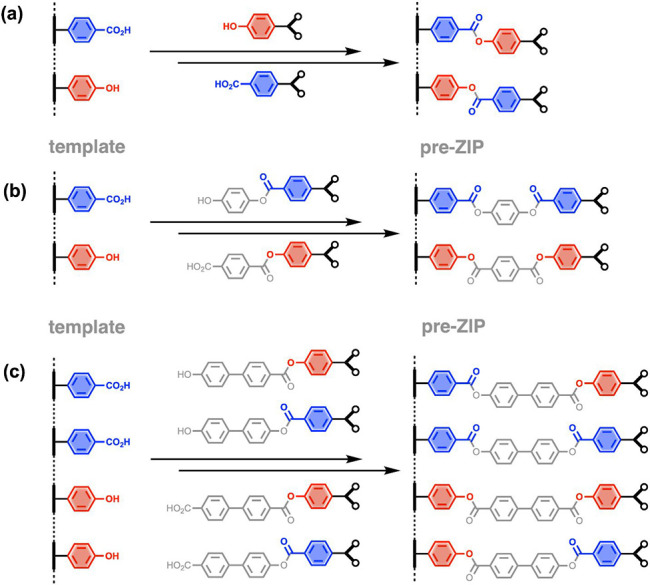
Information transferred from the parent to the daughter strand can be programmed by using base pairs connected by traceless linkers (gray). (a) Reciprocal replication. A base pair formed by the direct attachment of benzoic acid and phenol units results in a complementary copy of the template. (b) Direct replication. Connecting two identical bases via a symmetric linker results in an identical copy of the template after cleavage of all of the ester bonds to release the linker. (c) Replication with mutation. Isosteric linkers can be used to introduce mixtures of symmetric and unsymmetric base pairs, which result in simultaneous direct and reciprocal copying.
Figure 9
Figure 9
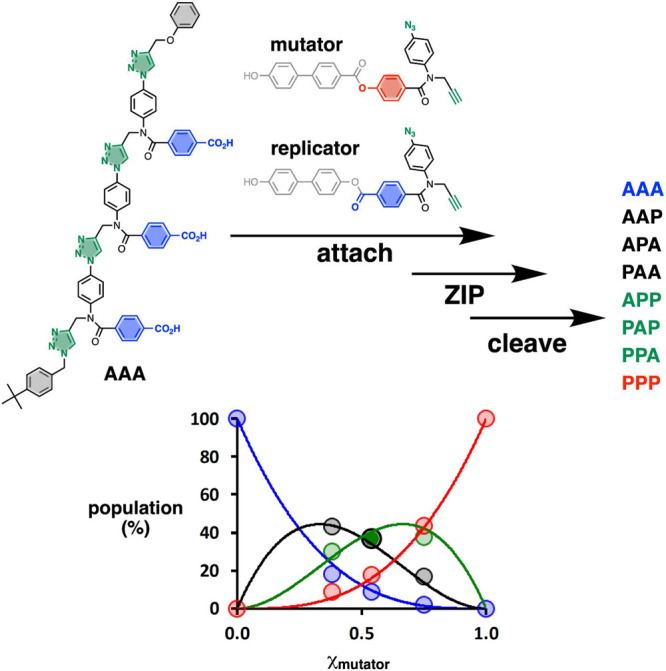
Product distributions for covalent template-directed replication of an AAA template in the presence of different amounts of a mutator monomer (χmutator). The population of the direct copy AAA is shown in blue, products with a single phenol mutation are shown in black, two phenol mutations are shown in green, and the fully mutated reciprocal copy PPP is shown in red. Calculated statistical distributions are shown as lines, and the experimental results are shown as dots.
Figure 10
Figure 10
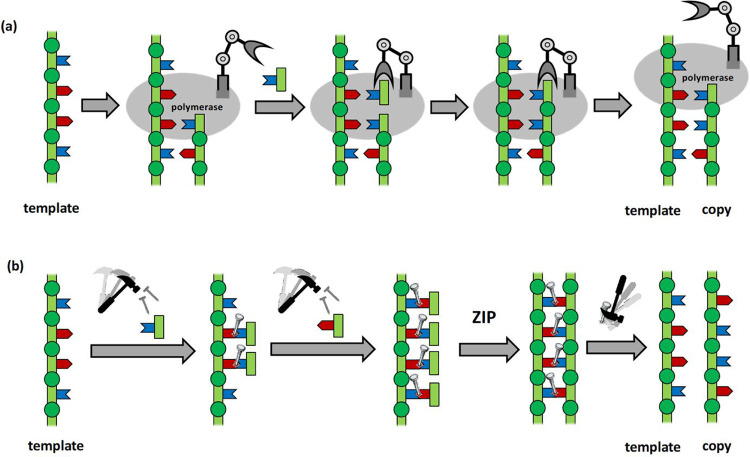
(a) Stepwise information transfer using kinetically labile base pairs in nucleic acids controlled by a polymerase. (b) Parallel information transfer using kinetically inert base pairs is an alternative chemical approach.

References

    1. Núñez-Villanueva D.; Ciaccia M.; Iadevaia G.; Sanna E.; Hunter C. A. Sequence Information Transfer Using Covalent Template-Directed Synthesis. Chem. Sci. 2019, 10, 5258–5266. 10.1039/C9SC01460H. - DOI - PMC - PubMed
    1. Ciaccia M.; Núñez-Villanueva D.; Hunter C. A. Capping Strategies for Covalent Template-Directed Synthesis of Linear Oligomers Using CuAAC. J. Am. Chem. Soc. 2019, 141, 10862–10875. 10.1021/jacs.9b04973. - DOI - PubMed
    1. Núñez-Villanueva D.; Hunter C. A. Controlled Mutation in the Replication of Synthetic Oligomers. Chem. Sci. 2021, 10.1039/D0SC06770A. - DOI - PMC - PubMed
    1. Sinden R. R.DNA Structure and Function; Academic Press: 1994; 10.1016/C2009-0-02451-9. - DOI
    1. Griffiths A. J. F.; Gelbart W. M.; Miller J. H.; Lewontin R. C.. Modern genetic analysis; Freeman: 1999.

Publication types

LinkOut - more resources