


The Impact of COVID-19 Viral Infection on the Hypothalamic-Pituitary-Adrenal Axis
- PMID: 33554871
- PMCID: PMC7837186
- DOI: 10.1016/j.eprac.2020.10.014
The Impact of COVID-19 Viral Infection on the Hypothalamic-Pituitary-Adrenal Axis
Abstract
Objective: To study the adrenocortical response to an acute coronavirus disease-2019 (COVID-19) infection.
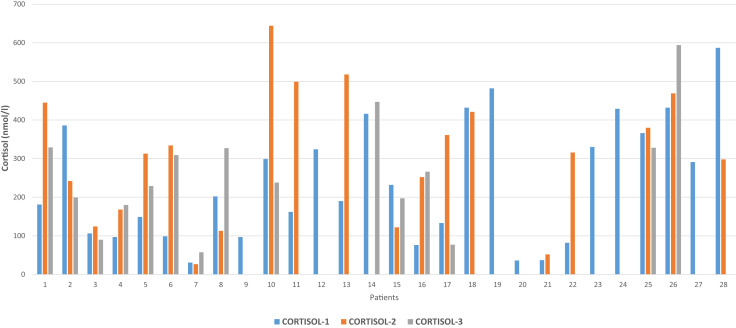
Methods: Morning plasma cortisol, adrenocorticotropic hormone (ACTH), and dehydroepiandrosterone sulfate levels were measured in 28 consecutive patients with COVID-19 (16 men, 12 women, median age 45.5 years, range 25-69 years) on day 1 to 2 of hospital admission. These tests were repeated twice in 20 patients and thrice in 15 patients on different days. The hormone levels were correlated with severity of the disease.
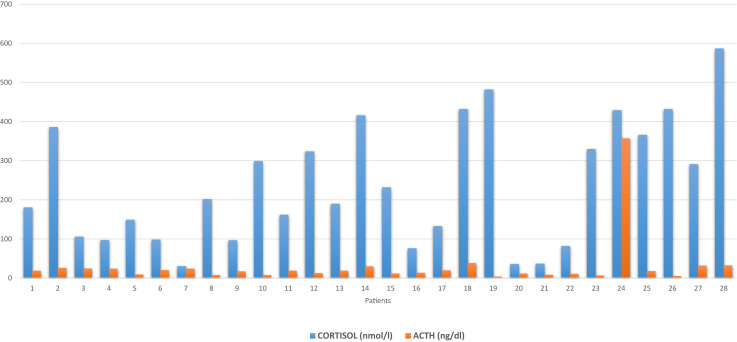
Results: The median morning cortisol level was 196 (31-587) nmol/L. It was <100 nmol/L in 8 patients (28.6%), <200 nmol/L in 14 patients (50%), and <300 nmol/L in 18 patients (64.3%). The corresponding ACTH values had a median of 18.5 ng/L (range 4-38 ng/L), and the ACTH level was <10 ng/L in 7 patients (26.9%), <20 ng/L in 17 patients (60.7%), and <30 ng/L in 23 patients (82.1%). The repeated testing on different days showed a similar pattern. Overall, if a cutoff level of <300 nmol/L is considered abnormal in the setting of acute disease, 9 patients (32%) had cortisol levels below this limit, regardless of whether the test was done only once (3 patients) or 3 times (6 patients). When the disease was more severe, the patients had lower cortisol and ACTH levels, suggesting a direct link between the COVID-19 infection and impaired glucocorticoid response.
Conclusion: Unexpectedly, the adrenocortical response in patients with COVID-19 infection was impaired, and a significant percentage of the patients had plasma cortisol and ACTH levels consistent with central adrenal insufficiency.
Keywords: ACTH; COVID-19; SARS-CoV-2; cortisol; glucocorticoids; hypothalamic-pituitary-adrenal axis.
Copyright © 2020 AACE. Published by Elsevier Inc. All rights reserved.
Figures
References
-
- World Health Organization . 2020. Coronavirus disease 2019 (COVID-19): situation report, 59.
-
- Accessed October 5, 2020. https://www.worldometers.info/coronavirus/
MeSH terms
Substances
LinkOut - more resources
Full Text Sources
Other Literature Sources
Medical
Research Materials
Miscellaneous
