


Mild Behavioral Impairment and Subjective Cognitive Decline Predict Cognitive and Functional Decline
- PMID: 33554909
- PMCID: PMC8075401
- DOI: 10.3233/JAD-201184
Mild Behavioral Impairment and Subjective Cognitive Decline Predict Cognitive and Functional Decline
Abstract
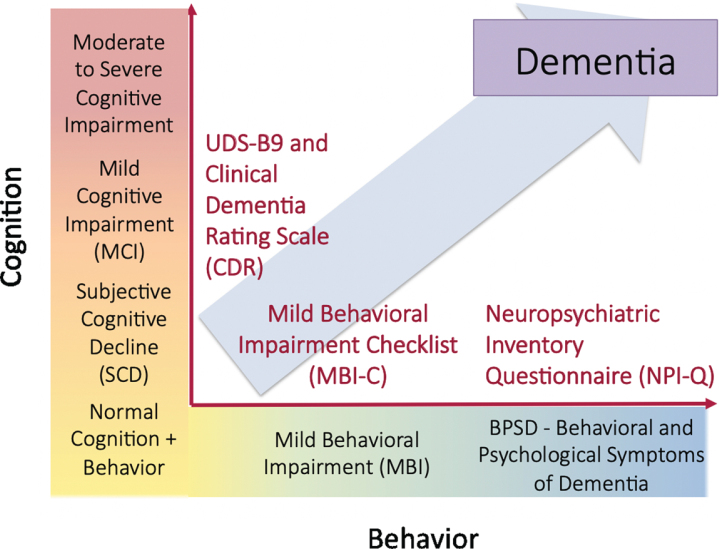
Background: Mild behavioral impairment (MBI) and subjective cognitive decline (SCD) are dementia risk states, and potentially represent neurobehavioral and neurocognitive manifestations, respectively, of early stage neurodegeneration. Both MBI and SCD predict incident cognitive decline and dementia, are associated with known dementia biomarkers, and are both represented in the NIA-AA research framework for AD in Stage 2 (preclinical disease).
Objective: To assess the associations of MBI and SCD, alone and in combination, with incident cognitive and functional decline in a population of older adults. We tested the hypothesis that MBI and SCD confer additive risk for decline.
Methods: Cognitively normal participants were followed up annually at Alzheimer's Disease Centers. Logistic regression assessed the relationship between baseline classification (MBI-SCD-, MBI-SCD+, MBI+SCD-, or MBI+SCD+) and 3-year outcome.
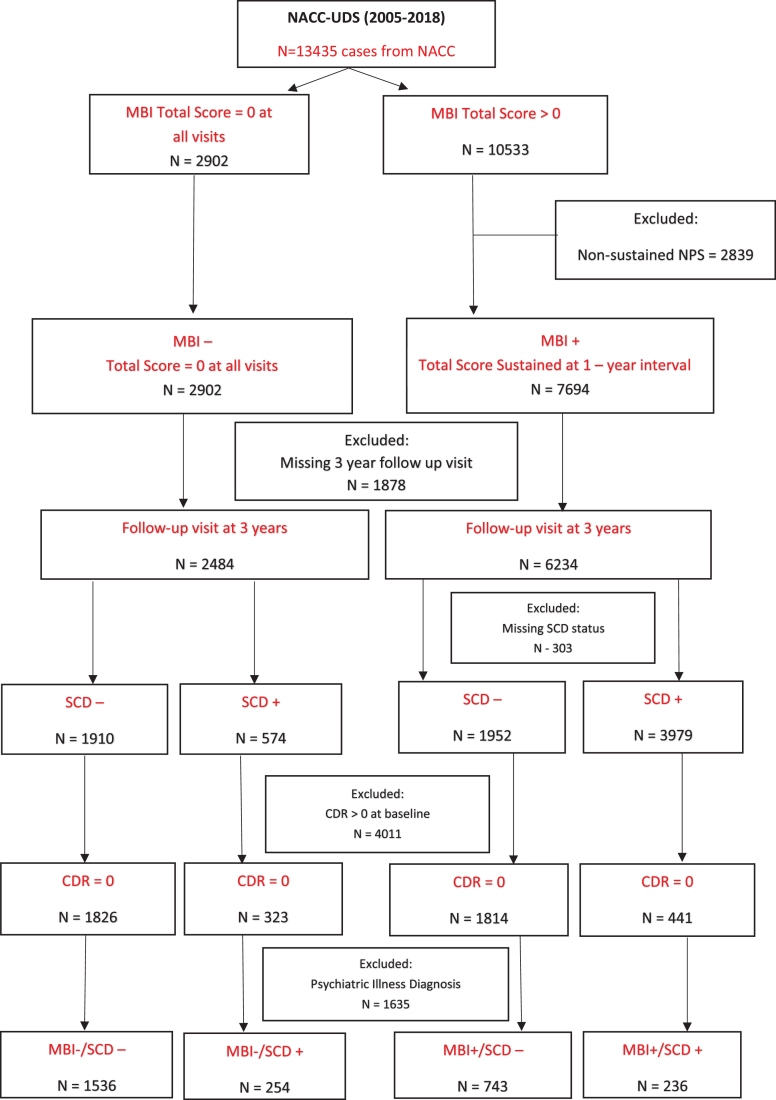
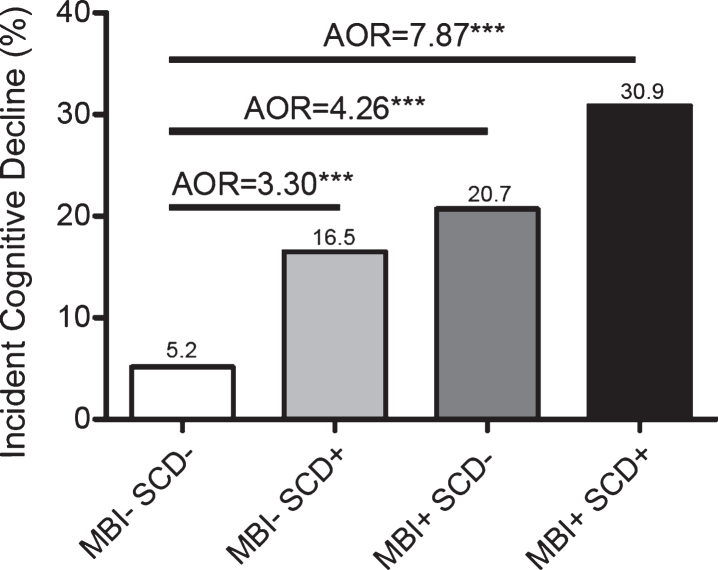
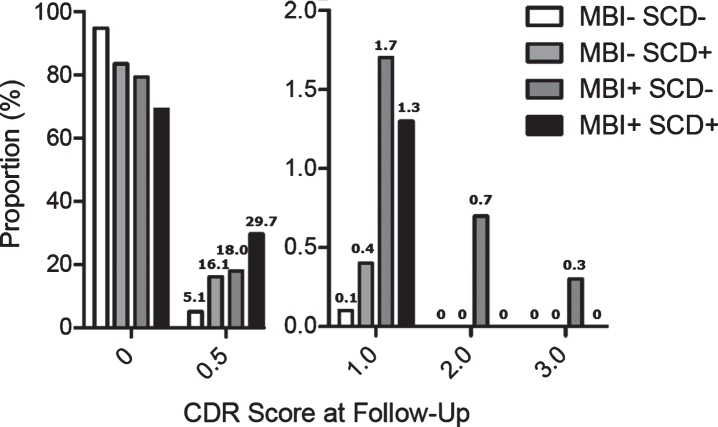
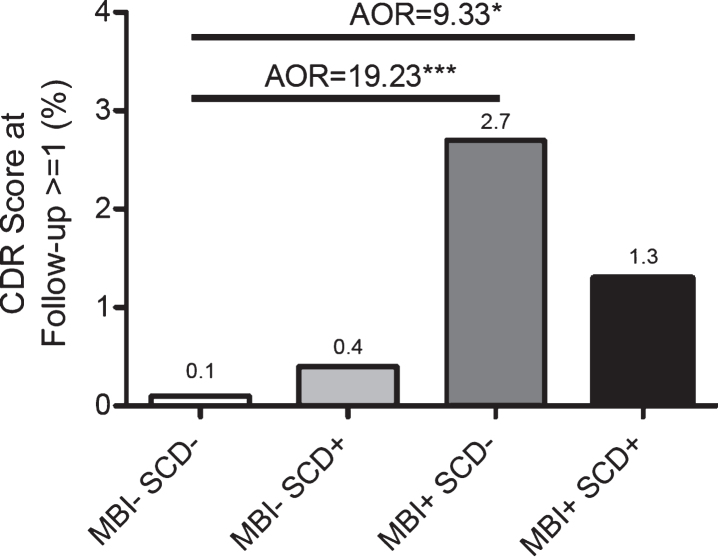
Results: Of 2,769 participants (mean age=76), 1,536 were MBI-SCD-, 254 MBI-SCD+, 743 MBI+SCD-, and 236 MBI+SCD+. At 3 years, 349 (12.6%) declined to CDR >0, including 23.1% of the MBI+group, 23.5% of the SCD+group, and 30.9% of the intersection group of both MBI+and SCD+participants. Compared to SCD-MBI-, we observed an ordinal progression in risk (ORs [95% CI]): 3.61 [2.42-5.38] for MBI-SCD+ (16.5% progression), 4.76 [3.57-6.34] for MBI+SCD- (20.7%), and 8.15 [5.71-11.64] for MBI+SCD+(30.9%).
Conclusion: MBI and SCD together were associated with the greatest risk of decline. These complementary dementia risk syndromes can be used as simple and scalable methods to identify high-risk patients for workup or for clinical trial enrichment.
Keywords: Mild behavioral impairment; mild cognitive impairment; neuropsychiatric symptoms; preclinical Alzheimer’s disease; subjective cognitive decline.
Conflict of interest statement
Authors’ disclosures available online (
Figures
References
-
- Mortby ME, Black SE, Gauthier S, Miller DS, Porsteinsson A, Smith EE, Ismail Z (2018) Dementia clinical trial implications of mild behavioral impairment. Int Psychogeriatr 30, 171–175. - PubMed
-
- Gauthier S, Albert M, Fox N, Goedert M, Kivipelto M, Mestre-Ferrandiz J, Middleton LT (2016) Why has therapy development for dementia failed in the last two decades? Alzheimers Dement 12, 60–64. - PubMed
Publication types
MeSH terms
Grants and funding
- P50 AG005142/AG/NIA NIH HHS/United States
- P30 AG010133/AG/NIA NIH HHS/United States
- P50 AG005146/AG/NIA NIH HHS/United States
- P50 AG047266/AG/NIA NIH HHS/United States
- P30 AG008017/AG/NIA NIH HHS/United States
- P30 AG010161/AG/NIA NIH HHS/United States
- P50 AG025688/AG/NIA NIH HHS/United States
- P50 AG005133/AG/NIA NIH HHS/United States
- P50 AG005138/AG/NIA NIH HHS/United States
- P50 AG047366/AG/NIA NIH HHS/United States
- P30 AG019610/AG/NIA NIH HHS/United States
- P30 AG028383/AG/NIA NIH HHS/United States
- P30 AG013854/AG/NIA NIH HHS/United States
- P30 AG053760/AG/NIA NIH HHS/United States
- P30 AG062428/AG/NIA NIH HHS/United States
- P30 AG010124/AG/NIA NIH HHS/United States
- P50 AG023501/AG/NIA NIH HHS/United States
- P30 AG062421/AG/NIA NIH HHS/United States
- P30 AG035982/AG/NIA NIH HHS/United States
- P50 AG008702/AG/NIA NIH HHS/United States
- U01 AG016976/AG/NIA NIH HHS/United States
- P30 AG008051/AG/NIA NIH HHS/United States
- P50 AG005681/AG/NIA NIH HHS/United States
- P30 AG013846/AG/NIA NIH HHS/United States
- P50 AG047270/AG/NIA NIH HHS/United States
- P30 AG062429/AG/NIA NIH HHS/United States
- P50 AG005136/AG/NIA NIH HHS/United States
- P30 AG049638/AG/NIA NIH HHS/United States
- P30 AG012300/AG/NIA NIH HHS/United States
- P30 AG062422/AG/NIA NIH HHS/United States
- P50 AG016573/AG/NIA NIH HHS/United States
- P30 AG062715/AG/NIA NIH HHS/United States
- P30 AG010129/AG/NIA NIH HHS/United States
LinkOut - more resources
Full Text Sources
Other Literature Sources
Medical
