. 2021 Mar;38(3):1627-1637.
doi: 10.1007/s12325-021-01630-z. Epub 2021 Feb 8.

Psychosocial Comorbidities and Health Status Among Adults with Moderate-to-Severe Atopic Dermatitis: A 2017 US National Health and Wellness Survey Analysis

Affiliations

Psychosocial Comorbidities and Health Status Among Adults with Moderate-to-Severe Atopic Dermatitis: A 2017 US National Health and Wellness Survey Analysis

Shawn G Kwatra et al. Adv Ther. 2021 Mar.

Abstract

Introduction: Atopic dermatitis (AD) is associated with sleep difficulties, depression, and anxiety. We evaluated the relationship between these psychosocial comorbidities and health outcomes among adults with moderate-to-severe AD in the USA.

Methods: Data were analyzed from the 2017 US National Health and Wellness Survey. Respondents with a physician diagnosis of AD or eczema with moderate-to-severe AD based on a Dermatology Life Quality Index score of 6 or more were included. Generalized linear models were used to examine the relationship between psychosocial comorbidities (sleep difficulties and anxiety based on self-report, depression based on the Patient Health Questionnaire-9) and health outcomes [the 36-item Short Form Health Survey, version 2; EuroQol five-dimension, five-level; Work Productivity and Activity Impairment questionnaire; and healthcare resource utilization (HRU)].

Results: Among respondents with moderate-to-severe AD (N = 1017), 56.6%, 70.7%, and 60.9% reported sleep difficulties, depression, and anxiety, respectively. These comorbidities were significantly associated with reduced physical and mental component summary scores and increased overall work impairment (P < 0.05 for all). Increased HRU was also observed.

Conclusion: Psychosocial comorbidities were frequently reported by respondents with moderate-to-severe AD and were significantly associated with health status, work loss, and HRU.

Keywords: Anxiety; Atopic dermatitis; Depression; Health-related quality of life; Healthcare resource utilization; Itch; Pruritus; Sleep difficulties; Work impairment.


Figures
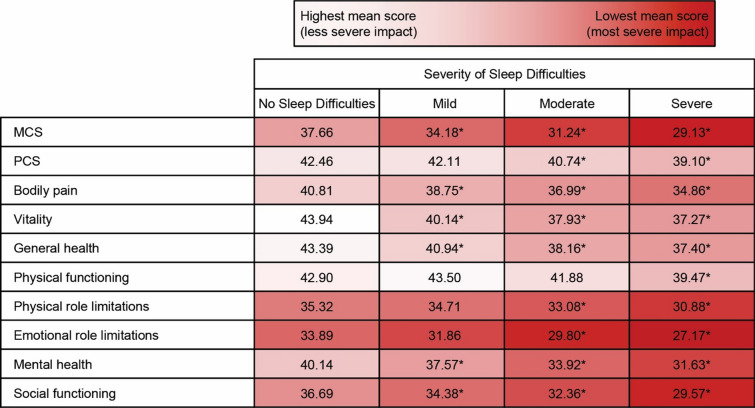
Fig. 1
Fig. 1
Heatmap of the SF-36v2 component summary and domain scores by the severity of sleep difficulties. Adjusted means were calculated on the basis of the results of generalized linear models that controlled for age, sex, race/ethnicity, education, income, employment status, body mass index, smoking status, alcohol use, Charlson comorbidity index, and the presence of other atopic conditions. *P < 0.05 relative to patients with no sleep difficulties. MCS mental component summary, PCS physical component summary, SF-36v2 36-item Short Form Health Survey, version 2
Fig. 2
Fig. 2
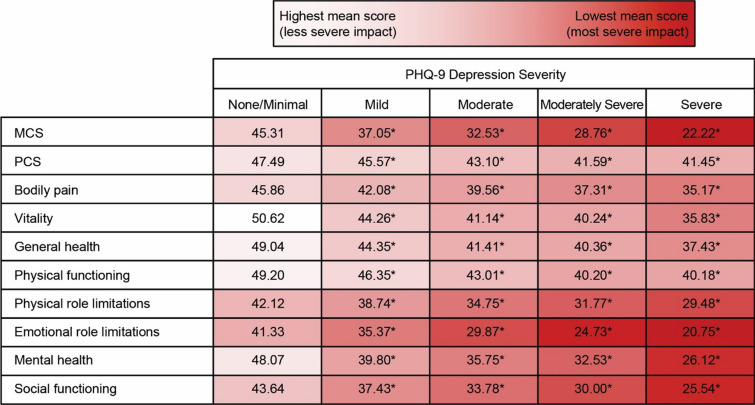
Heatmap of the association between depression severity and health status. Adjusted means were calculated on the basis of the results of generalized linear models that controlled for age, sex, race/ethnicity, education, income, employment status, body mass index, smoking status, alcohol use, Charlson comorbidity index, and the presence of other atopic conditions. *P < 0.05 relative to respondents with none/minimal depression. MCS mental component summary, PCS physical component summary, PHQ-9 Patient Health Questionnaire-9
Fig. 3
Fig. 3
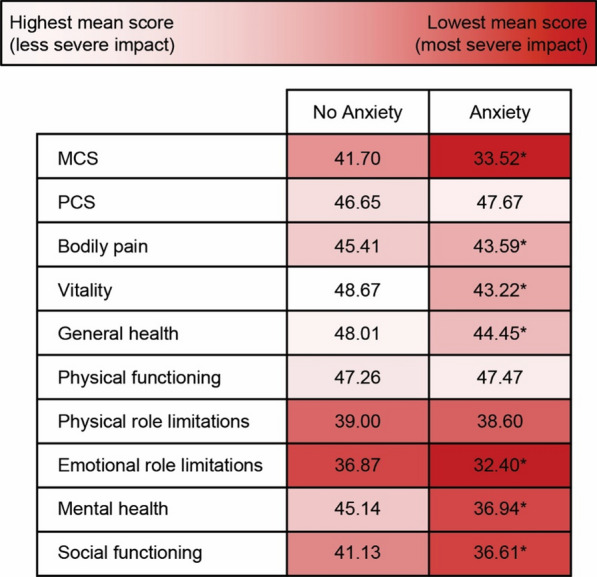
Heatmap of the association between the presence of anxiety and health status. Adjusted means were calculated on the basis of the results of generalized linear models that controlled for age, sex, race/ethnicity, education, income, employment status, body mass index, smoking status, alcohol use, Charlson comorbidity index, and the presence of other atopic conditions. *P < 0.05 relative to respondents with no anxiety. MCS mental component summary, PCS physical component summary

References

    1. Boguniewicz M, Fonacier L, Guttman-Yassky E, Ong PY, Silverberg J, Farrar JR. Atopic dermatitis yardstick: practical recommendations for an evolving therapeutic landscape. Ann Allergy Asthma Immunol. 2018;120(1):10–22.e2. doi: 10.1016/j.anai.2017.10.039. - DOI - PubMed
    1. Odhiambo JA, Williams HC, Clayton TO, Robertson CF, Asher MI. Global variations in prevalence of eczema symptoms in children from ISAAC phase three. J Allergy Clin Immunol. 2009;124(6):1251–8.e23. doi: 10.1016/j.jaci.2009.10.009. - DOI - PubMed
    1. Silverberg JI, Hanifin JM. Adult eczema prevalence and associations with asthma and other health and demographic factors: a US population-based study. J Allergy Clin Immunol. 2013;132(5):1132–1138. doi: 10.1016/j.jaci.2013.08.031. - DOI - PubMed
    1. Eckert L, Gupta S, Amand C, Gadkari A, Mahajan P, Gelfand JM. Impact of atopic dermatitis on health-related quality of life and productivity in adults in the United States: an analysis using the National Health and Wellness Survey. J Am Acad Dermatol. 2017;77(2):274–9.e3. doi: 10.1016/j.jaad.2017.04.019. - DOI - PubMed
    1. Yu SH, Attarian H, Zee P, Silverberg JI. Burden of sleep and fatigue in US adults with atopic dermatitis. Dermatitis. 2016;27(2):50–58. doi: 10.1097/DER.0000000000000161. - DOI - PubMed

Publication types