


Cochlear Implantation and Electric Acoustic Stimulation in Children With TMPRSS3 Genetic Mutation
- PMID: 33555745
- PMCID: PMC8594958
- DOI: 10.1097/MAO.0000000000002943
Cochlear Implantation and Electric Acoustic Stimulation in Children With TMPRSS3 Genetic Mutation
Abstract
Background: Mutations in the TMPRSS3 gene, although rare, can cause high frequency hearing loss with residual hearing at low frequencies. Several previous studies have reported cochlear implant (CI) outcomes for adults with TMPRSS3 mutation with mixed results. Although some studies have suggested that TMPRSS3 is expressed in spiral ganglion cells, it remains unclear if previously reported poor CI outcomes in this population were secondary to long durations of deafness or to the effects of the TMPRSS3 mutation. To date, no studies in the literature have reported CI outcomes for children with TMPRSS3 mutation treated with CI.
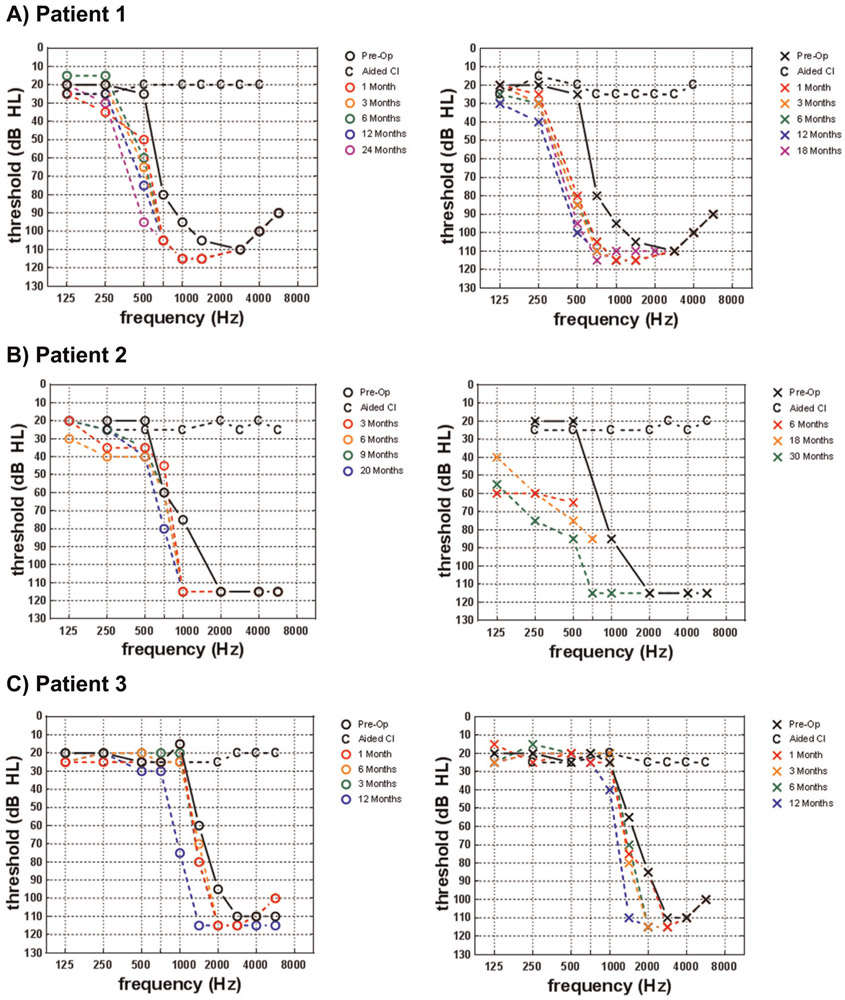
Objective: The current case series aimed to describe outcomes for three children with sloping hearing loss caused by TMPRSS3 mutation who underwent bilateral CI.
Study design: Case series.
Setting: Academic medical center.
Patients: Three children (3-4 yr) with TMPRSS3 mutation and normal sloping to profound high frequency hearing loss.
Interventions: CI and electric acoustic stimulation (EAS).
Main outcome measures: Outcome measures were residual hearing thresholds, speech recognition scores, and electrode placement determined via intraoperative CT imaging.
Results: All three children maintained residual acoustic hearing and received benefit from EAS. Mean change in low-frequency pure-tone average was 17 dB. Mean postoperative word and sentence recognition scores in the bilateral EAS condition were 80 and 75%, respectively.
Conclusions: Results indicate that CI with EAS is an appropriate treatment for children with TMPRSS3 genetic mutation. Pediatric results from this case series show more favorable CI outcomes than are currently reported for adults with TMPRSS3 mutation suggesting that the intervention may be time sensitive.
Copyright © 2020, Otology & Neurotology, Inc.
Conflict of interest statement
Conflict(S) of Interest to Declare: None directly related to this case series.
Figures
References
-
- Battelino S, Klancar G, Kovac J, Battelino T, Trebusak Podkrajsek K. TMPRSS3 mutations in autosomal recessive nonsyndromic hearing loss. Eur Arch Otorhinolaryngol 2016;273:1151–4. - PubMed
-
- Wattenhofer M, Di Iorio M, Rabionet R, et al. Mutations in the TMPRSS3 gene are a rare cause of childhood nonsyndromic deafness in Caucasian patients. J Mol Med 2002;80:124–31. - PubMed
-
- Scott HS, Kudoh J, Wattenhofer M, et al. Insertion of β-satellite repeats identifies a transmembrane protease causing both congenital and childhood onset autosomal recessive deafness. Nat Genet 2001;27:59–63. - PubMed
-
- Guipponi M, Toh MY, Tan J, et al. An integrated genetic and functional analysis of the role of type II transmembrane serine proteases (TMPRSSs) in hearing loss. Hum Mutat 2008;29:130–41. - PubMed
Publication types
MeSH terms
Substances
Grants and funding
LinkOut - more resources
Full Text Sources
Medical
Miscellaneous
