


Artemisinin-based combination therapy (ACT) and drug resistance molecular markers: A systematic review of clinical studies from two malaria endemic regions - India and sub-Saharan Africa
- PMID: 33556786
- PMCID: PMC7887327
- DOI: 10.1016/j.ijpddr.2020.11.006
Artemisinin-based combination therapy (ACT) and drug resistance molecular markers: A systematic review of clinical studies from two malaria endemic regions - India and sub-Saharan Africa
Abstract
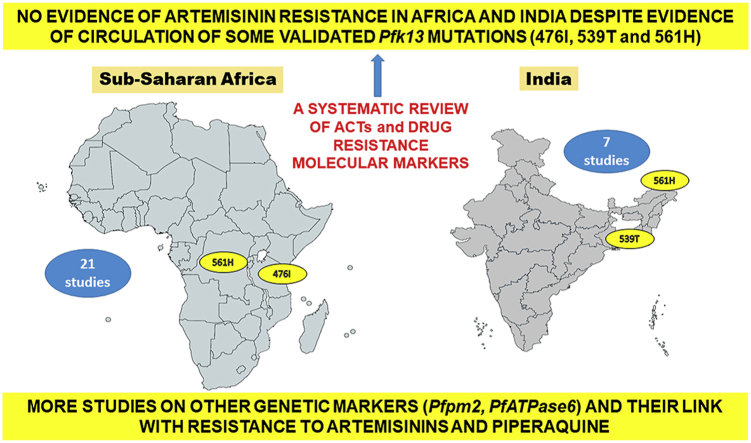
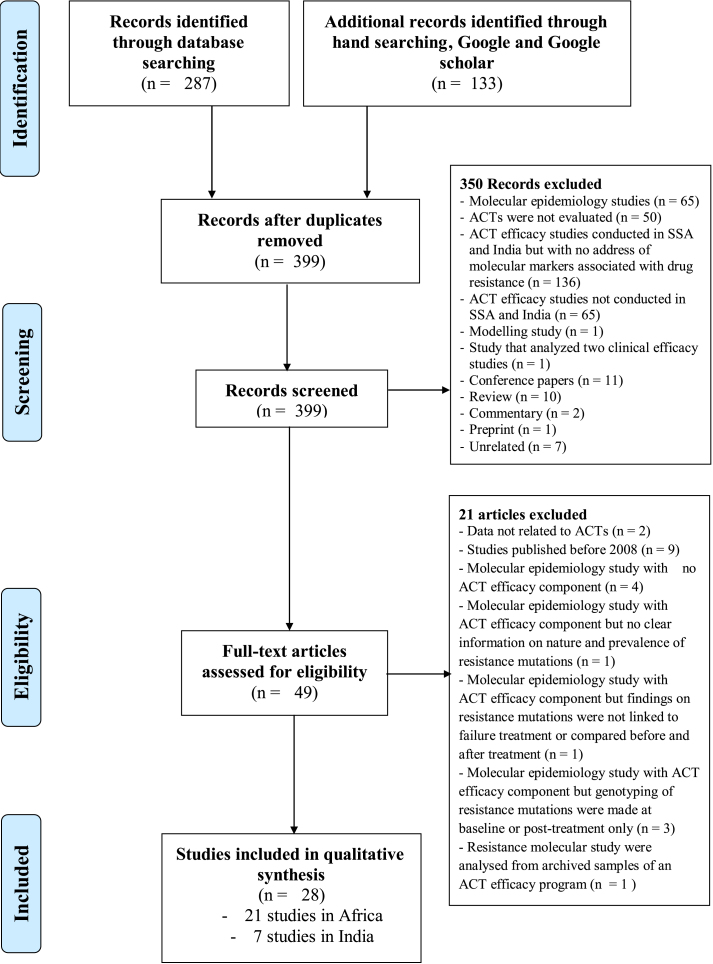
Artemisinin-based combination therapies (ACT) are currently used as a first-line malaria therapy in endemic countries worldwide. This systematic review aims at presenting the current scenario of drug resistance molecular markers, either selected or involved in treatment failures (TF) during in vivo ACT efficacy studies from sub-Saharan Africa (sSA) and India. Eight electronic databases were comprehensively used to search relevant articles and finally a total of 28 studies were included in the review, 21 from sSA and seven from India. On analysis, Artemether + lumefantrine (AL) and artesunate + sulfadoxine-pyrimethamine (AS + SP) are the main ACT in African and Indian regions with a 28-day efficacy range of 54.3-100% for AL and 63-100% for AS + SP respectively. It was observed that mutations in the Pfcrt (76T), Pfdhfr (51I, 59R, 108N), Pfdhps (437G) and Pfmdr1 (86Y, 184F, 1246Y) genes were involved in TF, which varied with respect to ACTs. Based on studies that have genotyped the Pfk13 gene, the reported TF cases, were mainly linked with mutations in genes associated with resistance to ACT partner drugs; indicating that the protection of the partner drug efficacy is crucial for maintaining the efficacy of ACT. This review reveals that ACT are largely efficacious in India and sSA despite the fact that some clinical efficacy and epidemiological studies have reported some validated mutations (i.e., 476I, 539T and 561H) in circulation in these two regions. Also, the role of PfATPase6 in ART resistance is controversial still, while P. falciparum plasmepsin 2 (Pfpm2) in piperaquine (PPQ) resistance and dihydroartemisinin (DHA) + PPQ failures is well documented in Southeast Asian countries but studied less in sSA. Hence, there is a need for continuous molecular surveillance of Pfk13 mutations for emergence of artemisinin (ART) resistance in these countries.
Keywords: Artemisinin-based combination therapy (ACT); Drug resistance molecular markers; Failure treatment; India; Sub-Saharan African countries.
Copyright © 2020 The Authors. Published by Elsevier Ltd.. All rights reserved.
Conflict of interest statement
The authors declare that they have no known competing financial interests or personal relationships that could have appeared to influence the work reported in this paper.
Figures
References
-
- Adjekukor C.U. Past and current findings in antimalarial drug resistance molecular markers in endemic areas of Africa. Int J Trop Dis Health. 2018;30:1–11. doi: 10.9734/IJTDH/2018/41204. - DOI
-
- Amato R., Lim P., Miotto O., Neal A.T., Sreng S., Suon S., Drury E. Genetic markers associated with dihydroartemisinin–piperaquine failure in Plasmodium falciparum malaria in Cambodia: a genotype-phenotype association study. Lancet Infect. Dis. 2017;17:164–173. doi: 10.1016/S1473-3099(16)30409-1. - DOI - PMC - PubMed
Publication types
MeSH terms
Substances
LinkOut - more resources
Full Text Sources
Other Literature Sources
Medical
Research Materials
Miscellaneous
