Review
. 2021 Feb 4;22(4):1579.
doi: 10.3390/ijms22041579.

Genetic Therapy for Intervertebral Disc Degeneration

Affiliations
Review

Genetic Therapy for Intervertebral Disc Degeneration

Eun Ji Roh et al. Int J Mol Sci. .

Abstract

Intervertebral disc (IVD) degeneration can cause chronic lower back pain (LBP), leading to disability. Despite significant advances in the treatment of discogenic LBP, the limitations of current treatments have sparked interest in biological approaches, including growth factor and stem cell injection, as new treatment options for patients with chronic LBP due to IVD degeneration (IVDD). Gene therapy represents exciting new possibilities for IVDD treatment, but treatment is still in its infancy. Literature searches were conducted using PubMed and Google Scholar to provide an overview of the principles and current state of gene therapy for IVDD. Gene transfer to degenerated disc cells in vitro and in animal models is reviewed. In addition, this review describes the use of gene silencing by RNA interference (RNAi) and gene editing by the clustered regularly interspaced short palindromic repeats (CRISPR) system, as well as the mammalian target of rapamycin (mTOR) signaling in vitro and in animal models. Significant technological advances in recent years have opened the door to a new generation of intradiscal gene therapy for the treatment of chronic discogenic LBP.

Keywords: CRISPR-Cas9; RNAi; genetic therapy; intervertebral disc degeneration; mTOR signaling; vector.


Conflict of interest statement

The authors declare no conflict of interest.

Figures
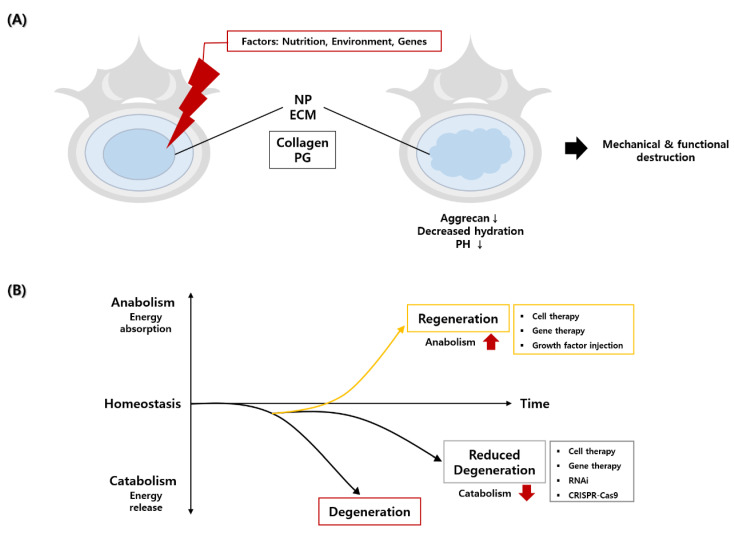
Figure 1
Figure 1
A schematic diagram of the cause of intervertebral disc degeneration and strategies to reduce disc degeneration and promote disc regeneration. (A) Nutritional, environmental, and genetic factors have caused changes in collagen and proteoglycan (PG) and the composition of the extracellular matrix (ECM) in nucleus pulposus (NP), resulting in a decrease in aggrecan and pH and loss of hydration, which systematically and functionally destroyed NP. (B) Regeneration of degenerated disc could be induced by an increase in anabolism and a decrease in disc degeneration could be induced by a decrease in catabolism.
Figure 2
Figure 2
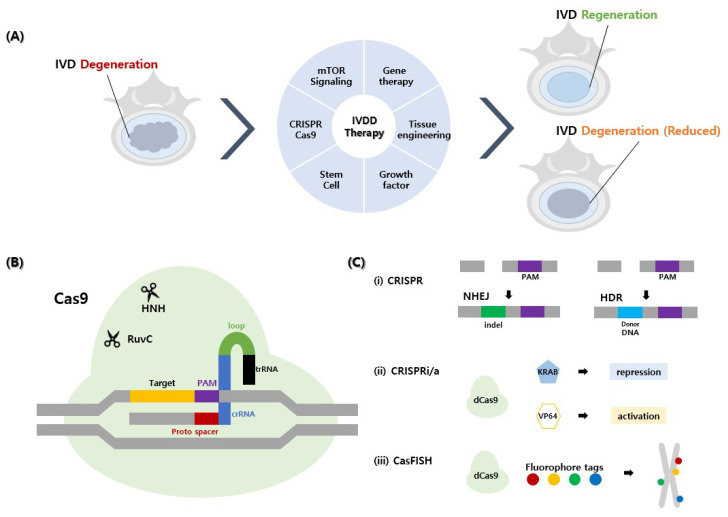
Schematic illustration of novel biological approaches and CRISPR-Cas9 as a gene therapy for the treatment of intervertebral disc degeneration (IVDD). Representative newly discovered biological approaches for the treatment of IVDD are shown as follows. (A) A simple diagram illustrating regeneration of IVDD using gene therapy, tissue engineering, growth factor, stem cell, CRISPR-Cas9, and mTOR signaling. (B) The form in which sgRNA, Cas9, and DNA are attached is called CRISPR-Cas9. sgRNA consisting of proto-spacer, crRNA, loop, and trRNA is cut and attached to the DNA proto spacer adjacent motif (PAM) sequence through Cas9 using HNH and Ruvc scissors. (C) The recovery mechanism of CRISPR-Cas9 in the intervertebral disc is as follows: (i) non-homologous end joining (NHEJ) of CRISPR inserts or deletes indels, and homology-directed repair (HDR) inserts new segments of DNA. (ii) CRISPR interference (CRISPRi) and CRISPR activation (CRISPRa) use dead Cas9 (dCas9) as a technology to mediate transcription site gene expression but have no cleavage effect and guide-target DNA at the start site of transcription. When combined with the KRAB domain, it inhibits transcription, and when combined with VP64, it activates the transcription of target DNA. (iii) Cas9-mediated fluorescence in situ hybridization (CASFISH) is dCas9, which enables DNA observation using fluorophore tags (multicolor). CRISPR: clustered regularly interspaced short palindromic repeats.

References

    1. Dowdell J., Erwin M., Choma T., Vaccaro A., Iatridis J., Cho S.K. Intervertebral Disk Degeneration and Repair. Neurosurgery. 2017;80:S46–S54. doi: 10.1093/neuros/nyw078. - DOI - PMC - PubMed
    1. Takeoka Y., Yurube T., Nishida K. Gene Therapy Approach for Intervertebral Disc Degeneration: An Update. Neuro-spine. 2020;17:3–14. doi: 10.14245/ns.2040042.021. - DOI - PMC - PubMed
    1. Han I. Moving Forward: Gene Therapy for Intervertebral Disc Degeneration. Neurospine. 2020;17:17–18. doi: 10.14245/ns.2040108.054. - DOI - PMC - PubMed
    1. Han I., Ropper A.E., Konya D., Kabataş S., Toktas Z., Aljuboori Z., Zeng X., Chi J.H., Zafonte R., Teng Y.D. Biological Approaches to Treating Intervertebral Disk Degeneration: Devising Stem Cell Therapies. Cell Transplant. 2015;24:2197–2208. doi: 10.3727/096368915X688650. - DOI - PubMed
    1. Choi U., Joshi H.P., Payne S.L., Kim K.-T., Kyung J.W., Choi H., Cooke M.J., Kwon S.Y., Roh E.J., Sohn S., et al. An Injectable Hyaluronan–Methylcellulose (HAMC) Hydrogel Combined with Wharton’s Jelly-Derived Mesenchymal Stromal Cells (WJ-MSCs) Promotes Degenerative Disc Repair. Int. J. Mol. Sci. 2020;21:7391. doi: 10.3390/ijms21197391. - DOI - PMC - PubMed

LinkOut - more resources