


Effects of a 2-Year Primary Care Lifestyle Intervention on Cardiometabolic Risk Factors: A Cluster-Randomized Trial
- PMID: 33557578
- PMCID: PMC7987882
- DOI: 10.1161/CIRCULATIONAHA.120.051328
Effects of a 2-Year Primary Care Lifestyle Intervention on Cardiometabolic Risk Factors: A Cluster-Randomized Trial
Abstract
Background: Intensive lifestyle interventions (ILIs) are the first-line approach to effectively treat obesity and manage associated cardiometabolic risk factors. Because few people have access to ILIs in academic health centers, primary care must implement similar approaches for a meaningful effect on obesity and cardiometabolic disease prevalence. To date, however, effective lifestyle-based obesity treatment in primary care is limited. We examined the effectiveness of a pragmatic ILI for weight loss delivered in primary care among a racially diverse, low-income population with obesity for improving cardiometabolic risk factors over 24 months.
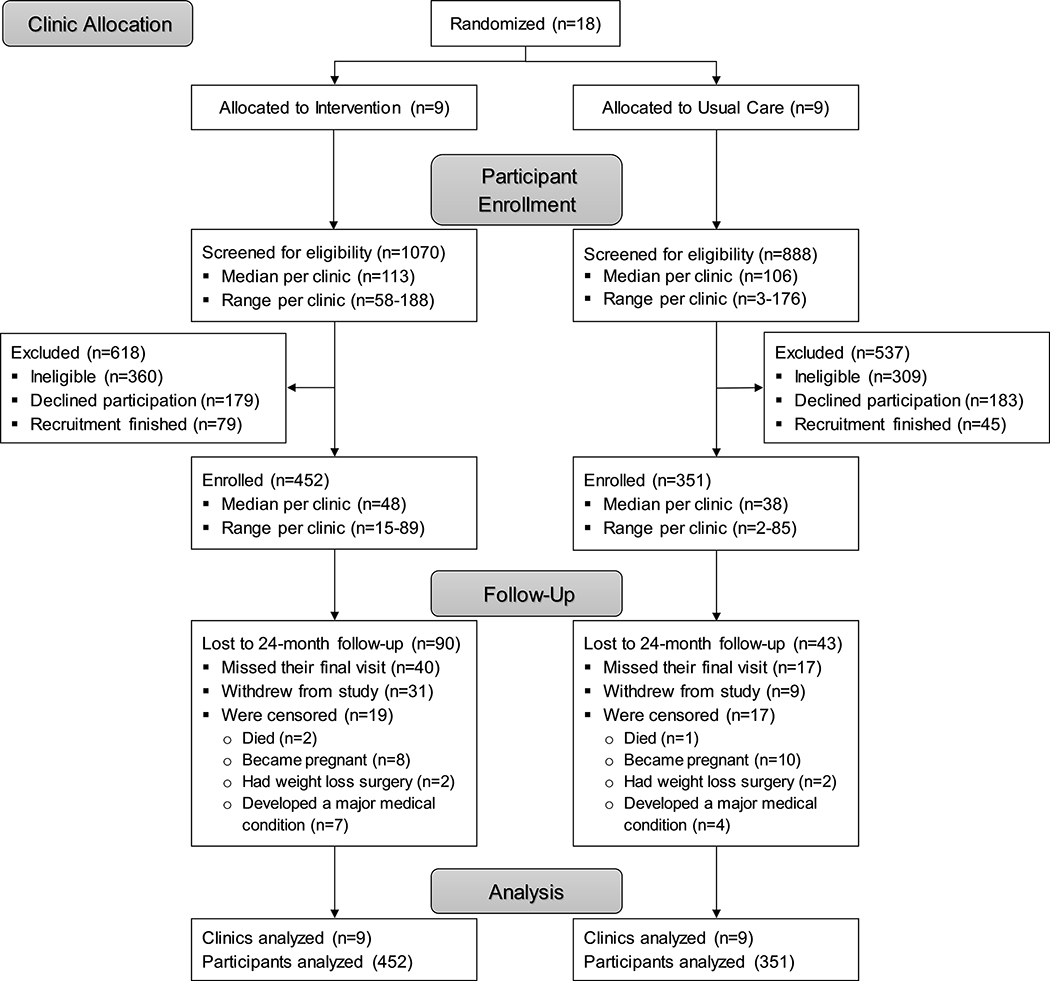
Methods: The PROPEL trial (Promoting Successful Weight Loss in Primary Care in Louisiana) randomly allocated 18 clinics equally to usual care or an ILI and subsequently enrolled 803 (351 usual care, 452 ILI) adults (67% Black, 84% female) with obesity from participating clinics. The usual care group continued to receive their normal primary care. The ILI group received a 24-month high-intensity lifestyle-based obesity treatment program, embedded in the clinic setting and delivered by health coaches in weekly sessions initially and monthly sessions in months 7 through 24.
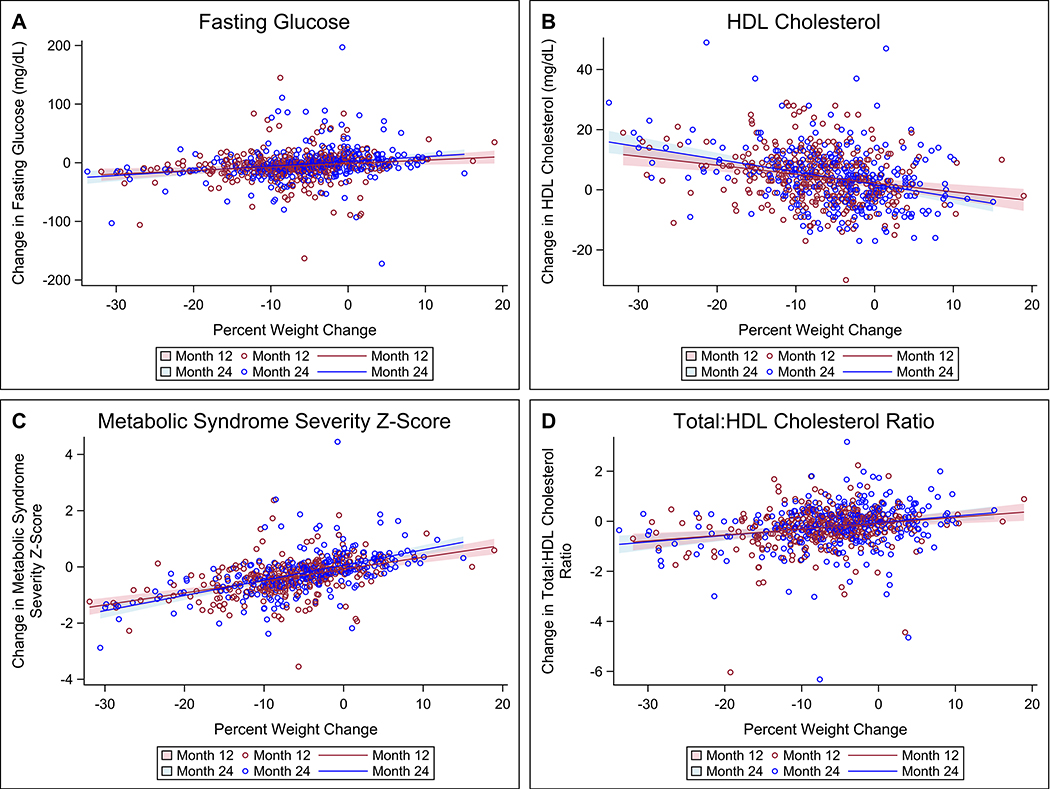
Results: As recently demonstrated, participants receiving the PROPEL ILI lost significantly more weight over 24 months than those receiving usual care (mean difference, -4.51% [95% CI, -5.93 to -3.10]; P<0.01). Fasting glucose decreased more in the ILI group compared with the usual care group at 12 months (mean difference, -7.1 mg/dL [95% CI, -12.0 to -2.1]; P<0.01) but not 24 months (mean difference, -0.8 mg/dL [95% CI, -6.2 to 4.6]; P=0.76). Increases in high-density lipoprotein cholesterol were greater in the ILI than in the usual care group at both time points (mean difference at 24 months, 4.6 mg/dL [95% CI, 2.9-6.3]; P<0.01). Total:high-density lipoprotein cholesterol ratio and metabolic syndrome severity (z score) decreased more in the ILI group than in the usual care group at both time points, with significant mean differences of the change of -0.31 (95% CI, -0.47 to -0.14; P<0.01) and -0.21 (95% CI, -0.36 to -0.06; P=0.01) at 24 months, respectively. Changes in total cholesterol, low-density lipoprotein cholesterol, triglycerides, and blood pressure did not differ significantly between groups at any time point.
Conclusions: A pragmatic ILI consistent with national guidelines and delivered by trained health coaches in primary care produced clinically relevant improvements in cardiometabolic health in an underserved population over 24 months. Registration: URL: https://www.clinicaltrials.gov; Unique identifier: NCT02561221.
Keywords: cardiovascular diseases; life style; obesity; primary health care.
Conflict of interest statement
CONFLICT OF INTEREST DISCLOSURES
Louisiana State University (LSU), Pennington Biomedical Research Center, and Montclair State University have interest in the intellectual property surrounding the weight graph that was used in the intervention and CKM, among others, is an inventor of the technology. Licensing of that technology results in financial benefits to LSU, Pennington Biomedical Research Center, Montclair State University and the inventors. CKM further reports grants from WW, Egg Board, Academy of Nutrition and Dietetics, and ABGIL, personal fees from NaturallySlim and ACAP, Health WW, Zafgen, Florida Hospital, Metagenic, Gila Therapeutics, Academy of Nutrition and Dietetics, ABGIL, Adaptic, EHE health, and OpenFit outside the submitted work. VF reports grants from Bayer, Boehringer Ingelheim, and Gilead, personal fees from Takeda, Novo Nordisk, Sanofi-Aventis, Eli Lilly, Abbott, AstraZeneca, and Intarcia, and stock options from Microbiome Technologies, Insulin Algorithms, BRAVO4Health, and Amgen outside the submitted work. CJL reports personal fees from Amgen, AstraZeneca, Esperion, Sanofi, and Regeneron outside the submitted work. The work related to this manuscript occurred prior to Dr. Eboni Price-Haywood’s appointment to the PCORI Board of Governors. Other authors have no conflicts of interest.
Figures
References
-
- Hales CM, Carroll MD, Fryar CD, Ogden CL. Prevalence of obesity and severe obesity among adults: United States, 2017–2018. NCHS Data Brief, no. 360. Hyattsville, MD: National Center for Health Statistics; 2020. - PubMed
Publication types
MeSH terms
Associated data
Grants and funding
LinkOut - more resources
Full Text Sources
Other Literature Sources
Medical
Research Materials
