. 2021 Mar 18;65(4):e02479-20.
doi: 10.1128/AAC.02479-20. Print 2021 Mar 18.

AT-527, a Double Prodrug of a Guanosine Nucleotide Analog, Is a Potent Inhibitor of SARS-CoV-2 In Vitro and a Promising Oral Antiviral for Treatment of COVID-19

Affiliations

AT-527, a Double Prodrug of a Guanosine Nucleotide Analog, Is a Potent Inhibitor of SARS-CoV-2 In Vitro and a Promising Oral Antiviral for Treatment of COVID-19

Steven S Good et al. Antimicrob Agents Chemother. .

Abstract

The impact of severe acute respiratory syndrome coronavirus-2 (SARS-CoV-2), the causative agent of COVID-19, is global and unprecedented. Although remdesivir has recently been approved by the FDA to treat SARS-CoV-2 infection, no oral antiviral is available for outpatient treatment. AT-527, an orally administered double prodrug of a guanosine nucleotide analog, was previously shown to be highly efficacious and well tolerated in hepatitis C virus (HCV)-infected subjects. Here, we report the potent in vitro activity of AT-511, the free base of AT-527, against several coronaviruses, including SARS-CoV-2. In normal human airway epithelial cells, the concentration of AT-511 required to inhibit replication of SARS-CoV-2 by 90% (EC90) was 0.47 μM, very similar to its EC90 against human coronavirus (HCoV)-229E, HCoV-OC43, and SARS-CoV in Huh-7 cells. Little to no cytotoxicity was observed for AT-511 at concentrations up to 100 μM. Substantial levels of the active triphosphate metabolite AT-9010 were formed in normal human bronchial and nasal epithelial cells incubated with 10 μM AT-511 (698 ± 15 and 236 ± 14 μM, respectively), with a half-life of at least 38 h. Results from steady-state pharmacokinetic and tissue distribution studies of nonhuman primates administered oral doses of AT-527, as well as pharmacokinetic data from subjects given daily oral doses of AT-527, predict that twice daily oral doses of 550 mg AT-527 will produce AT-9010 trough concentrations in human lung that exceed the EC90 observed for the prodrug against SARS-CoV-2 replication. This suggests that AT-527 may be an effective treatment option for COVID-19.

Keywords: AT-511; AT-527; AT-9010; COVID-19; SARS-CoV-2; lung; triphosphate.


Figures

FIG 1
FIG 1
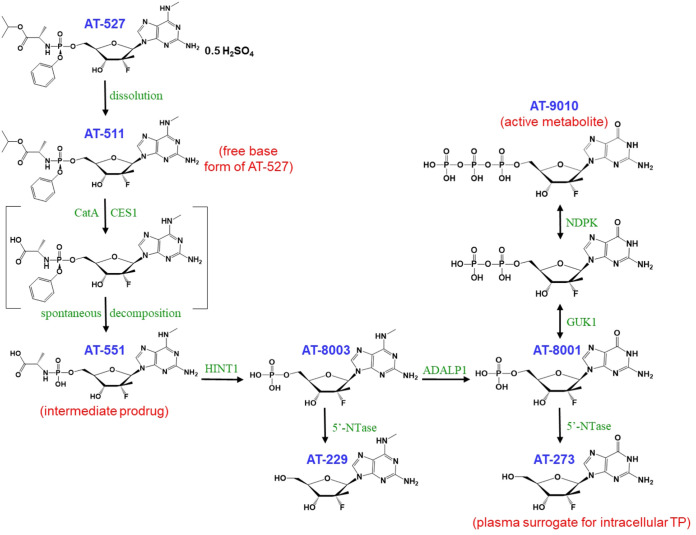
Putative pathway for metabolism of AT-527 to its active triphosphate, AT-9010. Enzymes likely involved in the metabolic pathways include cathepsin A (CatA), carboxylesterase 1 (CES1), histidine nucleotide triad 1 (HINT1), adenosine deaminase-like protein 1 (ADALP1), guanidylate kinase 1 (GUK1), nucleoside diphosphate kinase (NDPK), and 5′-nucleotidase (5′-NTase).
FIG 2
FIG 2
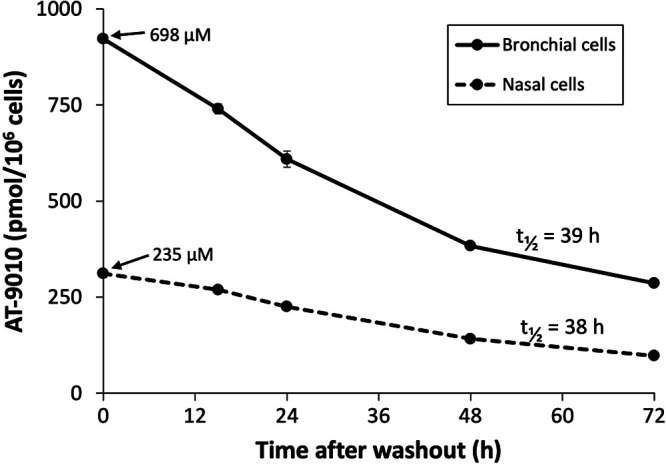
Formation and intracellular half-life of AT-9010 in primary human bronchial and nasal epithelial cells. After cells were exposed to 10 μM AT-511 for 8 h, they were rinsed, and fresh medium was applied for 0, 15, 24, 48, and 72 h post-drug removal. Cells were collected and extracted at each time point (n = 3), the active TP was measured by LC-MS/MS, and the half-life (t1/2) was determined as described in Materials and Methods. Data are expressed at means ± SEs.
FIG 3
FIG 3
Plasma profiles of AT-511 and its metabolites in nonhuman primates after oral doses of AT-527. Cynomolgus monkeys (n = 3) were orally administered a loading dose of 60 mg/kg AT-527 followed by 30 mg/kg maintenance doses every 12 h for 3 days to achieve steady state. Blood was collected preceding and at 0.5, 1, 2, 4, 6, 8, and 12 h after the 5th dose, and plasma AT-511, AT-551, and AT-273 concentrations were determined by LC-MS/MS. Data are expressed as means ± SEs.
FIG 4
FIG 4
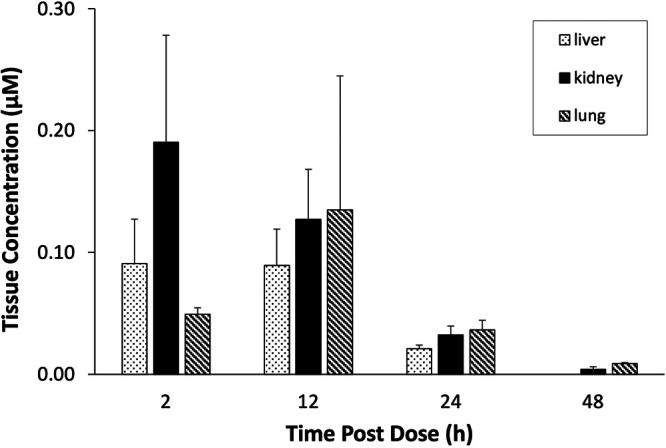
Tissue concentrations of AT-9010 in nonhuman primates. Cynomolgus monkeys were given a loading dose of 60 mg/kg AT-527 followed by 30 mg/kg maintenance doses every 12 h for 3 days to achieve steady state. Tissue samples were collected under anesthesia at the indicated time points after the last dose, flash frozen, and homogenized, and AT-9010 concentrations were determined by LC-MS/MS. Data are expressed as means ± SEs (n = 3).
FIG 5
FIG 5
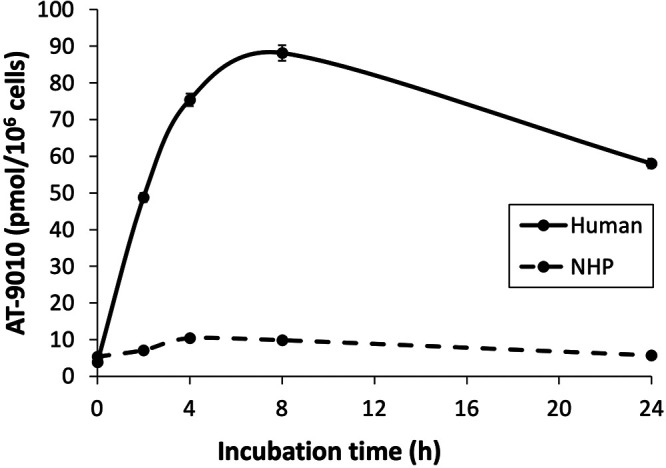
AT-9010 concentrations in primary human and cynomolgus monkey hepatocytes. Hepatocytes were incubated with 10 μM AT-511 for 0, 2, 4, 8, and 24 h in triplicate. They were then washed, extracted, and analyzed for AT-9010 by LC-MS/MS. Data were used from reference and are expressed as means ± SEs.
FIG 6
FIG 6
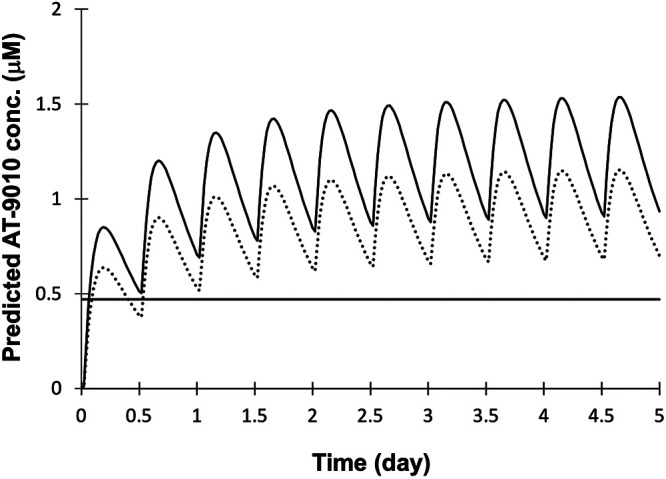
Simulated AT-9010 concentrations in human lung. Human lung AT-9010 concentrations were predicted for 550-mg BID dosing using published data from subjects given daily 550-mg doses of AT-527 as described in Materials and Methods. The solid curve represents predicted lung concentrations of the active TP metabolite after correcting for the AT-9010 lung-to-liver concentration ratio of 1.6 observed in cynomolgus monkeys at 12 h after the last of 6 BID doses of AT-527 as described for Fig. 4. The dotted curve represents predicted lung concentrations of the active TP metabolite after correcting for the AT-9010 lung-to-AT-273 plasma ratio of 1.2 observed in the same monkeys at the same time point. The horizontal line represents the EC90 of AT-511 against SARS-CoV-2 in HAE cells in vitro (0.47 μM).

References

    1. Lu H, Stratton CW, Tang YW. 2020. The Wuhan SARS-CoV-2-what's next for China. J Med Virol 92:546–547. 10.1002/jmv.25738. - DOI - PMC - PubMed
    1. Salgado-Benvindo C, Thaler M, Tas A, Ogando NS, Bredenbeek PJ, Ninaber DK, Wang Y, Hiemstra PS, Snijder EJ, van Hemert MJ. 2020. Suramin inhibits SARS-CoV-2 infection in cell culture by interfering with early steps of the replication cycle. Antimicrob Agents Chemother 64:e00900-20. 10.1128/AAC.00900-20. - DOI - PMC - PubMed
    1. Wang M, Cao R, Zhang L, Yang X, Liu J, Xu M, Shi Z, Hu Z, Zhong W, Xiao G. 2020. Remdesivir and chloroquine effectively inhibit the recently emerged novel coronavirus (2019-nCoV) in vitro. Cell Res 30:269–271. 10.1038/s41422-020-0282-0. - DOI - PMC - PubMed
    1. Beigel JH, Tomashek KM, Dodd LE, Mehta AK, Zingman BS, Kalil AC, Hohmann E, Chu HY, Luetkemeyer A, Kline S, Lopez de Castilla D, Finberg RW, Dierberg K, Tapson V, Hsieh L, Patterson TF, Paredes R, Sweeney DA, Short WR, Touloumi G, Lye DC, Ohmagari N, Oh MD, Ruiz-Palacios GM, Benfield T, Fätkenheuer G, Kortepeter MG, Atmar RL, Creech CB, Lundgren J, Babiker AG, Pett S, Neaton JD, Burgess TH, Bonnett T, Green M, Makowski M, Osinusi A, Nayak S, Lane HC, Members A-SG. 2020. Remdesivir for the treatment of Covid-19 - preliminary report. N Engl J Med 383:1813–1826. 10.1056/NEJMoa2007764. - DOI - PMC - PubMed
    1. Eastman RT, Roth JS, Brimacombe KR, Simeonov A, Shen M, Patnaik S, Hall MD. 2020. Remdesivir: a review of its discovery and development leading to emergency use authorization for treatment of COVID-19. ACS Cent Sci 6:672–683. 10.1021/acscentsci.0c00489. - DOI - PMC - PubMed

Publication types

MeSH terms