. 2021 Feb 8;11(1):3278.
doi: 10.1038/s41598-021-82800-5.

Assessment of common housekeeping genes as reference for gene expression studies using RT-qPCR in mouse choroid plexus

Affiliations

Assessment of common housekeeping genes as reference for gene expression studies using RT-qPCR in mouse choroid plexus

Kim Hoa Ho et al. Sci Rep. .

Abstract

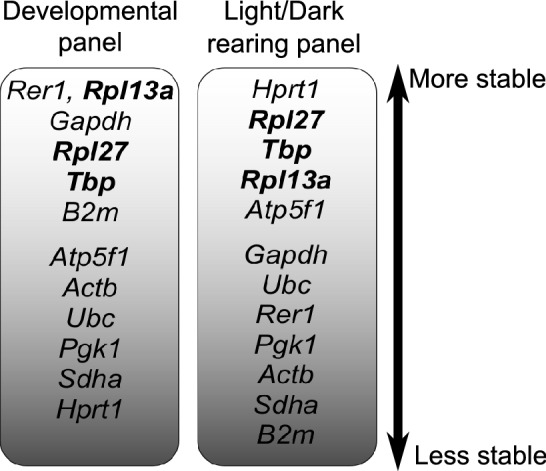
Choroid plexus (ChP), a vascularized secretory epithelium located in all brain ventricles, plays critical roles in development, homeostasis and brain repair. Reverse transcription quantitative real-time PCR (RT-qPCR) is a popular and useful technique for measuring gene expression changes and also widely used in ChP studies. However, the reliability of RT-qPCR data is strongly dependent on the choice of reference genes, which are supposed to be stable across all samples. In this study, we validated the expression of 12 well established housekeeping genes in ChP in 2 independent experimental paradigms by using popular stability testing algorithms: BestKeeper, DeltaCq, geNorm and NormFinder. Rer1 and Rpl13a were identified as the most stable genes throughout mouse ChP development, while Hprt1 and Rpl27 were the most stable genes across conditions in a mouse sensory deprivation experiment. In addition, Rpl13a, Rpl27 and Tbp were mutually among the top five most stable genes in both experiments. Normalisation of Ttr and Otx2 expression levels using different housekeeping gene combinations demonstrated the profound effect of reference gene choice on target gene expression. Our study emphasized the importance of validating and selecting stable housekeeping genes under specific experimental conditions.


Conflict of interest statement

The authors declare no competing interests.

Figures
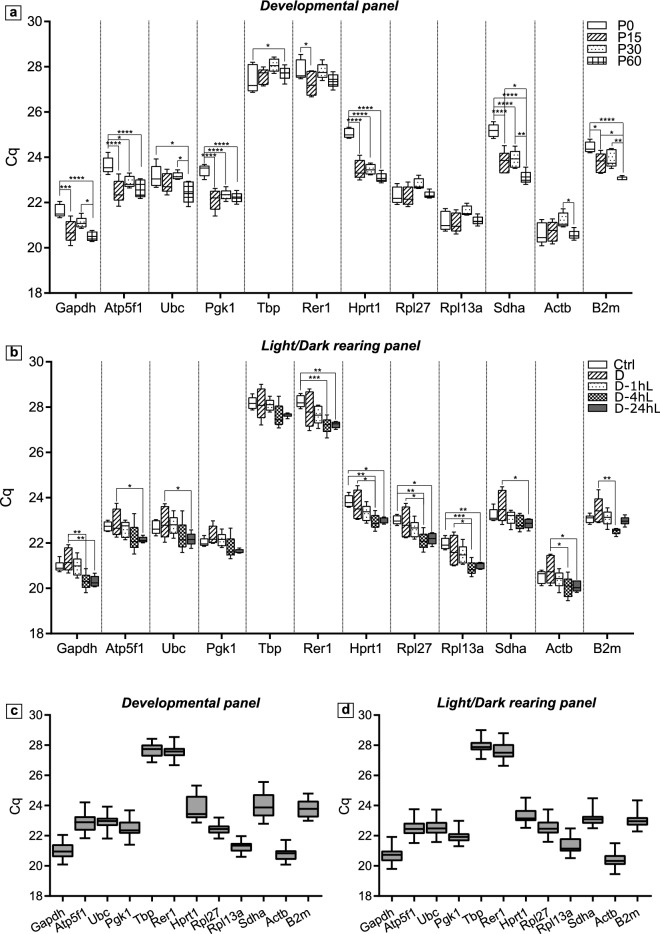
Figure 1
Figure 1
Descriptive statistics of 12 candidate reference genes in two sets of choroid plexus samples. Box-and-whisker plot showing Cq values of 12 housekeeping genes examined in the Developmental panel, displayed in different age groups (a) or displayed as all samples in the panel (c). Cq values of 12 housekeeping genes examined in the Light/Dark rearing panel, displayed in different rearing conditions (b) or displayed as all samples in the panel (d). Whisker indicates value range, the line inside the box was plotted at median value. (n = 5 mice per group (see Material and Method, Supplementary Table S1 for more details). Data is presented as Mean ± SD, adjusted p-values are indicated as *p ≤ 0.05, **p ≤ 0.01, ***p ≤ 0.001, ****p ≤ 0.0001. Cq: quantification cycle.
Figure 2
Figure 2
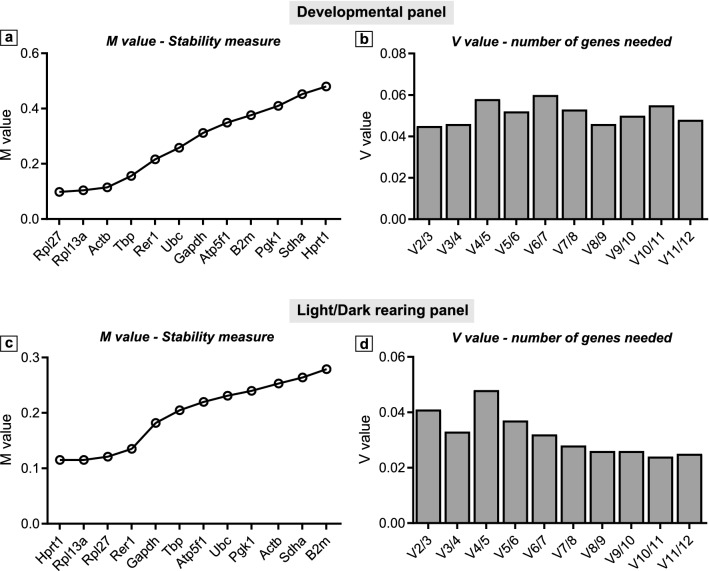
geNorm stability analysis. M value represents the gene expression stability in the Developmental (a) and in the Light/Dark rearing (c) panels. V value suggests the optimal number of reference genes per qPCR experiment in the Developmental (b) and in the Light/Dark rearing (d) panels.
Figure 3
Figure 3
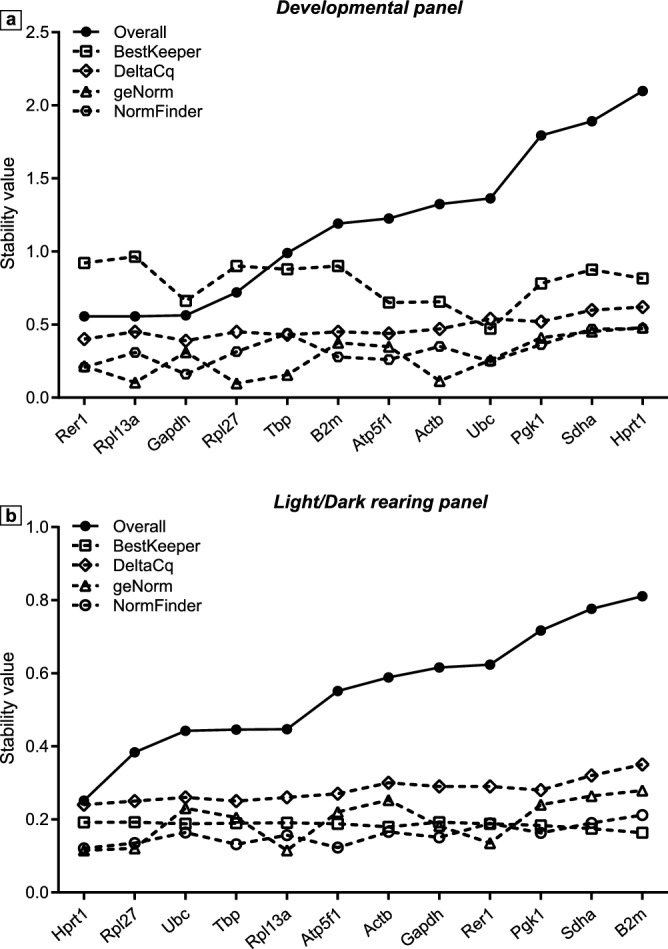
Conformity in rankings of reference genes by 4 methods. Stability ranking of 12 reference genes in the Developmental (a) and in the Light/Dark rearing (b) panels, calculated per assessment method (geNorm, triangle; NormFinder, hexagon; BestKeeper, square; DeltaCq, diamond) and as geometric mean of the 4 rankings (Overall, full black circle) (see Table 3 for more details).
Figure 4
Figure 4
Summary of gene stability ranking. The 2 columns illustrate gene stability order of the 2 experimental panels with decreasing stability from top to bottom. Three genes (bold) were among the top 5 most stable for both panels.
Figure 5
Figure 5
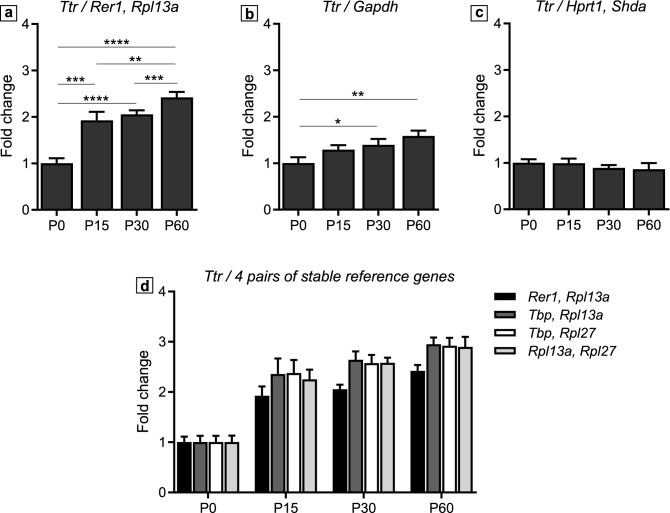
Relative expression of Ttr normalised to different reference genes. Ttr relative expression compared to the most stable reference genes in the Developmental panel: Rer1, Rpl13a (a); to Gapdh (b) and to the least stable genes in the Developmental panel: Sdha, Hprt1 (c). Ttr relative expression normalized to Rer1, Rpl13a versus different combination of the 3 common stable genes Tbp, Rpl13a, Rpl27 (d). Data is presented as Mean ± SD, adjusted p-values are indicated as *p ≤ 0.05, **p ≤ 0.01, ***p ≤ 0.001, ****p ≤ 0.0001.
Figure 6
Figure 6
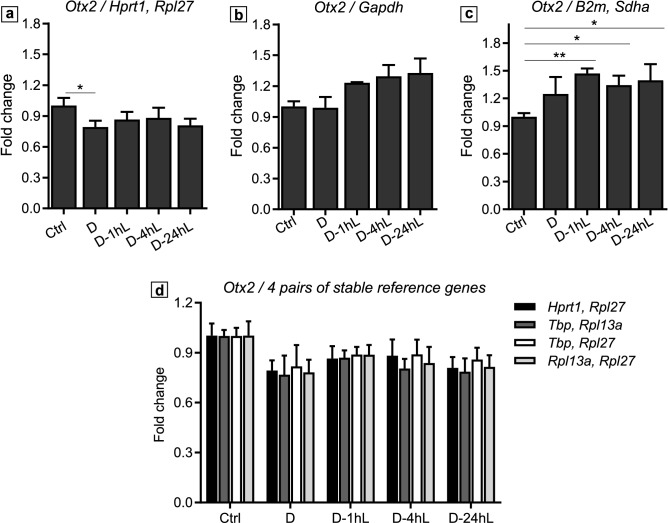
Relative expression of Otx2 normalised to different reference genes. Otx2 relative expression compared to the most stable reference genes in the Light/Dark rearing panel: Hprt1, Rpl27 (a); to Gapdh (b) and to the least stable genes in the Light/Dark rearing panel: B2m, Sdha (c). Otx2 relative expression normalized to Hprt1, Rpl27 versus different combination of the 3 common stable genes Tbp, Rpl13a, Rpl27 (d). Data is presented as Mean ± SD, adjusted p-values are indicated as *p ≤ 0.05.

References

    1. Dani, N. et al. A cellular and spatial map of the choroid plexus across brain ventricles and ages. bioRxiv (2019) 10.1101/627539. - PMC - PubMed
    1. Sturrock RR. A morphological study of the development of the mouse choroid plexus. J. Anat. 1979;129:777. - PMC - PubMed
    1. Wilting J, Christ B. An experimental and ultrastructural study on the development of the avian choroid plexus. Cell Tissue Res. 1989;255:487–494. doi: 10.1007/BF00218783. - DOI - PubMed
    1. Redzic ZB, Preston JE, Duncan JA, Chodobski A, Szmydynger-Chodobska J. The choroid plexus-cerebrospinal fluid system: from development to aging. Curr. Top. Dev. Biol. 2005;71:1–52. doi: 10.1016/S0070-2153(05)71001-2. - DOI - PubMed
    1. Damkier HH, Brown PD, Praetorius J. Cerebrospinal fluid secretion by the choroid plexus. Physiol. Rev. 2013;93:1847–1892. doi: 10.1152/physrev.00004.2013. - DOI - PubMed

Publication types