. 2021 Apr;46(5):949-958.
doi: 10.1038/s41386-021-00970-2. Epub 2021 Feb 8.

Adolescent stress sensitizes the adult neuroimmune transcriptome and leads to sex-specific microglial and behavioral phenotypes

Affiliations

Adolescent stress sensitizes the adult neuroimmune transcriptome and leads to sex-specific microglial and behavioral phenotypes

Mandakh Bekhbat et al. Neuropsychopharmacology. 2021 Apr.

Abstract

Adolescent exposure to chronic stress, a risk factor for mood disorders in adulthood, sensitizes the neuroinflammatory response to a subsequent immune challenge. We previously showed that chronic adolescent stress (CAS) in rats led to distinct patterns of neuroimmune priming in adult male and female rats. However, sex differences in the neuroimmune consequences of CAS and their underlying mechanisms are not fully understood. Here we hypothesized that biological sex would dictate differential induction of inflammation-related transcriptomic pathways and immune cell involvement (microglia activation and leukocyte presence) in the hippocampus of male and female rats with a history of CAS. Adolescent rats underwent CAS (six restraint and six social defeat episodes during postnatal days 38-49), and behavioral assessments were conducted in adolescence and adulthood. Neuroimmune measures were obtained following vehicle or a systemic lipopolysaccharide (LPS) challenge in adulthood. CAS led to increased time in the corners of the open field in adolescence. In males, CAS also increased social avoidance. As adults, CAS rats displayed an exaggerated enrichment of the nuclear factor kappa-light-chain-enhancer of activated B cells (NFκB) pathway and chemokine induction following LPS challenge, and increased number of perivascular CD45+ cells in the hippocampus. However, CAS females, but not males, showed exaggerated glucocorticoid receptor (GR) pathway enrichment and increased microglial complexity. These results provide further insight to the mechanisms by which peripheral immune events may influence neuroimmune responses differentially among males and females and further demonstrate the importance of adolescent stress in shaping adult responses.


Figures
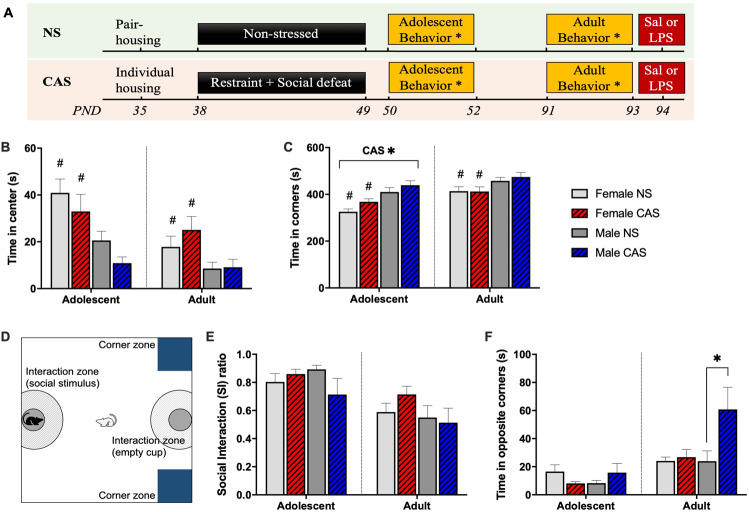
Fig. 1
Fig. 1. Chronic adolescent stress (CAS) led to anxiety-like behavior and male-specific social avoidance.
A Female and male rats of NS or CAS background were behaviorally tested once in adolescence on postnatal day (PND)50, and again in adulthood on PND91. B Adolescent CAS rats displayed no change in time spent in the center, but (C) a significant increase in time spent in the corners (p < 0.05). D Social interaction arena setup is depicted. E CAS did not impact SI ratio in either sex when assessed in adolescence or adulthood. F CAS led to a significant increase in time spent in opposite corners in males (p < 0.05), but not in females. Data are presented as mean ± SEM. CAS*, main effect of CAS (p < 0.05); *, effect of CAS (p < 0.05) within males; # main effect of sex. CAS Chronic Adolescent Stress, NS Non-stressed, SI social interaction.
Fig. 2
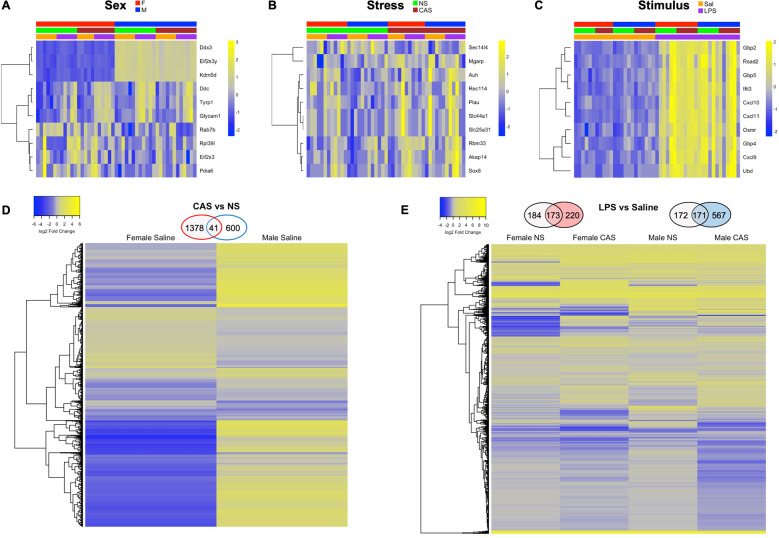
Fig. 2. Chronic adolescent stress (CAS)-associated genes were largely distinct between females and males at baseline.
Female and male rats of NS or CAS background received a systemic injection of either saline or LPS in adulthood. Four hours later, hippocampal tissue was collected for bulk RNA-Seq. Differential expression analysis on the hippocampal transcripts was performed using the package edgeR in Bioconductor. A–C Expression of top ten DEGs are shown for the main factors of sex, stress, and LPS. D The impact of CAS on baseline (unstimulated) gene expression was suassessed within each sex using the contrasts “F.CAS.Sal versus F.NS.Sal” and “M.CAS.Sal versus M.NS.Sal.” The number of differentially expressed genes (DEG) from each paired contrast is displayed in Venn diagrams above the heatmaps. CAS-associated genes were largely distinct between males and females with a greater number of upregulated genes in female rats and similar numbers of downregulated genes across males and females. Subsequent pathway analyses showed that genes differentially regulated by CAS in female rats enriched pathways related to signal transduction, histone deacetylases, and cytoskeleton remodeling. Genes differentially regulated by CAS in male rats were related to G protein-coupled receptor signaling, Notch signaling, and NMDA receptor trafficking (Tables S5–6). E LPS-induced changes in gene expression were assessed within each of the four groups (Female-NS, Female-CAS, Male-NS, Male-CAS) using the contrast “LPS versus Sal.” Similar clusters of genes were differentially regulated by LPS across the four groups, with substantial DEG overlap between NS and CAS conditions within each sex. See GSEA pathway results in detail in Table 1, S7–10 and Fig S1. CAS Chronic Adolescent Stress, NS Non-stressed, Sal Saline.
Fig. 3
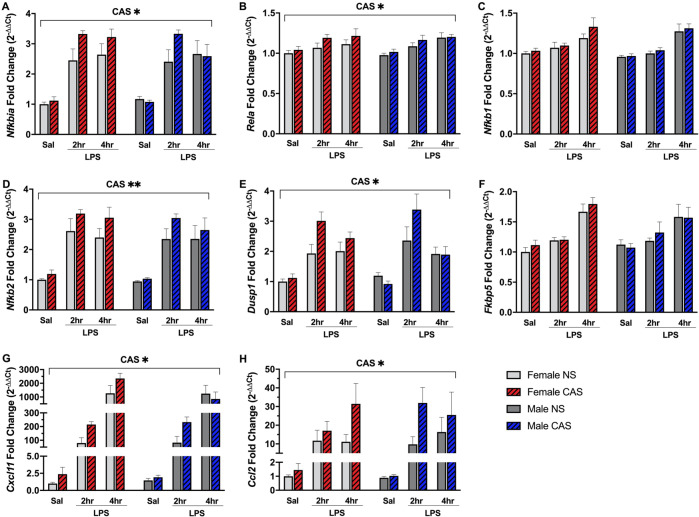
Fig. 3. Chronic Adolescent Stress (CAS) exaggerated the expression of NFκB subunits and chemokines.
Female and male rats of NS or CAS background received a systemic injection of either saline or LPS in adulthood. Two and four hours later, mRNA expression of NFκB pathway members Nfkbia, Rela, Nfkb1, and Nfkb2 (A–D), GR targets Dusp1 and Fkbp5 (E–F), and the chemokines Ccl2 and Cxcl11 (G–H) were assessed via quantitative PCR. NFκB pathway: CAS rats displayed exaggerated hippocampal mRNA expression of (A) Nfkbia, (B) Rela, and (D) Nfkb2 compared to NS rats (all p < 0.05). CAS did not significantly impact the expression of (C) Nfkb1. GR pathway: CAS potentiated the expression of (E) Dusp1 (p < 0.05). CAS did not alter the expression of (F) Fkbp5. Chemokines: CAS exaggerated the expression of (G) Ccl2 and (H) Cxcl11 (all p < 0.05). Data are mean fold change ± SEM. Main effect of CAS is denoted by CAS* (p < 0.05) or CAS** (p < 0.01). CAS Chronic Adolescent Stress, NS Non-stressed, LPS lipopolysaccharide, Sal Saline.
Fig. 4
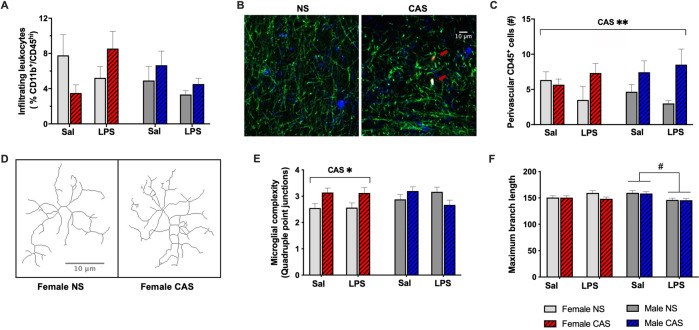
Fig. 4. CAS increased perivascular CD45 presence and sex-specifically alters microglial morphology in the hippocampus.
Female and male rats of NS or CAS background received a systemic injection of either saline or LPS in adulthood on PND94. Two hours later, leukocyte infiltration, perivascular CD45 immunoreactivity, and microglial morphology were assessed in the hippocampus. A The percent of CD11b+/CD45high infiltrating myeloid cells was not impacted by sex, stress, or LPS stimulus. B Representative CD45 staining (red, indicated by arrow) in close proximity to blood vessels (green) and distinct from microglia (blue) in the hippocampus of NS and CAS rats. C CAS increased CD45 immunoreactivity in the hippocampus (p < 0.01). D Representative microglia skeletons are shown to illustrate differential microglial complexity between females NS and CAS groups. E CAS increased microglial complexity within females (p < 0.05), but not males. F LPS decreased maximum branch length of microglia in males (p < 0.05), but not females. Data are presented as mean ± SEM. **CAS, main effect of CAS (p < 0.01); *CAS, effect of CAS (p < 0.05) within females; #, LPS effect within males. CAS Chronic Adolescent Stress, NS Non-stressed, LPS lipopolysaccharide, Sal Saline.

References

    1. Bekhbat M, Neigh GN. Sex differences in the neuro-immune consequences of stress: focus on depression and anxiety. Brain Behav Immun. 2018;67:1–12. - PMC - PubMed
    1. Danese A, Pariante CM, Caspi A, Taylor A, Poulton R. Childhood maltreatment predicts adult inflammation in a life-course study. Proc Natl Acad Sci USA. 2007;104:1319–24. - PMC - PubMed
    1. Ehrlich KB, Chen E, Yu T, Miller GE, Brody GH. Exposure to Parental Depression in Adolescence and Risk for Metabolic Syndrome in Adulthood. Child Dev. 2017;90:1272–85. - PMC - PubMed
    1. Pyter LM, Kelly SD, Harrell CS, Neigh GN. Sex differences in the effects of adolescent stress on adult brain inflammatory markers in rats. Brain Behav Immun. 2013;30:88–94. - PMC - PubMed
    1. Pearson-Leary J, Eacret D, Chen R, Takano H, Nicholas B, Bhatnagar S. Inflammation and vascular remodeling in the ventral hippocampus contributes to vulnerability to stress. Transl Psychiatry. 2017;7:e1160. - PMC - PubMed

Publication types