


Standard radiographic assessments of distal radius fractures miss involvement of the distal radioulnar joint: a diagnostic study
- PMID: 33558991
- PMCID: PMC9110479
- DOI: 10.1007/s00402-021-03801-7
Standard radiographic assessments of distal radius fractures miss involvement of the distal radioulnar joint: a diagnostic study
Abstract
Introduction: Distal radius fractures account for one-fifth of all fractures in the emergency department. Their classification based on standard radiographs is common practice although low inter-observer reliabilities and superiority of computer tomography (CT) scanning in evaluation of joint congruency have been reported.
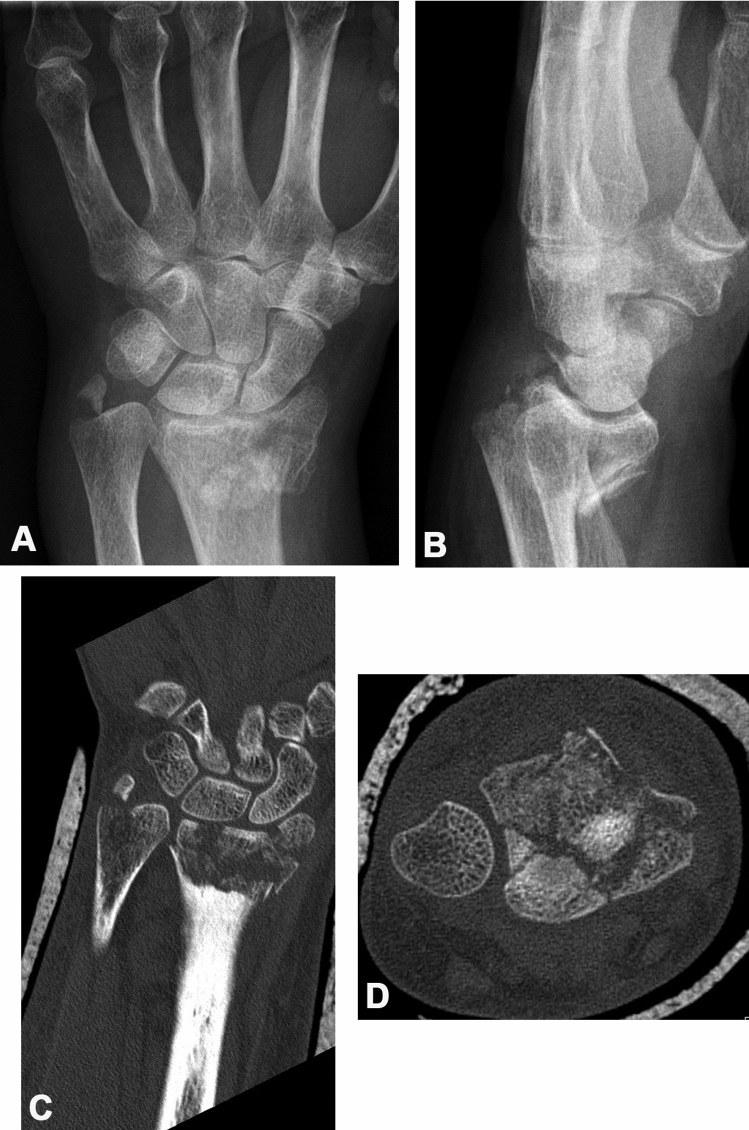
Materials and methods: We retrospectively analyzed 96 displaced distal radius fractures scheduled for open reduction and internal fixation using standard radiographic assessment. The radiographs were classified with the Arbeitsgemeinschaft für Osteosynthesefragen/Orthopaedic Trauma Association (AO/OTA), Fernandez and Frykman classifications by three observers and inter-rater reliabilities were calculated. Additional CT scanning was performed in all cases and the following parameters were assessed: radiocarpal joint involvement, fracture extent into the radial sigmoid notch, i.e. the distal radio-ulnar joint, comminution of the metaphysis, and concomitant ulnar styloid fracture. The CT scans were used as a reference standard to determine sensitivity and accuracy of standard radiographic assessment in evaluation of distal radius fractures.
Results: The inter-rater agreement for the AO classification was 35.4%, 68.8% for the Fernandez and 38.5% for the Frykman classification. Fracture extension into the radiocarpal joint was present in 81 cases (84.4%). Sigmoid notch involvement was found in 81 fractures (84.4%). Involvement of both joints was present in 72 cases (75%). The sensitivity of standard radiographs regarding radiocarpal joint involvement was 93.8%. Considering involvement of the distal radio-ulnar joint the false-negative rate using standard radiographs was 61.7% and the test's accuracy for sigmoid notch involvement was 45.8%.
Conclusion: This study demonstrates that involvement of the sigmoid notch is frequently missed in standard radiographs. The presented data support the frequent use of CT imaging to allow the holistic illustration of a fracture's complexion and to ensure optimal pre-operative planning.
Keywords: Distal radioulnar joint; Distal radius fracture; Fracture classification system; Interobserver reliability.
© 2021. The Author(s).
Conflict of interest statement
The authors declare they have no financial interests.
Figures

References
MeSH terms
LinkOut - more resources
Full Text Sources
Other Literature Sources
Medical
