Review
. 2021 Aug;110(2):346-360.
doi: 10.1002/cpt.2194. Epub 2021 Mar 2.

Biomarker-Guided Individualization of Antibiotic Therapy

Affiliations
Review

Biomarker-Guided Individualization of Antibiotic Therapy

Linda B S Aulin et al. Clin Pharmacol Ther. 2021 Aug.

Abstract

Treatment failure of antibiotic therapy due to insufficient efficacy or occurrence of toxicity is a major clinical challenge, and is expected to become even more urgent with the global rise of antibiotic resistance. Strategies to optimize treatment in individual patients are therefore of crucial importance. Currently, therapeutic drug monitoring plays an important role in optimizing antibiotic exposure to reduce treatment failure and toxicity. Biomarker-based strategies may be a powerful tool to further quantify and monitor antibiotic treatment response, and reduce variation in treatment response between patients. Host response biomarkers, such as CRP, procalcitonin, IL-6, and presepsin, could potentially carry significant information to be utilized for treatment individualization. To achieve this, the complex interactions among immune system, pathogen, drug, and biomarker need to be better understood and characterized. The purpose of this tutorial is to discuss the use and evidence of currently available biomarker-based approaches to inform antibiotic treatment. To this end, we also included a discussion on how treatment response biomarker data from preclinical, healthy volunteer, and patient-based studies can be further characterized using pharmacometric and system pharmacology based modeling approaches. As an illustrative example of how such modeling strategies can be used, we describe a case study in which we quantitatively characterize procalcitonin dynamics in relation to antibiotic treatments in patients with sepsis.


Conflict of interest statement

The authors report no conflict of interest. As Editor‐in‐Chief for Clinical Pharmacology and Therapeutics, Piet H. van der Graaf was not involved in the peer review and editorial decision of this manuscript.

Figures

Figure 1
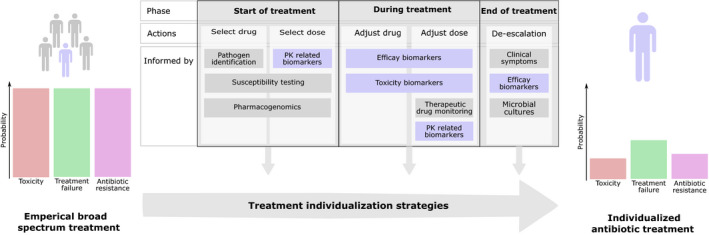
Figure 1
Overview of the use of biomarker‐informed treatment individualization strategies. Current empirical antibiotic treatments are associated with significant risk of toxicity (red), treatment failure (green), and antibiotic resistance development (purple). These risks could be reduced by optimizing antibiotic treatments at an individual level. Specifically, treatment individualization strategies informed by biomarkers (blue) could play an important part. Such biomarkers can inform on pharmacokinetics (PKs), efficacy, and toxicity, and guide the treatment throughout all phases of infection.
Figure 2
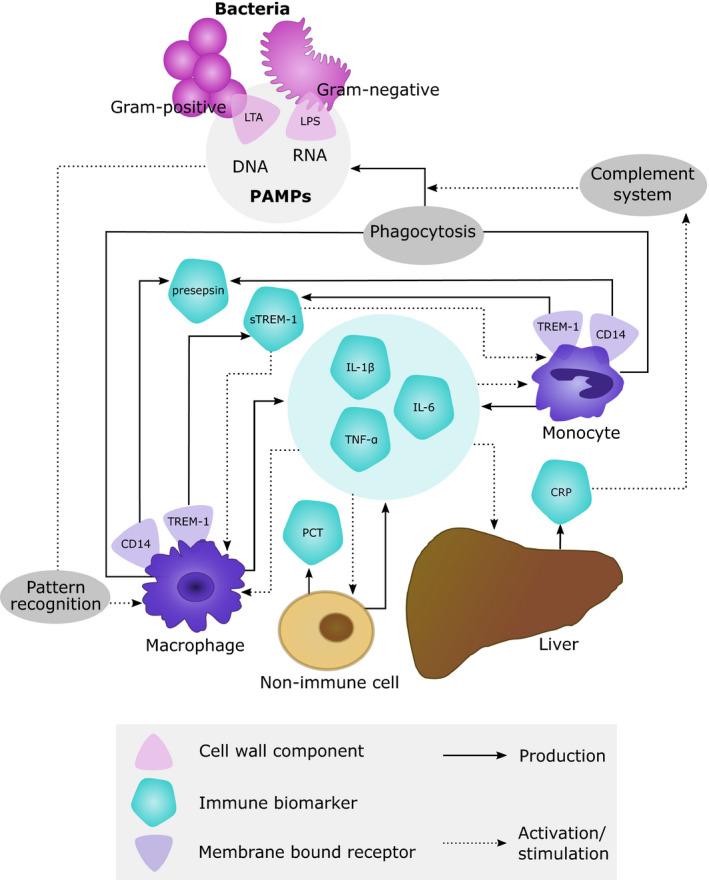
Figure 2
Biological basis of immune response biomarkers produced by host cells after exposure to bacterial pathogens. CRP, C‐reactive protein; IL, interleukin; LPS, lipopolysaccharide; LTA, lipoteichoic acid; PAMPs, pathogen associated molecular patterns; PCT, procalcitonin; (s)TREM‐1, (soluble) triggering receptor expressed on myeloid cells 1; TNF‐α, tumor necrosis factor‐α.
Figure 3
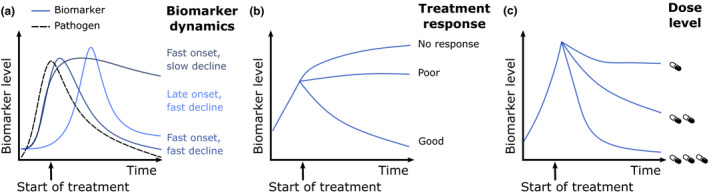
Figure 3
Key characteristics of treatment response biomarkers. To enable the assessment of treatment response biomarker should (a) be rapidly induced and have a relatively short half‐life to satisfactory follow the course of infection, (b) be able to stratify treatment response, and (c) have a characterized drug exposure‐response relationship.
Figure 4
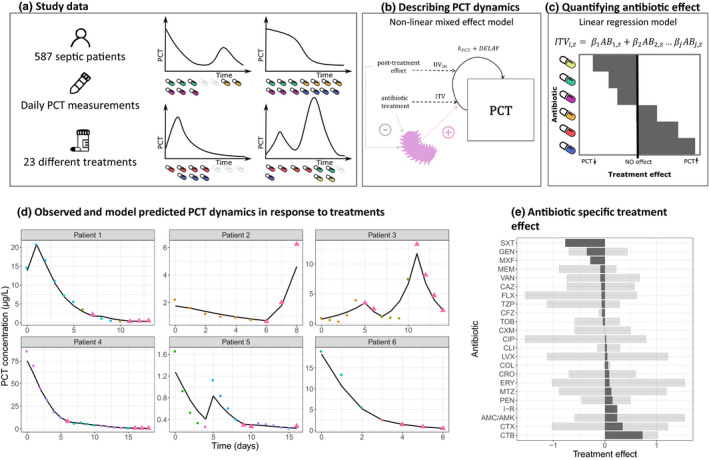
Figure 4
Procalcitonin (PCT) biomarker case study workflow. (a) Overview of study data and examples of biomarker time course data in relation to antibiotic therapy. (b) Pharmacodynamic model to capture PCT dynamics and antibiotic drug effects, where kpct represents a first‐order infection induced production or degradation rate of PCT, delay a time‐dependent delay of antibiotic effect, interindividual variation (IIV)IM post‐treatment immune response, and intertreatment variation (ITV). (c) Quantification of individual antibiotic effects using a linear regression analysis. (d) A selection of observed PCT profiles (points) and model predictions (solid lines), illustrating the diversity of dynamics and treatments. Colored points indicate different treatments, consisting up to three antibiotics, whereas triangles indicate observation without any treatment. (e) The mean (dark gray area) and the range (shaded area) of the treatment response related to pairwise combinations and mono‐treatments per individual antibiotic. A negative treatment response value is associated with decrease of PCT while a positive is associated with an increase.
Figure 5
Figure 5
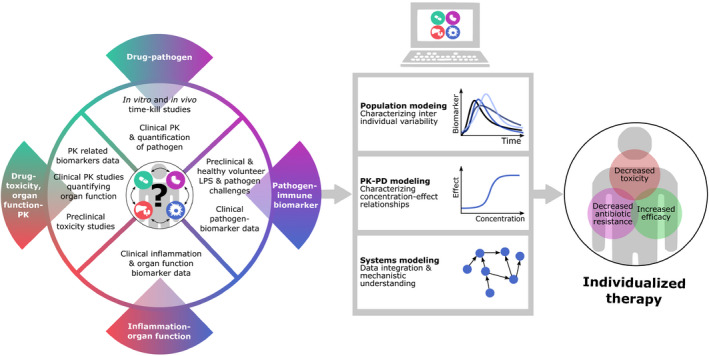
Strategies to develop biomarker‐based strategies to individualize antibiotic therapy. The success of treatment of bacterial infections is affected by several interacting factors. These relationships need to be specifically characterized to enable individualized antibiotic treatments. Such characterization requires data form multiple sources, such as preclinical experiments, healthy volunteer studies, and clinical data, each contributing with unique information. The analysis and integration of such datasets require advanced modeling techniques, including population, pharmacokinetic‐pharmacodynamic (PK‐PD), and systems modeling. From these models we can obtain valuable insights aiding treatment optimization.

References

    1. Garnacho‐Montero, J.et al. Impact of adequate empirical antibiotic therapy on the outcome of patients admitted to the intensive care unit with sepsis. Crit. Care Med. 31, 2742–2751 (2003). - PubMed
    1. De Waele, J.J.et al. Risk factors for target non‐attainment during empirical treatment with β‐lactam antibiotics in critically ill patients. Intensive Care Med. 40, 1340–1351 (2014). - PubMed
    1. Belgrader, P.et al. Rapid pathogen detection using a microchip PCR array instrument. Clin. Chem. 44, 2191–2194 (1998). - PubMed
    1. Thorsted, A., Nielsen, E.I. & Friberg, L.E. Pharmacodynamics of immune response biomarkers of interest for evaluation of treatment effects in bacterial infections. Int. J. Antimicrob. Agents 56, 106059 (2020). - PubMed
    1. Llewelyn, M.J.et al. The antibiotic course has had its day. BMJ 3418, j3418 (2017). - PubMed

Publication types

MeSH terms