. 2021 Feb 1;77(Pt 2):194-204.
doi: 10.1107/S2059798320015454. Epub 2021 Jan 26.

Homogeneous batch micro-crystallization of proteins from ammonium sulfate

Affiliations

Homogeneous batch micro-crystallization of proteins from ammonium sulfate

Claudia Stohrer et al. Acta Crystallogr D Struct Biol. .

Abstract

The emergence of X-ray free-electron lasers has led to the development of serial macromolecular crystallography techniques, making it possible to study smaller and more challenging crystal systems and to perform time-resolved studies on fast time scales. For most of these studies the desired crystal size is limited to a few micrometres, and the generation of large amounts of nanocrystals or microcrystals of defined size has become a bottleneck for the wider implementation of these techniques. Despite this, methods to reliably generate microcrystals and fine-tune their size have been poorly explored. Working with three different enzymes, L-aspartate α-decarboxylase, copper nitrite reductase and copper amine oxidase, the precipitating properties of ammonium sulfate were exploited to quickly transition from known vapour-diffusion conditions to reproducible, large-scale batch crystallization, circumventing the tedious determination of phase diagrams. Furthermore, the specific ammonium sulfate concentration was used to fine-tune the crystal size and size distribution. Ammonium sulfate is a common precipitant in protein crystallography, making these findings applicable to many crystallization systems to facilitate the production of large amounts of microcrystals for serial macromolecular crystallography experiments.

Keywords: ammonium sulfate; batch crystallization; microcrystals; serial crystallography.


Figures

Figure 1
Figure 1
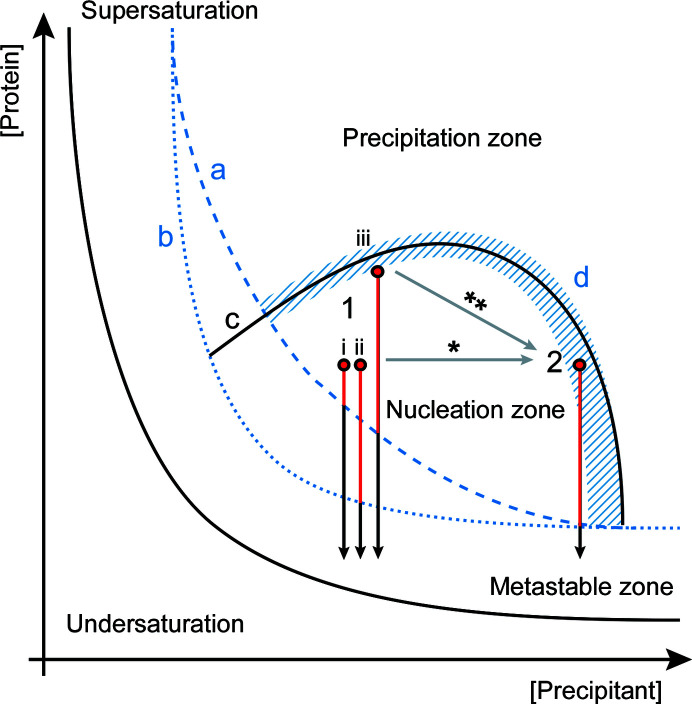
Schematic overlay of the crystallization phase diagrams for the three used model enzymes. The proposed boundaries between the metastable zone and the nucleation zone are drawn differently for ADC/AcNiR (dashed blue line a) and ECAO (dotted blue line b). The same generic boundary between the nucleation and the precipitation zone is drawn for ADC and ECAO (line c). AcNiR crystallizes from an initial precipitation phase; thus, there is no sharp boundary between the nucleation and precipitation zones, as indicated by the striped area in blue (labelled d). The grey arrows show the different ways of moving through the phase diagram. For ADC and ECAO the ammonium sulfate concentration was adjusted directly, resulting in a horizontal move along the phase diagram (*). For AcNiR this was performed by changing the protein:precipitant ratio, thereby moving on the diagonal (**). The vertical red/black arrows represent time spent in the metastable zone for batch crystallization at (1) a lower ammonium sulfate concentration for ADC (i), ECAO (ii) and AcNiR (iii) and (2) a higher concentration. The red part of the arrow illustrates the difference in time spent in the nucleation zone, depending on the starting point and the borderline between the metastable zone and the nucleation zone. For AcNiR no effect on crystal size could be observed, but effects on crystallization speed and the amount of accompanying amorphous precipitation were observed upon increasing the ammonium sulfate concentration.
Figure 2
Figure 2
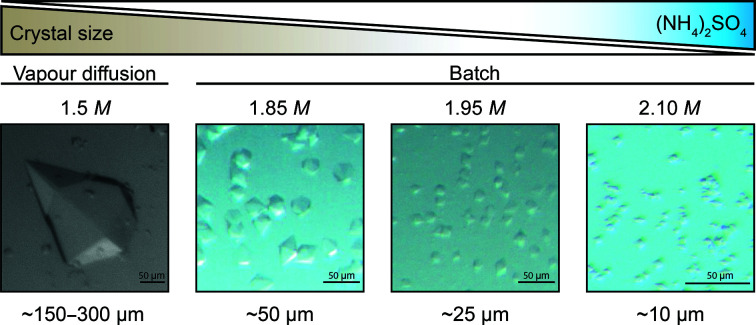
The crystal size of ADC is dependent on the ammonium sulfate concentration; increasing the concentration of ammonium sulfate leads to smaller crystals.
Figure 3
Figure 3
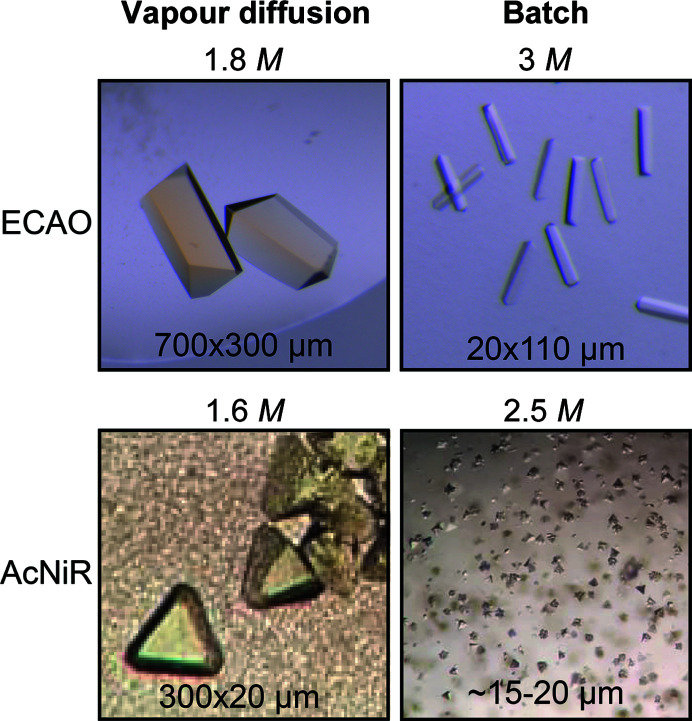
Comparison of ECAO (top) and AcNiR (bottom) crystals obtained by vapour diffusion (left) and batch micro-crystallization (right). For both proteins, obtaining microcrystals required an increase in the ammonium sulfate concentration (the concentration is indicated at the top of each image).
Figure 4
Figure 4
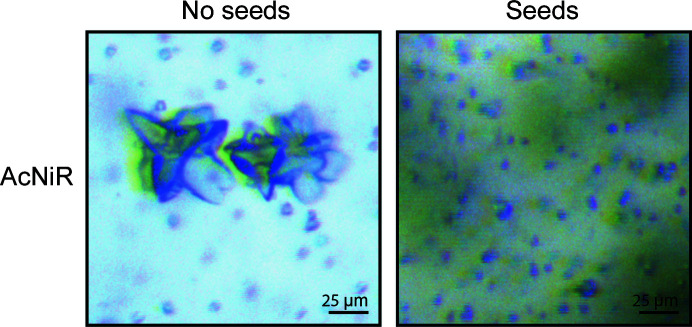
Microcrystals of AcNiR grown with and without the addition of seeds using a 1:3 protein:precipitant ratio. The addition of seeds led to a higher reproducibility and faster crystallization, as well as minimizing the formation of the larger clusters seen on the left. The pictures were taken before centrifugation to remove precipitate (green haze).

References

    1. Albert, A., Dhanaraj, V., Genschel, U., Khan, G., Ramjee, M. K., Pulido, R., Sibanda, B. L., von Delft, F., Witty, M., Blundell, T. L., Smith, A. G. & Abell, C. (1998). Nat. Struct. Biol. 5, 289–293. - PubMed
    1. Arnott, Z. L. P., Nozaki, S., Monteiro, D. C. F., Morgan, H. E., Pearson, A. R., Niki, H. & Webb, M. E. (2017). Biochemistry, 56, 4931–4939. - PMC - PubMed
    1. Asakura, S. & Oosawa, F. (1958). J. Polym. Sci. 33, 183–192.
    1. Barends, T. R. M., Foucar, L., Ardevol, A., Nass, K., Aquila, A., Botha, S., Doak, R. B., Falahati, K., Hartmann, E., Hilpert, M., Heinz, M., Hoffmann, M. C., Köfinger, J., Koglin, J. E., Kovacsova, G., Liang, M., Milathianaki, D., Lemke, H. T., Reinstein, J., Roome, C. M., Shoeman, R. L., Williams, G. J., Burghardt, I., Hummer, G., Boutet, S. & Schlichting, I. (2015). Science, 350, 445–450. - PubMed
    1. Battye, T. G. G., Kontogiannis, L., Johnson, O., Powell, H. R. & Leslie, A. G. W. (2011). Acta Cryst. D67, 271–281. - PMC - PubMed

MeSH terms