. 2020 Dec;14(6):860-895.
doi: 10.14444/7156. Epub 2020 Dec 29.

International Society for the Advancement of Spine Surgery Policy 2020 Update-Minimally Invasive Surgical Sacroiliac Joint Fusion (for Chronic Sacroiliac Joint Pain): Coverage Indications, Limitations, and Medical Necessity

Affiliations

International Society for the Advancement of Spine Surgery Policy 2020 Update-Minimally Invasive Surgical Sacroiliac Joint Fusion (for Chronic Sacroiliac Joint Pain): Coverage Indications, Limitations, and Medical Necessity

Morgan Lorio et al. Int J Spine Surg. 2020 Dec.

Abstract

The index 2014 International Society for the Advancement of Spine Surgery Policy Statement-Minimally Invasive Surgical Sacroiliac Joint Fusion-was generated out of necessity to provide an International Classification of Diseases, Ninth Revision (ICD-9)-based background and emphasize tools to ensure correct diagnosis. A timely ICD-10-based 2016 update provided a granular threshold selection with improved level of evidence and a more robust and relevant database (Appendix Table A1). As procedures and treatment options have evolved, this 2020 update reviews and analyzes the expanding evidence base and provides guidance relating to differences between the lateral and dorsal surgical procedures for minimally invasive surgical sacroiliac joint fusion.

Keywords: diagnosis; minimally invasive surgery; pelvis; sacroiliac joint.


Conflict of interest statement

Disclosures and COI: The authors received no funding for this update; ML – SAB Vivex Biologics; RK – no COI; AA – Consultant Surgalign.

Figures

Figure 1
Figure 1
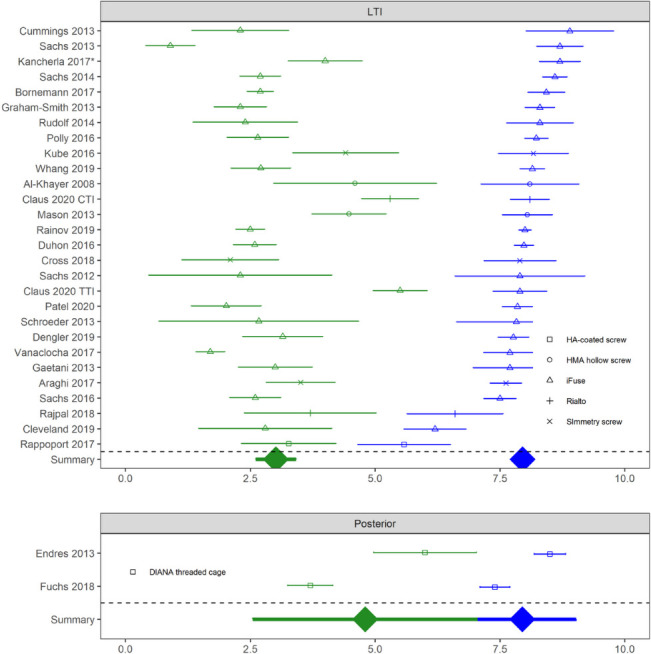
Baseline (blue) and last follow-up (green) visual analog scale or numeric rating scale sacroiliac joint (SIJ) pain scores in cohorts of patients treated with lateral transiliac (LTI) SIJ fusion (SIJF) or posterior SIJF. Horizontal bracketed bars denote confidence limit. Device type shown by shape. Kancherla is primarily titanium triangular implants but includes a small number of cases with a screw. CTI indicates cylindrical titanium implant.
Figure 2
Figure 2
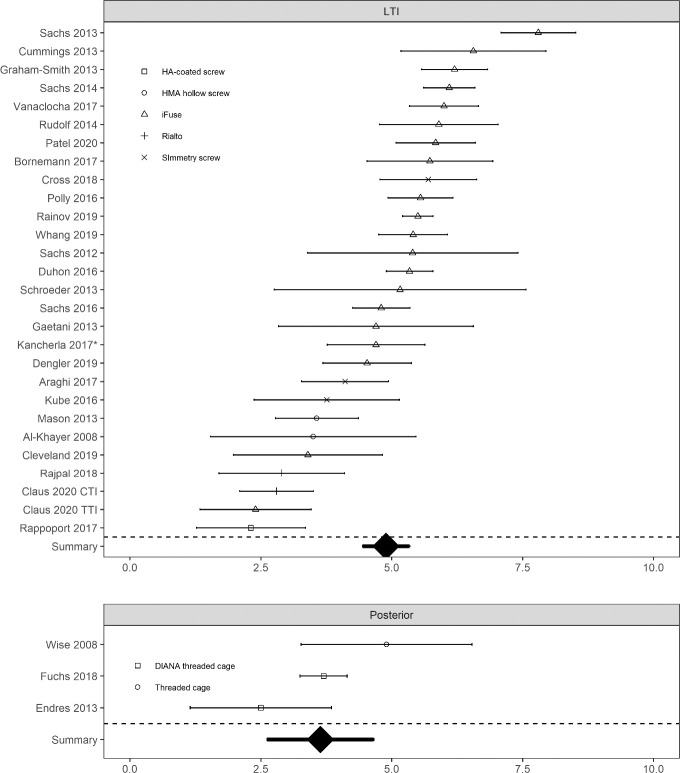
Change in visual analog scale or numeric rating scale sacroiliac joint pain score by study for devices placed by lateral transiliac (LTI) approach or posterior approach. Larger positive values mean more improvement. Device type shown by shape. Horizontal bracketed bars denote confidence limit. Note that Wise 2008 reported change scores but not population means at baseline and follow-up.
Figure 3
Figure 3
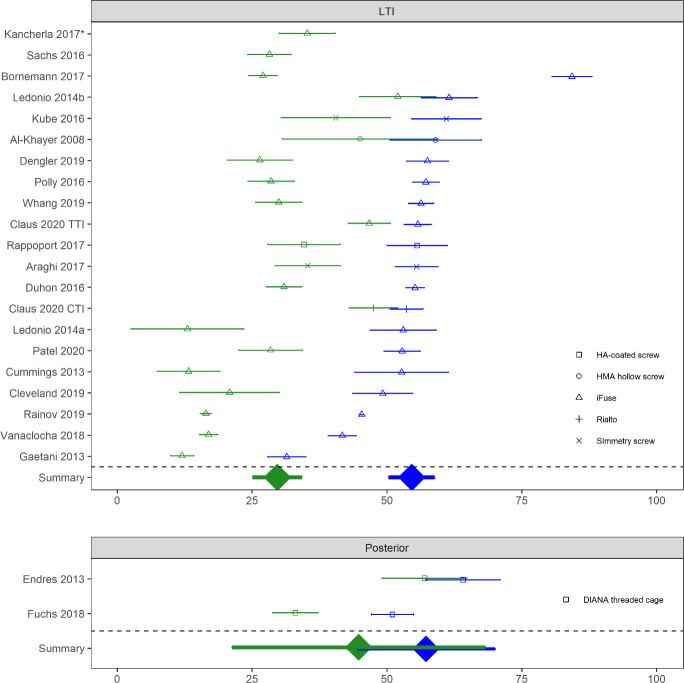
Baseline (blue) and last follow-up (green) ODI scores in cohorts of patients treated with lateral transiliac (LTI) sacroiliac joint fusion (SIJF) or posterior SIJF. Two studies did not report baseline ODI scores. Device type shown by shape. Horizontal bars denote confidence limit.
Figure 4
Figure 4
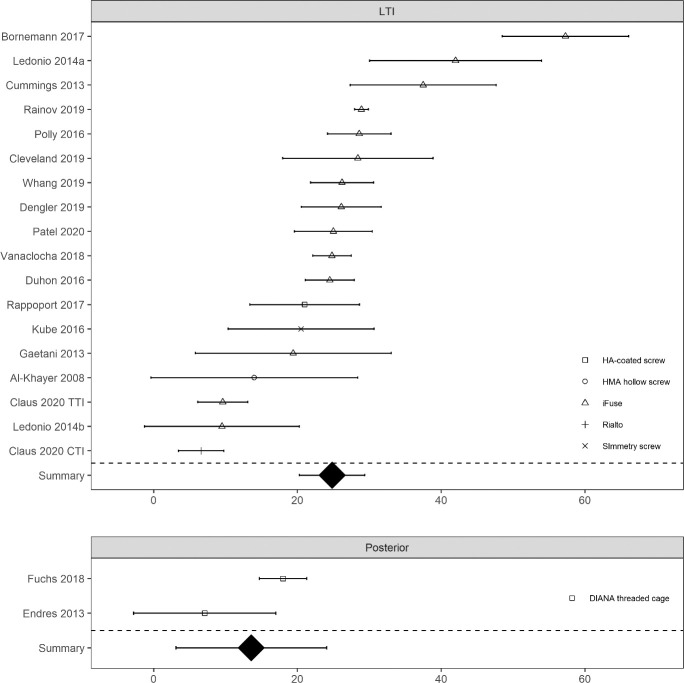
Change in Oswestry Disability Index by study for devices placed by lateral transiliac (LTI) procedure and posterior procedure. Larger positive values mean more improvement. Device type shown by shape. Horizontal bracketed bars denote confidence limit.
Figure A1
Figure A1
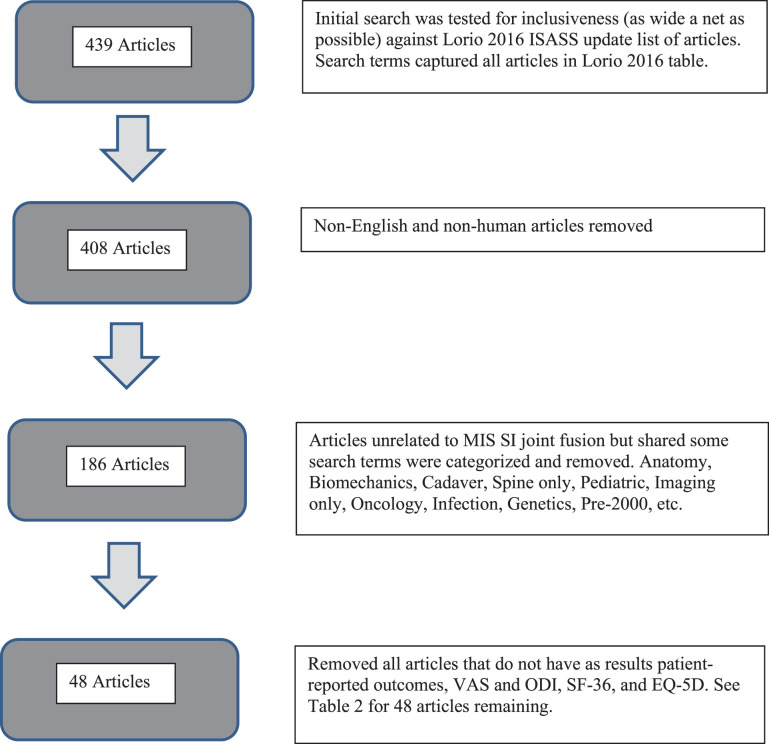
Literature search exclusions flow chart. The flow chart excludes the following 8 articles; narrative, systematic reviews, and meta-analyses: Shamrock – Global Spine Journal – 2019: The safety profile of percutaneous minimally invasive sacroiliac joint fusion.; Whelan – Techniques in Orthopaedics – 2019: The evidence for sacroiliac joint surgery.; Tran – Pain Physician - 2019: Sacroiliac joint fusion methodology—minimally invasive compared to screw-type surgeries: a systematic review and meta analysis.; Zaidi – J Neurosurg Spine 2015: Surgical and clinical efficacy of sacroiliac joint fusion: a systematic review of the literature.; Heiney – Int J Spine Surg 2015: A systematic review of minimally invasive sacroiliac joint fusion utilizing a lateral transarticular technique.; Lingutla – Eur Spine J 2016: Sacroiliac joint fusion for low back pain: a systematic review and meta-analysis.; Yson - PM R 2019: Sacroiliac joint fusion: approaches and recent outcomes. Published online.; Martin – Int J Spine Surg. 2020: Minimally invasive sacroiliac joint fusion: the current evidence. Also excludes: Mao A - Orthop Rev (Pavia) 2018: A Consideration for the utility of the post-operative Oswestry Disability Index for measuring outcomes after sacroiliac joint fusion, as this article was simply an evaluation of ODI as an outcome measure.

References

    1. Vleeming A, Schuenke MD, Masi AT, Carreiro JE, Danneels L, Willard FH. The sacroiliac joint: an overview of its anatomy, function and potential clinical implications. J Anat. 2012;221(6):537–567. doi: 10.1111/j.1469-7580.2012.01564.x. - DOI - PMC - PubMed
    1. Cohen SP. Sacroiliac joint pain: a comprehensive review of anatomy, diagnosis, and treatment. Anesth Analg. 2005;101(5):1440–1453. doi: 10.1213/01.ANE.0000180831.60169.EA. - DOI - PubMed
    1. Dietrichs E. Anatomy of the pelvic joints—a review. Scand J Rheumatol Suppl. 1991;88:4–6. - PubMed
    1. Szadek KM, Hoogland PV, Zuurmond WW, de Lange JJ, Perez RS. Nociceptive nerve fibers in the sacroiliac joint in humans. Reg Anesth Pain Med. 2008;33(1):36–43. doi: 10.1016/j.rapm.2007.07.011. - DOI - PubMed
    1. Sturesson B, Selvik G, Udén A. Movements of the sacroiliac joints. A roentgen stereophotogrammetric analysis. Spine. 1989;14(2):162–165. - PubMed