Observational Study
. 2021 Nov 9;36(11):2084-2093.
doi: 10.1093/ndt/gfaa332.

Ultrafiltration rate and incident atrial fibrillation among older individuals initiating hemodialysis

Affiliations
Observational Study

Ultrafiltration rate and incident atrial fibrillation among older individuals initiating hemodialysis

Jennifer E Flythe et al. Nephrol Dial Transplant. .

Abstract

Background: Higher ultrafiltration (UF) rates are associated with numerous adverse cardiovascular outcomes among individuals receiving maintenance hemodialysis. We undertook this study to investigate the association of UF rate and incident atrial fibrillation in a large, nationally representative US cohort of incident, older hemodialysis patients.

Methods: We used the US Renal Data System linked to the records of a large dialysis provider to identify individuals ≥67 years of age initiating hemodialysis between January 2006 and December 2011. We applied an extended Cox model as a function of a time-varying exposure to compute adjusted hazard ratios (HRs) and 95% confidence intervals (CIs) for the association of delivered UF rate and incident atrial fibrillation.

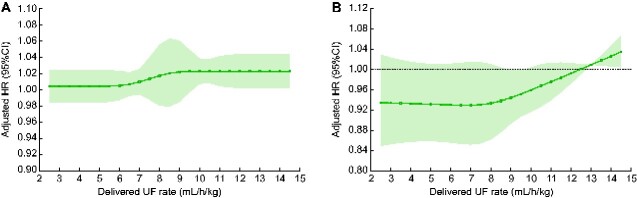
Results: Among the 15 414 individuals included in the study, 3177 developed atrial fibrillation. In fully adjusted models, a UF rate >13 mL/h/kg (versus ≤13 mL/h/kg) was associated with a higher hazard of incident atrial fibrillation [adjusted HR 1.19 (95% CI 1.07-1.30)]. Analyses using lower UF rate thresholds (≤10 versus >10 mL/h/kg and ≤8 versus >8 mL/h/kg, separately) yielded similar results. Analyses specifying the UF rate as a cubic spline (per 1 mL/h/kg) confirmed an approximately linear dose-response relationship between the UF rate and the risk of incident atrial fibrillation: risk began at UF rates of ~6 mL/h/kg and the magnitude of this risk flattened, but remained elevated, at rates ≥9 mL/h/kg.

Conclusion: In this observational study of older individuals initiating hemodialysis, higher UF rates were associated with higher incidences of atrial fibrillation.

Keywords: atrial fibrillation; cardiovascular; hemodialysis; ultrafiltration rate.


Figures

FIGURE 1
FIGURE 1
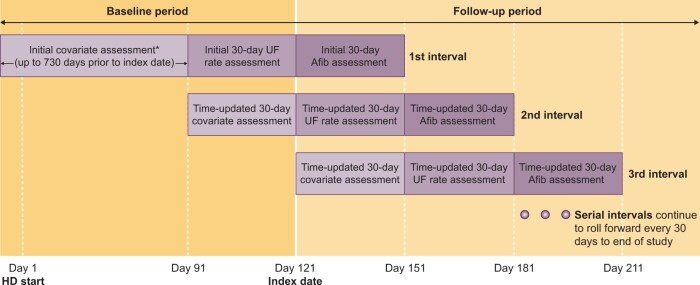
Study design. The baseline period extends up to 730 days prior to the index date, which is designed as Day 121 after initiation of hemodialysis. Baseline covariates, UF rate and other dialysis parameters were assessed during the baseline period. The follow-up period begins at the index date and is divided into successive 30-day covariate assessment intervals, 30-day UF rate (exposure) intervals and 30-day atrial fibrillation (outcome) intervals. AFib, atrial fibrillation; UF rate, mean delivered UF rate (mL/h/kg).
FIGURE 2
FIGURE 2
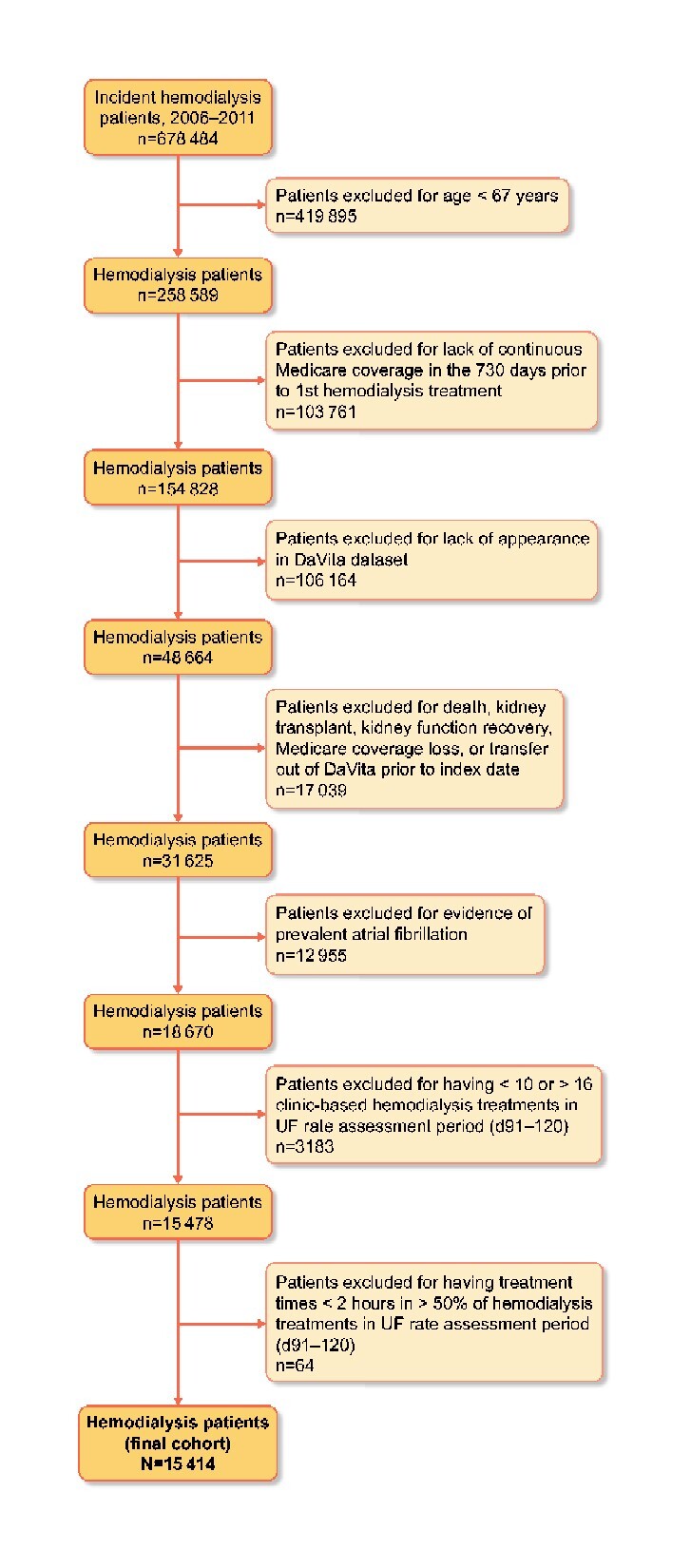
Flow chart depicting study cohort assembly. D, day.
FIGURE 3
FIGURE 3
Adjusted associations between mean delivered UF rate and incident atrial fibrillation when UF rate is modeled as a cubic spline (per 1 mL/h/kg). The solid black lines indicate multivariable-adjusted HRs for incident atrial fibrillation as a function of UF rate and the light gray shading represents the associated 95% CIs. (A) Adjusted HRs and 95% CIs comparing UF rate values 1 mL/h/kg apart where the comparator is lower. (B) Adjusted HRs and 95% CIs comparing UF rate values to a reference of 13 mL/h/kg. All models are adjusted for year of incident dialysis-dependent kidney failure, age, sex, race, Hispanic ethnicity, census division, socioeconomic status variables, Medicare/Medicaid dual eligibility, comorbid conditions (Table 1), number of hospital days in 30 days prior to UF rate ascertainment period, vascular access type, predialysis systolic and diastolic BP, number of hemodialysis treatments in the UF rate ascertainment period and serum albumin, eGFR, potassium and calcium. Estimates are presented for UF rates between 2.5 and 14.5 mL/h/kg (the 5th and 95th percentiles of delivered UF rate in the study sample, respectively). AFib, atrial fibrillation; UF rate, mean delivered UF rate (mL/h/kg).
FIGURE 4
FIGURE 4
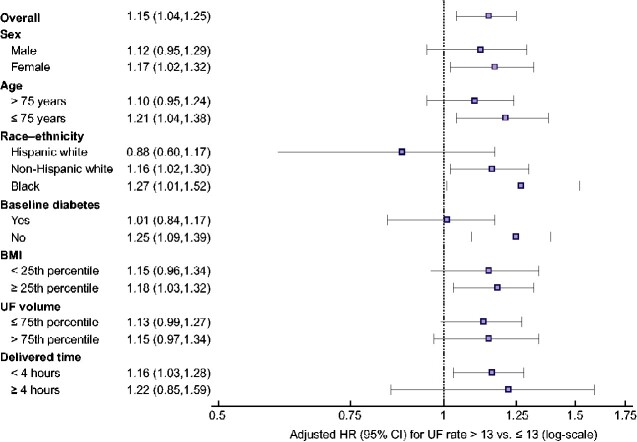
Association between UF rate >13 (versus ≤13) mL/h/kg and incident atrial fibrillation within clinically relevant subgroups. Extended Cox models with multiple imputation for missing data were used to compute adjusted HRs and 95% CIs for the association of delivered UF rate exposure (<13 versus ≥13 mL/h/kg) and incident atrial fibrillation. All models were stratified by year of incident end-stage kidney disease. Models were adjusted for age, sex, race, Hispanic ethnicity, census division, socioeconomic status variables, Medicare/Medicaid dual eligibility, all comorbid conditions listed in Table 1, number of hospital days in the 30 days prior to the UF rate ascertainment period, vascular access type, predialysis systolic and diastolic BP, number of dialysis treatments during the UF rate ascertainment period and serum albumin, eGFR, potassium and calcium. The subgroups of body mass index, UF volume and delivered treatment time were restricted to the 14 695 patients without missing UF rate–related data in the follow-up time period. UF rate, mean delivered UF rate (mL/h/kg).

Comment in

References

    1. Goldstein BA, Arce CM, Hlatky MA. et al. Trends in the incidence of atrial fibrillation in older patients initiating dialysis in the United States. Circulation 2012; 126: 2293–2301 - PMC - PubMed
    1. Airy M, Chang TI, Ding VY. et al. Risk profiles for acute health events after incident atrial fibrillation in patients with end-stage renal disease on hemodialysis. Nephrol Dial Transplant 2018; 33: 1590–1597 - PMC - PubMed
    1. Zimmerman D, Sood MM, Rigatto C. et al. Systematic review and meta-analysis of incidence, prevalence and outcomes of atrial fibrillation in patients on dialysis. Nephrol Dial Transplant 2012; 27: 3816–3822 - PubMed
    1. Winkelmayer WC, Patrick AR, Liu J. et al. The increasing prevalence of atrial fibrillation among hemodialysis patients. J Am Soc Nephrol 2011; 22: 349–357 - PMC - PubMed
    1. Roy-Chaudhury P, Tumlin JA, Koplan BA. et al. Primary outcomes of the Monitoring in Dialysis Study indicate that clinically significant arrhythmias are common in hemodialysis patients and related to dialytic cycle. Kidney Int 2018; 93: 941–951 - PubMed

Publication types