


FlyORF-TaDa allows rapid generation of new lines for in vivo cell-type-specific profiling of protein-DNA interactions in Drosophila melanogaster
- PMID: 33561239
- PMCID: PMC8022459
- DOI: 10.1093/g3journal/jkaa005
FlyORF-TaDa allows rapid generation of new lines for in vivo cell-type-specific profiling of protein-DNA interactions in Drosophila melanogaster
Abstract
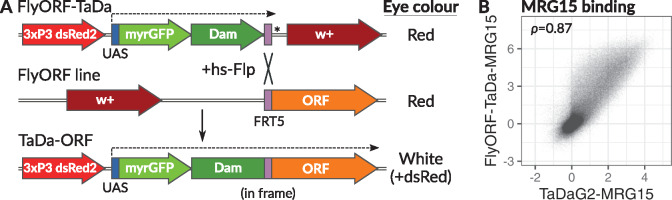
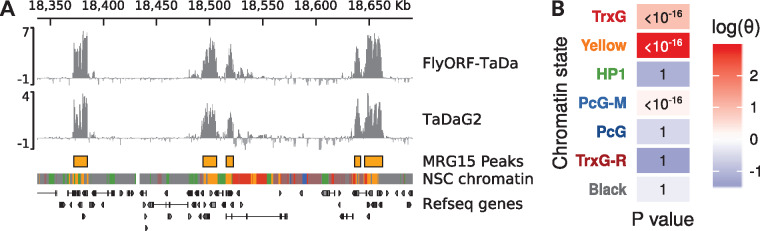
Targeted DamID (TaDa) is an increasingly popular method of generating cell-type-specific DNA-binding profiles in vivo. Although sensitive and versatile, TaDa requires the generation of new transgenic fly lines for every protein that is profiled, which is both time-consuming and costly. Here, we describe the FlyORF-TaDa system for converting an existing FlyORF library of inducible open reading frames (ORFs) to TaDa lines via a genetic cross, with recombinant progeny easily identifiable by eye color. Profiling the binding of the H3K36me3-associated chromatin protein MRG15 in larval neural stem cells using both FlyORF-TaDa and conventional TaDa demonstrates that new lines generated using this system provide accurate and highly reproducible DamID-binding profiles. Our data further show that MRG15 binds to a subset of active chromatin domains in vivo. Courtesy of the large coverage of the FlyORF library, the FlyORF-TaDa system enables the easy creation of TaDa lines for 74% of all transcription factors and chromatin-modifying proteins within the Drosophila genome.
Keywords: Chromatin; DamID; Development; Neural stem cells; Transcription; Transcription factor.
© The Author(s) 2020. Published by Oxford University Press on behalf of Genetics Society of America.
Figures
References
-
- Albertson R, Chabu C, Sheehan A, Doe CQ.. 2004. Scribble protein domain mapping reveals a multistep localization mechanism and domains necessary for establishing cortical polarity. J Cell Sci. 117:6061–6070. doi:10.1242/jcs.01525. - PubMed
-
- Bischof J, Bjorklund M, Furger E, Schertel C, Taipale J, et al.2013. A versatile platform for creating a comprehensive UAS-ORFeome library in Drosophila. Development. 140:2434–2442. doi:10.1242/dev.088757. - PubMed
-
- Brand AH, Perrimon N.. 1993. Targeted gene expression as a means of altering cell fates and generating dominant phenotypes. Development. 118:401–415. - PubMed
Publication types
MeSH terms
Substances
Grants and funding
LinkOut - more resources
Full Text Sources
Molecular Biology Databases