


Healthcare Disparities and the COVID-19 Pandemic: Analysis of Primary Language and Translations of Visitor Policies at NCI-Designated Comprehensive Cancer Centers
- PMID: 33561493
- PMCID: PMC7955247
- DOI: 10.1016/j.jpainsymman.2021.01.140
Healthcare Disparities and the COVID-19 Pandemic: Analysis of Primary Language and Translations of Visitor Policies at NCI-Designated Comprehensive Cancer Centers
Abstract
Context: Coronavirus Disease 2019 (COVID-19) has caused unprecedented disruptions to cancer care, including through strict hospital visitation policies. Since a substantial proportion of the U.S. population report a non-English language as their primary language, it is critical that information is disseminated in multiple languages.
Objectives: To examine the availability of language translations of visitation restrictions on adult National Cancer Institute-designated comprehensive cancer centers (CCCs) Web sites.
Methods: Cross-sectional analysis of visitation policies abstracted from public-facing Web sites of CCCs in June 2020. Using U.S. Census data, CCC's city and state proportions of self-identifying Hispanic/Latinx population were categorized into three cohorts: low (<10%), moderate (10%-20%), and high (>20%).
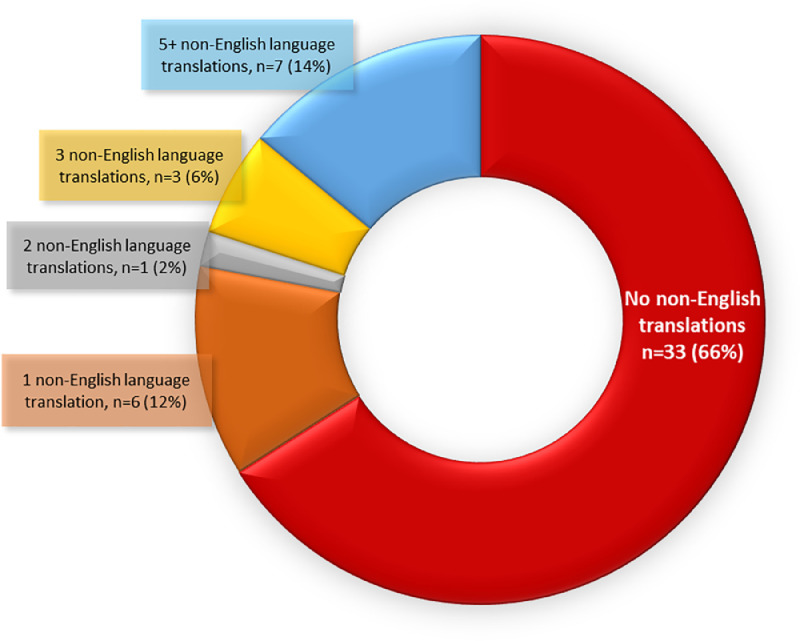
Results: As of June 2020, all 50 CCCs published a COVID-19 visitation policy on their Web site. Of these, 33 (66%) posted policies only in English, whereas 17 (34%) included one or more non-English translations. A minority of CCCs published Spanish language resources, which did not differ based on state or city demographics: for example, only 42% (8 of 19), 10% (1 of 10), and 38% (8 of 21) of CCCs published Spanish language resources in cities with low, moderate, and high Hispanic/Latinx populations, respectively.
Conclusion: `Most CCC's did not publish non-English language translations of their visitor policies. Even in cities and states with larger Hispanic/Latinx populations, most CCCs did not publish resources in Spanish. This study highlights a key opportunity to mitigate communication barriers and deliver culturally competent, patient-centered care.
Keywords: COVID-19; Health disparities; cancer care delivery; cultural competence; languages; translation; visitor policies.
Copyright © 2021. Published by Elsevier Inc.
Figures
References
-
- U.S. Census Bureau . 2019. Quick facts—population estimates, July 1, 2019, (V2019)https://www.census.gov/quickfacts/fact/table/US/PST045219 Available at: Accessed October 2, 2020.
-
- Centers for Disease Control and Prevention . 2020. Demographic trends of COVID-19 cases and deaths in the US reported to CDC.https://covid.cdc.gov/covid-data-tracker/#demographics Available at: Accessed October 2, 2020.
-
- U.S. Census Bureau . 2019. Languages spoken at home by ability to speak English for the population 5 years and over.https://data.census.gov/cedsci/table?q=language&tid=ACSDT1Y2019.B16001&h... Available at: Accessed October 2, 2020.
-
- U.S. Census Bureau . 2019. Nativity by language spoken at home by ability to speak English for the population 5 years and over (Black of African American alone)https://data.census.gov/cedsci/table?q=black%20language&d=ACS%201-Year%2... Available at: Accessed October 2, 2020.
-
- Timmins CL. The impact of language barriers on the health care of Latinos in the United States: a review of the literature and guidelines for practice. J Midwifery Womens Health. 2002;47:80–96. - PubMed
MeSH terms
LinkOut - more resources
Full Text Sources
Other Literature Sources
Medical
Research Materials
