Review
. 2021 May:67:101269.
doi: 10.1016/j.arr.2021.101269. Epub 2021 Feb 6.

Is personality associated with dementia risk? A meta-analytic investigation

Affiliations
Review

Is personality associated with dementia risk? A meta-analytic investigation

Damaris Aschwanden et al. Ageing Res Rev. 2021 May.

Abstract

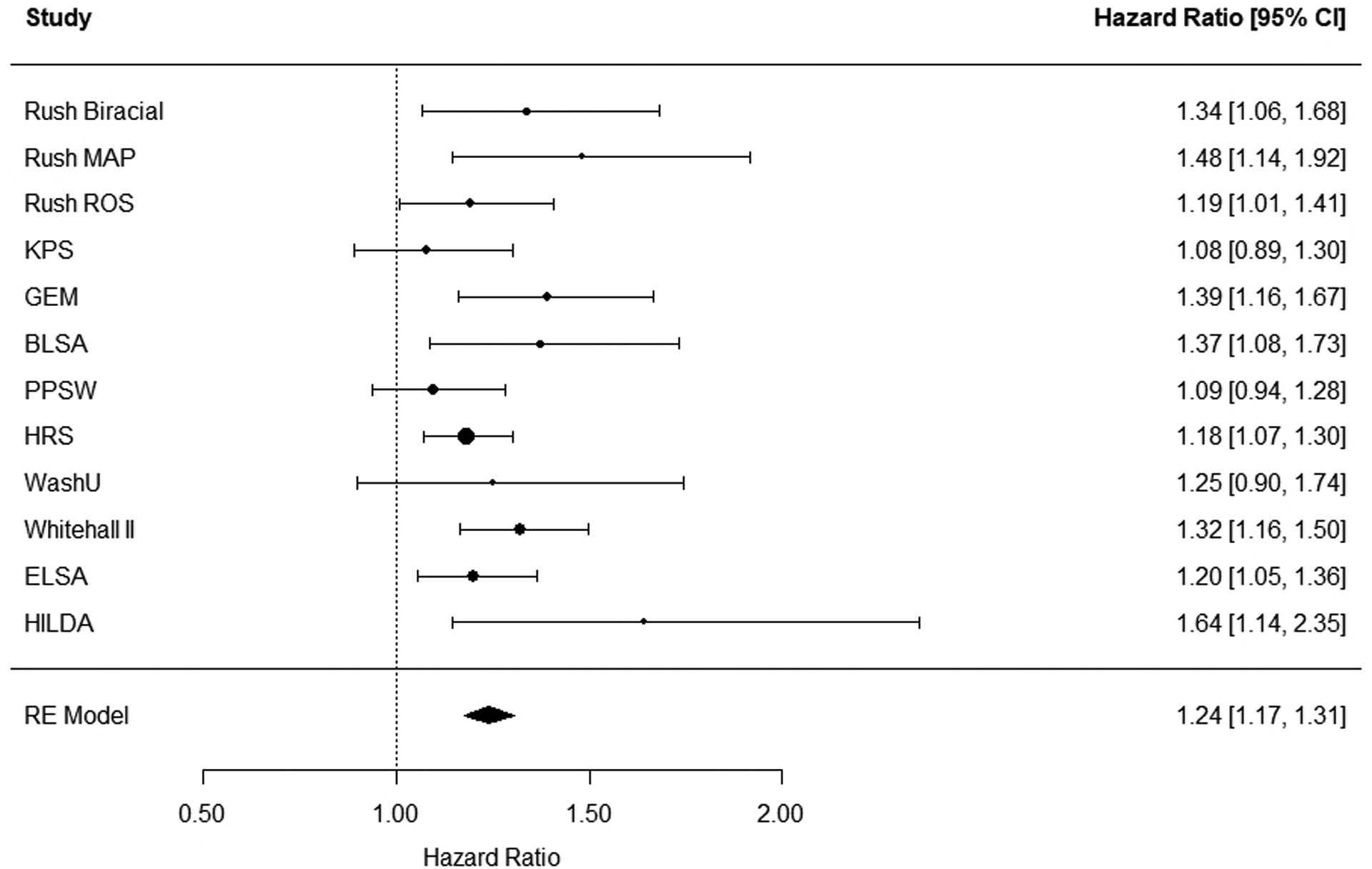
This study provides a quantitative synthesis of the prospective associations between personality traits (neuroticism, extraversion, openness, agreeableness, conscientiousness) and the risk of incident Alzheimer's disease and related dementias. We conducted five separate meta-analyses with 8-12 samples (N = 30,036 to 33,054) that were identified through a systematic literature search following the MOOSE guidelines. Higher neuroticism (HR = 1.24, 95% CI [1.17, 1.31]) and lower conscientiousness (HR = 0.77, 95% CI [0.73, 0.81]) were associated with increased dementia risk, even after accounting for covariates such as depressive symptoms. Lower extraversion (HR = 0.92, 95% CI [0.86, 0.97]), openness (HR = 0.91, 95% CI [0.86, 0.96]), and agreeableness (HR = 0.90, 95% CI [0.83, 0.98]) were also associated with increased risk, but these associations were less robust and not significant in fully adjusted models. No evidence of publication bias was found. The strength of associations was unrelated to publication year (i.e., no evidence of winner's curse). Meta-regressions indicated consistent effects for neuroticism, openness, and conscientiousness across methods to assess dementia, dementia type, follow-up length, sample age, minority, country, and personality measures. The association of extraversion and agreeableness varied by country. Our findings indicate robust associations of neuroticism and conscientiousness with dementia risk.

Keywords: Alzheimer’s disease; Conscientiousness; Dementia; Meta-Analysis; Neuroticism; Personality traits.


Conflict of interest statement

The authors declare no potential conflicts of interest concerning the research, the authorship, and publication of this article.

Figures
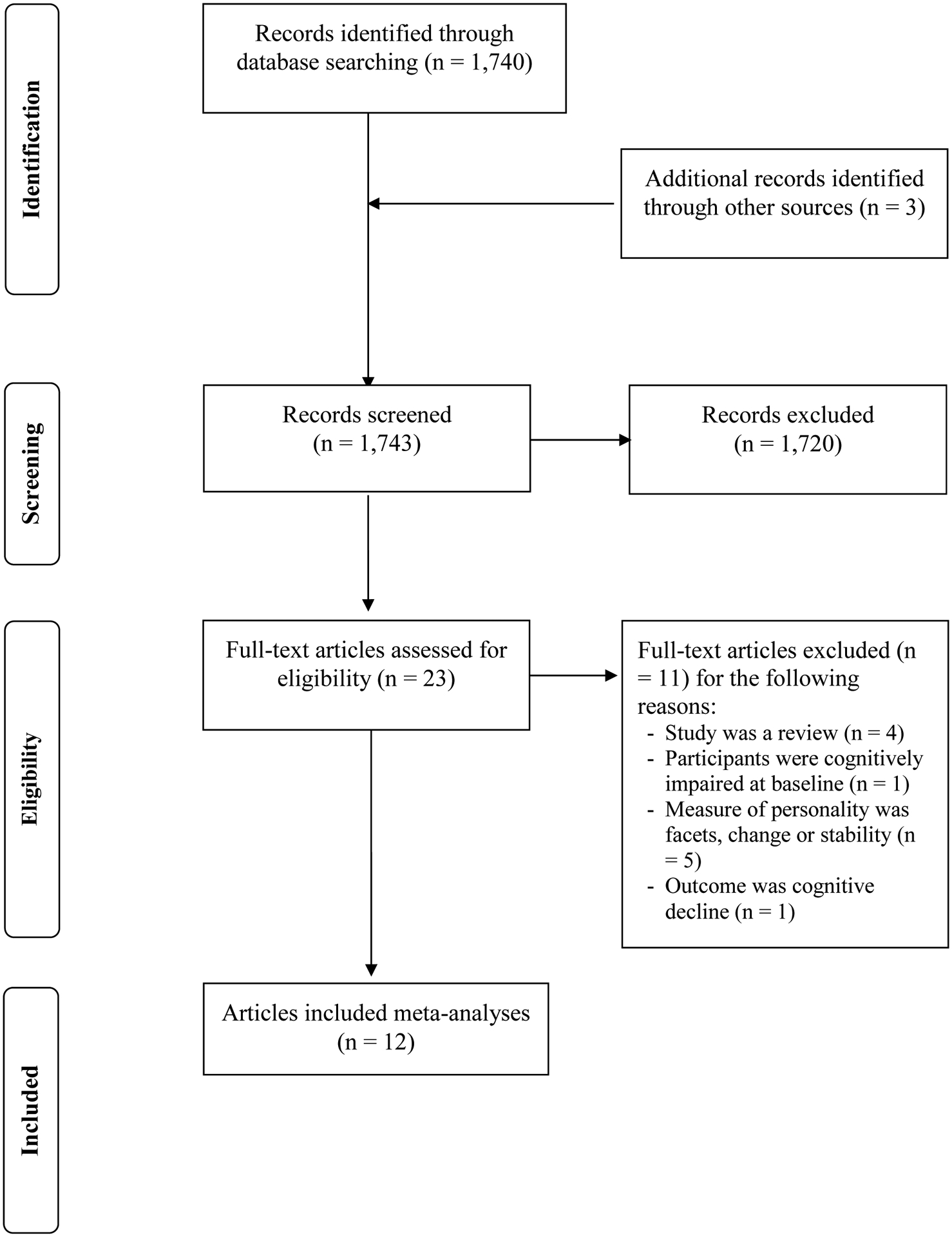
Figure 1.
Figure 1.
Flow diagram for identifying eligible studies. In the present meta-analytic investigation, 12 articles (results from 13 samples) were included.
Figure 2.
Figure 2.
Forest plot for neuroticism. The plot summarizes the individual study estimates and the average effect of the random-effects (RE) model. Effect sizes are displayed in hazard ratios with corresponding 95% confidence intervals (95% CI). Rush Biracial = Rush Memory and Aging Biracial (White, African-Americans); Rush MAP = Rush Memory and Aging Project; Rush ROS = Rush Religious Order Study; KPS = Kungsholmen Project Stockholm; GEM = Ginkgo Evaluation of Memory study; BLSA = Baltimore Longitudinal Study of Aging; PPSW = Prospective Population Study of Women; HRS = Health Retirement Study; WashU = Study conducted at Washington University in St. Louis; Whitehall II = Whitehall II Study; ELSA = English Longitudinal Study of Aging; HILDA = Household, Income and Labour Dynamics in Australia.
Figure 3.
Figure 3.
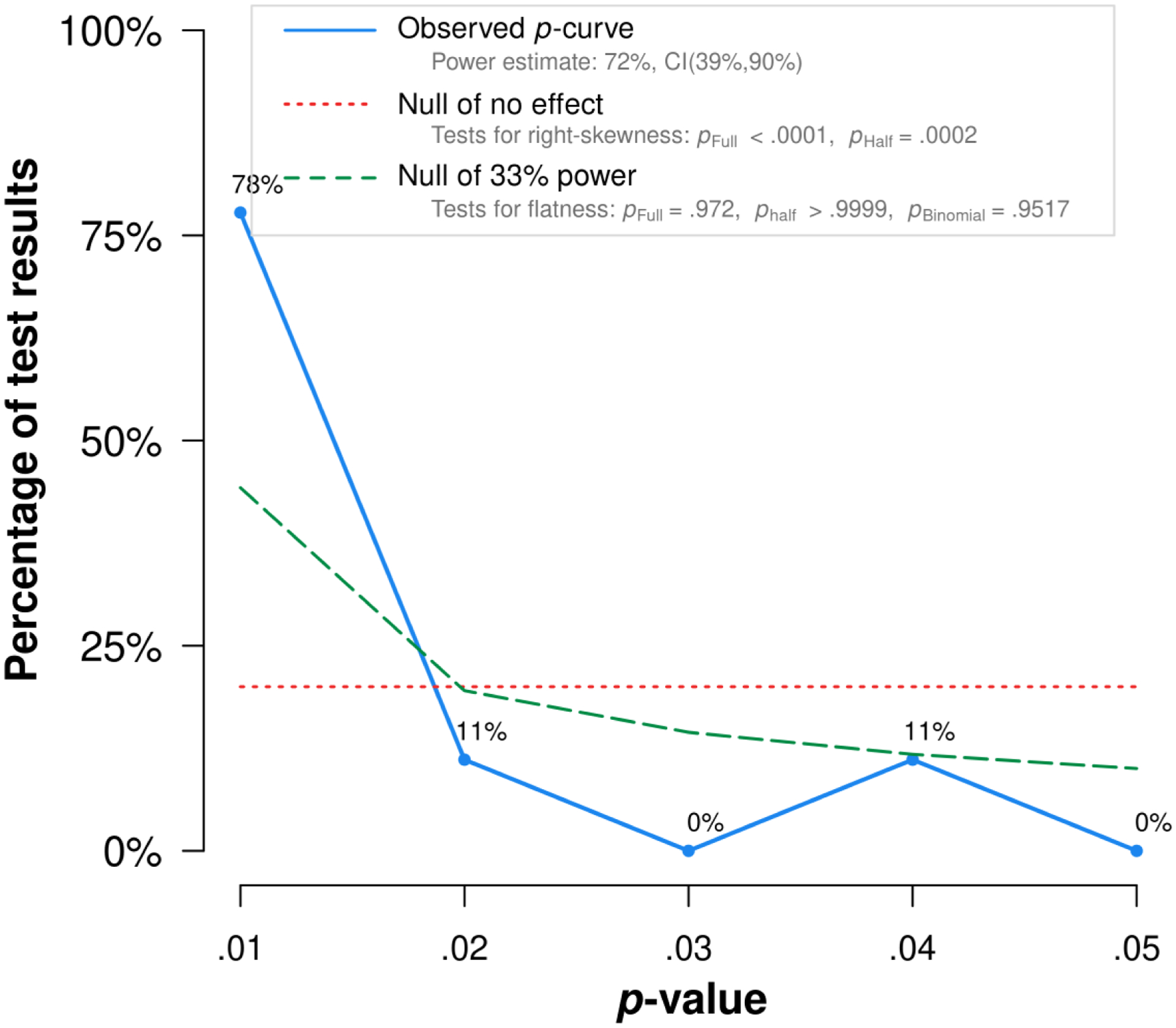
P-curve for neuroticism. The observed p-curve includes 9 statistically significant (p < .05) results, of which 8 are p < .025. There were 3 additional results entered but excluded from p-curve because they were p > .05. The p-curve analysis provides information about the evidential value: If the half p-curve test is right-skewed with p < .05, or both the half and full test are right-skewed with p < .1, then p-curve analysis indicates the presence of evidential value (Simonsohn et al., 2015). Here, both conditions were met (p < .0001 and p =.0002, respectively; see supplemental material S3), suggesting evidential value and providing some reassurance that the significant findings were unlikely to be the result of selective reporting.

References

    1. Allemand M, Zimprich D, Martin M, 2008. Long-term correlated change in personality traits in old age. Psychol. Aging 23, 545–557. 10.1037/a0013239 - DOI - PubMed
    1. Alzheimer’s Association, 2017. 2017. Alzheimer’s disease facts and figures. Alzheimers Dement. 13, 325–373. 10.1016/j.jalz.2017.02.001 - DOI
    1. Anstey KJ, Mack HA, Cherbuin N, 2009. Alcohol consumption as a risk factor for dementia and cognitive decline: meta-analysis of prospective studies. Am. J. Geriatr. Psychiatry 17, 542–555. 10.1097/JGP.0b013e3181a2fd07 - DOI - PubMed
    1. Aschwanden D, Sutin AR, Luchetti M, Stephan Y, Terracciano A, 2020. Personality and dementia risk in England and Australia. GeroPsych 1–12. 10.1024/1662-9647/a000241 - DOI - PMC - PubMed
    1. Baumgart M, Snyder HM, Carrillo MC, Fazio S, Kim H, Johns H, 2015. Summary of the evidence on modifiable risk factors for cognitive decline and dementia: a population-based perspective. Alzheimers Dement. 11, 718–726. 10.1016/j.jalz.2015.05.016 - DOI - PubMed

Publication types